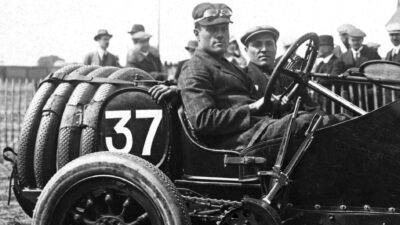
Grand prix racing proper returned to Europe in 1912. For the French GP at Dieppe, Fiat was there – along with Bruce-Brown. He had as team-mates his countryman and friend de Palma and Wagner, a formidable line-up. But there was a half-scale fly in the ointment in the form of the new twin-cam Peugeot. This instantly rendered monsters like the Fiat out-of-date, something the brilliant Georges Boillot lost no time in demonstrating during practice.
Hanging back and playing the waiting game was unlikely to work for Bruce-Brown in these circumstances. With nothing to lose, he carried the fight to the opposition from the off – and was magnificent. After six hours of racing he ended the first day leading Boillot by 2min, he and Scudelari impressing the Europeans with their athletic and synchronised pit work, fine-honed after working together so long in America. The other Fiats were 27 and 48min behind.
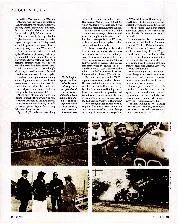
On the second day it was raining, as if ordered by the more nimble Peugeot. Still, Bruce-Brown and Boillot fought tooth and nail until a dog crossed the path of the Fiat. Bruce-Brown was unable to avoid it and it ruptured the car’s fuel tank miles away from the pits. After repairs he had to take on fuel out on the course – which was illegal. As Boillot passed, Bruce-Brown indicated to him that the Fiat was out and that he had no need to overstress his car, an act of sportsmanship that made a big impression on the Frenchman who duly drove to victory.
That was the end of June. Bruce-Brown had three months to enjoy his socialite life before travelling to Milwaukee, venue of the Vanderbilt Cup and Grand Prize races. He missed Monday Vanderbilt practice and was late arriving on the Tuesday, in the company of fellow wealthy American Caleb Bragg — a team-mate and close friend. Their other team-mate ‘Terrible Teddy’ Tetzlaff had already shattered the record with a lap of 6min 15sec, and so Bruce-Brown needed to get straight down to business. After some exploratory laps he pitted for fuel, ready now to push. Asked if he wanted to change tyres, he declined. Tetzlaff was already out there and Bruce-Brown took off after him, using him as his target His first flying lap took 5min 53sec, an average of 83mph. Down the long straight leading to ‘graveyard turn’ Tetzlaff knew Bruce-Brown was gaining on him. But as he got to the corner, he noted his sparring partner was no longer there.
It was arguably the first time in the sport’s history that it had lost its accepted standard-bearer
Bruce-Brown and Scudelari lay dying in an adjacent field. The Milwaukee Sentinel recorded the following harrowing scene: “The daring driver, after regaining consciousness for a brief spell, made a Herculean effort to raise himself. In a mumbled tone and yet audible to his anguished fellow drivers, who stood silently by, covered with dirt and grease, but plainly showing their emotions in tears, Brown asked for his mother. It was his last effort.”
He died at the nearby Trinity Hospital from a fractured skull and internal injuries. Scudelari passed away a week later.
Bragg, who went on to win the race, was the man who had to make the phone call to Mrs Bruce-Brown to give her the news she had feared most. Yet motor racing’s loss was almost as acute as hers. It was arguably the first time in the sport’s history that it had lost its accepted standard-bearer.
The sport had been robbed, especially when you consider Bruce-Brown’s youth. Born in 1890, he was the same age as subsequent aces Pietro Bordino, Antonio Ascari and Tazio Nuvolari. In a perfect world the four of them would have been fighting it out for decades.






 Great Read