And what an engine this four-cam motor is. It loves to rev. The shove is impressive from 1500rpm to around 5000rpm, which is when the induction noise assumes a more serious tone, and it hammers on to 6500rpm. They were capable of revving well into the sevens, and driving it now, I can only assume that some ran them harder even than that, such is the mechanical smoothness and lack of inertia felt.
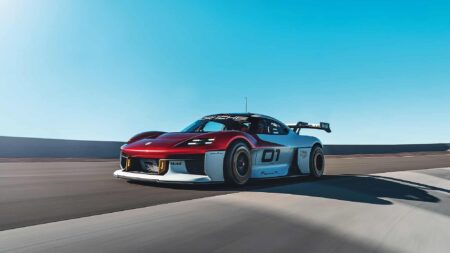
It’s an addictive machine. You exit the final right-hander in third gear, grab fourth and, as the air rushes over your head and the 550 begins to wander, you begin to wonder how something with a quarter of the horsepower of Porsche’s latest toy can prove almost as thrilling. Even more remarkable is the fact that this particular example feels as though it could lap for hours, but then I suspect it is rather expertly maintained.
It’s an addictive machine. You exit the final right-hander in third gear, grab fourth and, as the air rushes over your head and the 550 begins to wander, you begin to wonder how something with a quarter of the horsepower of Porsche’s latest toy can prove almost as thrilling. Even more remarkable is the fact that this particular example feels as though it could lap for hours, but then I suspect it is rather expertly maintained.
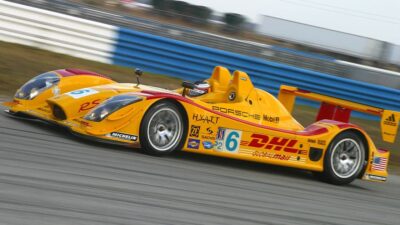
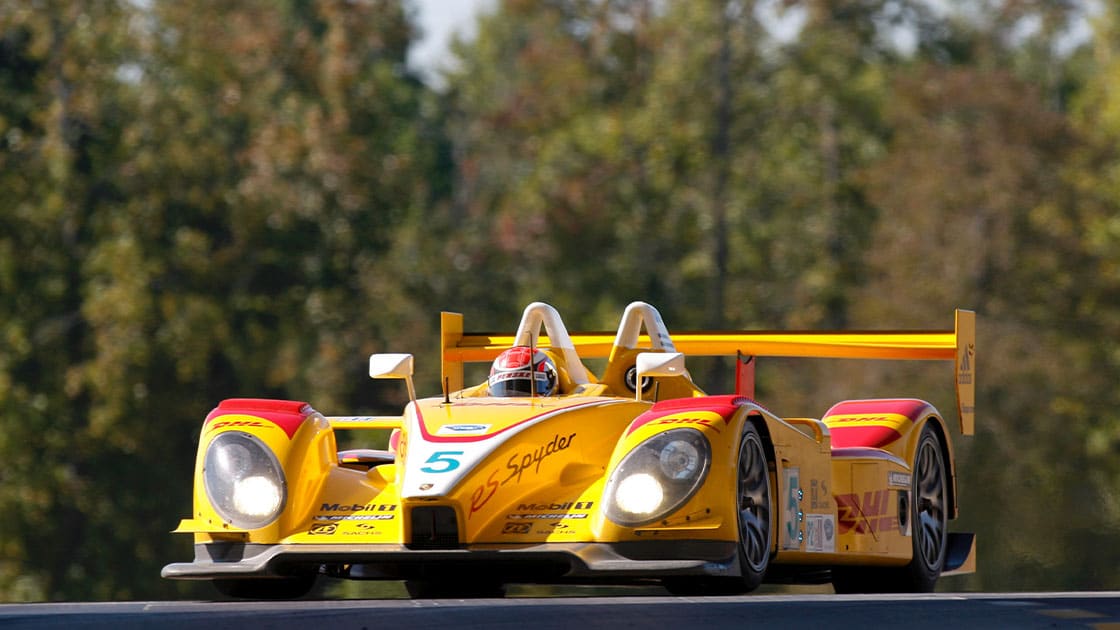
The modern RS Spyder is an incredible machine: so amenable, so nimble, so damn fast. It continues the lineage begun by the 550, and even though this sounds like an emotionally clouded observation, strands of that gorgeous little silver car’s DNA are very much apparent in the yellow monster. Long may such genetic excellence continue.
Jenks on… the 550 Spyder, Moss and Porsche
1953 Paris Salon
The German firm showed a delightful open two-seater competition car based on the factory Nürburgring cars, fitted with the latest ohc engine; this follows the normal Porsche flat-four layout, but has twin camshafts to each bank of cylinders, the camshafts being driven by bevels and shafts. A large double-choke downdraught carburetter is used for each bank and the distributor is driven off the end of each inlet camshaft, supplying sparks for two plugs per cylinder… A power output of 110bhp is claimed and a speed of 225kph (140mph).
October 1953
1954 Le Mans 24 Hours
The three Porsches were the new 550 models, the prototype of which ran in the Mille Miglia. They were open two-seaters, with the engine and gearbox behind the driver, but in front of the rear axle, suspension being IFS at the front by trailing links and torsion bars with swing-axles on torsion bars at the rear. The three cars were perfectly turned out, coloured flashes along the rear wings giving identity, these being blue, green and red, for the pairs of drivers.
June 1954
1955 Lisbon Grand Prix
Never having even sat in a Porsche Spyder before, Moss soon mastered the technique of handling and found the lightness and responsiveness of the car very agreeable. His best time of the two training periods was 2min. 27.27sec, 12sec better than the rest of the field with but one exception. Portuguese J Filipe Nogeuira, driving his own Porsche Spyder, made the excellent time of 2min 30.6sec.
The race was naturally dominated by Moss with the factory car, but as in practice Filipe Nogeuira was the outstanding driver. The Portuguese driver kept the silver Porsche in sight, losing only two or three seconds a lap. When the traffic became heavy, the hallmark of a great grand prix driver began to make itself felt and Moss drew right away, but even so, during the 25 laps of the 5.4-kilometre circuit the Portuguese driver only lost 63 seconds.
September 1955
Team spirit
One is often tempted to refer to ‘typical German thoroughness and orderliness’, but this is never possible while the Porsche firm continue to be successful at racing, for they have the slap-happy sporting attitude of most English teams, their set-up being anything but ‘typical German’.
October 1955