

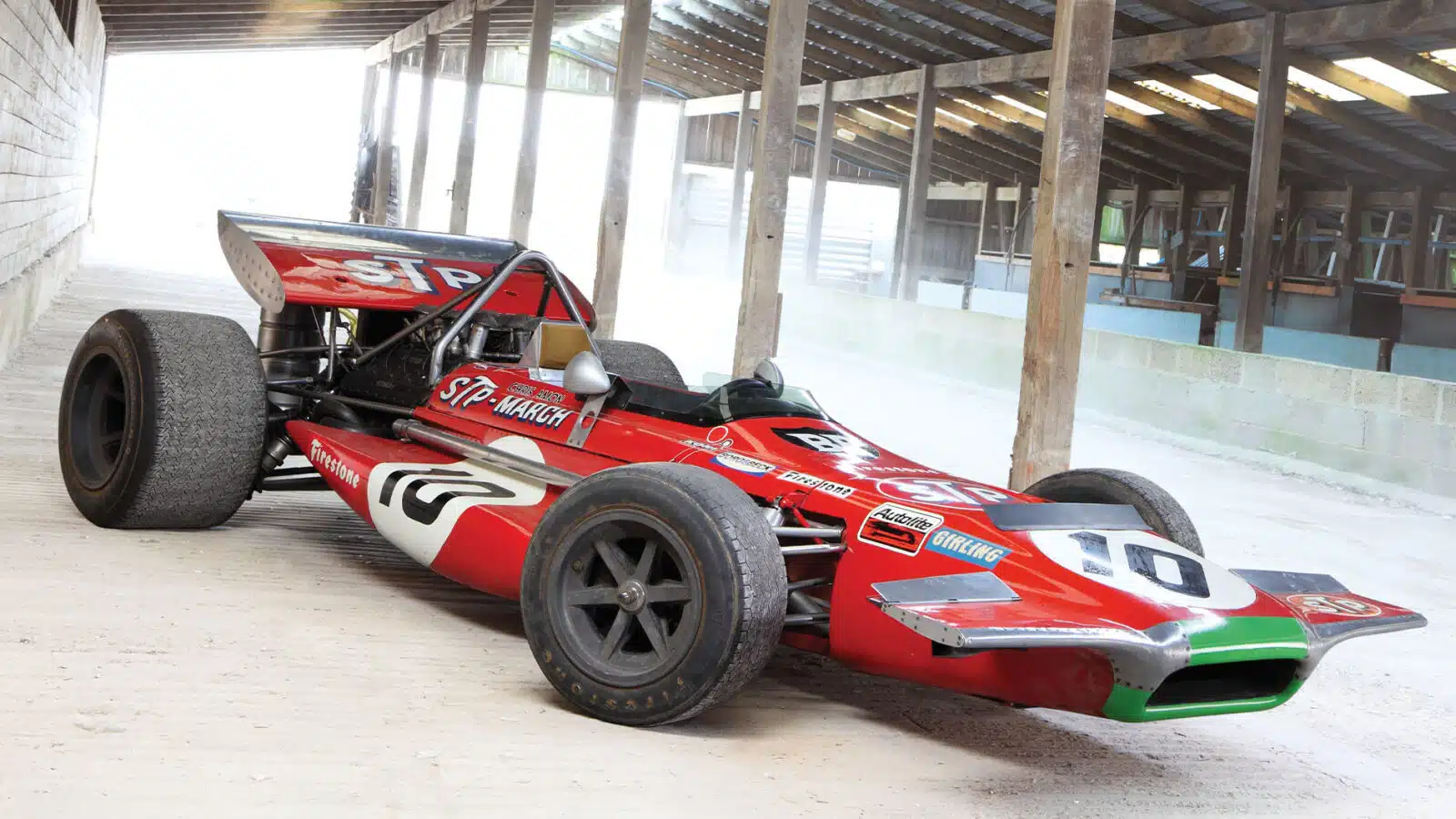

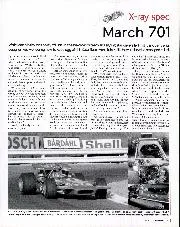
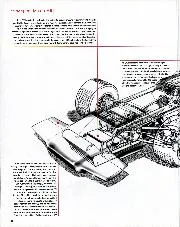

Amon stuck with 701/1 throughout the season. At Monaco he belied its bulky looks by qualifying second, and holding second place for most of the race until a bolt dropped out of the rear suspension. The car was radically rebuilt before the Belgian GP, with a new monocoque, still in 18swg aluminium, carrying the previous car’s running gear and chassis number. Helped by lighter wheels, side tanks and radiator, it had shed about 30kgs. At Spa Chris battled for the lead with Pedro Rodriguez‘s BRM, only to be beaten to the flag by 1.1sec. He scored another fine second in the French GP on the daunting Clermont-Ferrand circuit, chasing Rindt’s Lotus 72 home, and at Hockenheim he was lying third behind Rindt and Jacky Ickx‘s Ferrari when the engine blew. Amon had access to a spare car, 701/6, with a monocoque made of lighter gauge aluminium, but he preferred 701/1 and never raced No 6. As the season drew on the 701s were clearly becoming less competitive, but the brave Amon continued to get results: eighth in Austria, seventh at Monza, third in Canada, fifth at Watkins Glen and fourth in Mexico.
By now, no longer on best terms with Mosley, Amon had signed to go to Matra for 1971, and Siffert was going to BRM: Mosley sold Jo his car, 701/5, for his own use. For March it had been an incredibly hectic year, not only in F1 but also trying to turn a profit building production F2 and F3 cars, and running a Can-Am programme. Money was still desperately short. The muchvaunted STP sponsorship had in fact been a mere £25,000. Porsche had quietly paid £30,000 for Siffert’s drive, to keep him away from Ferrari, and Firestone had put in £27,000. But it had been a long, hard season, and the now departed Amon was still owed a substantial sum.

Back in 701
Marc Wright
So, in November 1970, Mosley was facing a difficult winter. He had the sensationally talented Peterson on board for ’71, but he was desperately hunting for sponsorship and rent-a-drive deals. And there were new F2 and F3 cars to be marketed. What he needed was some off-season publicity. So he called me. At the time I was the youthful editor of Autosport, and — to my dumbfounded amazement — he offered me a real scoop: a track test of a current F1 car.
There had been one or two journalists who’d driven, and written about, F1 cars before. Autosport’s long-time technical editor John Bolster, whose own racing career had ended in a big accident in the 1949 British GP, was an experienced track tester, and had frequently been entrusted with highpowered single-seaters and sports-racers. On another plane was Paul Frere, the Belgian writer, who is surely the only full-time journalist to have finished second in his home Grand Prix and won Le Mans, both in works Ferraris.
In total contrast, my racing experience was then confined to a couple of seasons in Clubmans Formula, first with a 1-litre U2 and then with a one-off 1600 called the RLR. I’d track-tested a variety of F3, GT and sports-racing machinery for the magazine, but an F1 car was beyond my ken. I’d known Max for some years — he too had been a Clubmans driver — and what he really wanted was exposure to prospective customers for March’s new F2 and F3 chassis. But he knew that if he offered me a few laps in an F1 car, that would ensure a good spread.

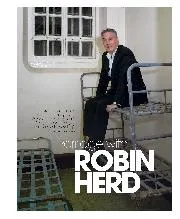
With Robin Herd and March crew
The track selected was the Silverstone Club circuit. The appointed day, Friday November 27, was cold and threateningly overcast. I arrived to find an impressive group waiting for me: Max Mosley, Robin Herd, Alan Rees and Ronnie Peterson were all there. So was racer and wrench Bill Stone, who’d been March’s first-ever employee, and fellow Kiwi Pete Kerr, a great character, who’d been employee No 3. Roger Silman, F1 mechanics Dave James and Bernie Ferri, Dewar Thomas and team organiser John ‘Ace’ Waddington were on hand too. Lined up beside the March transporter were the new F2 car, the 712, which had already done some testing in Peterson’s hands; the new F3 car, the 713, which had been finished that morning and had never turned a wheel; and Amon’s 701/1, veteran of 15 races in the preceding eight months and not long off the plane from Mexico.