

Archive
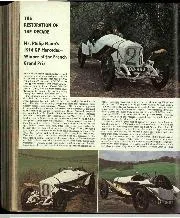
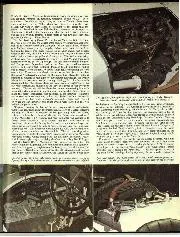
THE RESTORATION OF THE DECADE
Mr. Philip Mann’s 1914 GP Mercedes— Winner of the French Grand Prix PERHAPS the most exciting discovery and subsequent meticulous racing-car rebuild of the past decade has been that by…

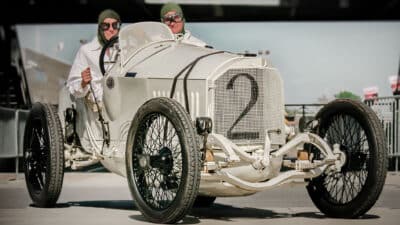
Mercedes Indy winner rides again
May 23, 2015. Aside from a few historic parade laps, the Indianapolis Motor Speedway’s asphalt has lain quiet all day. The 500 is less than 24 hours away, though, and the paddock area is absolutely rammed with souvenir hunters, autograph collectors and the otherwise curious. Some modern Grand Prix venues fail to generate a parallel atmosphere on race day.
It is early evening by the time things calm sufficiently to attempt photography of Christian Lautenschlager’s 1914 Mercedes, which headed a team 1-2-3 in that year’s French GP at Lyon. One of its sister cars – thought to be the second-placed finisher of Louis Wagner – was subsequently acquired by Raffaele ‘Ralph’ de Palma (also often spelt DePalma, it appears both ways in Mercedes/Daimler documentation) and within a year had become an Indy 500 winner. It’s only when the Merc rumbles towards Gasoline Alley that you realise how busy the Speedway remains, with knots of people gathering to contemplate the immaculate white leviathan. “Man, that’s cool. What the hell is it? Does it still race?”
It does, indeed. Based in Oregon, current owner George Wingard believes very strongly that old cars should be used as their designers intended. Its stint at Indy will necessarily be brief, however: such is the pageantry of race morning, and so early are the main event’s 33 Dallaras installed on the grid, that the commemorative parade completes less than a full lap. For 79-year-old Wingard, though, it’s a spectacular way to mark his first Indy 500.

Mercedes entrant was struck by heartbreak in 1912, but sister car won three years later
“I don’t know why I haven’t been before,” he says. “I’m not much of an observer. I watch on TV, but I’ve written a book about Mercedes at Indy and guess anybody who has done that should really take a look…”
Bill Boddy covered the Lautenschlager car in the June 1970 edition of Motor Sport, following restoration by then-owner Philip Mann, and it passed to Wingard in 1981. “My daughter Gail was 17 and had travelled to Denmark on an archaeological dig, but didn’t come home,” he says. “She then sent a note to tell me she was in London, where she was holding down two jobs – one in a tavern and the other in a bakery. I thought I’d better visit to find out what was going on, but she was doing great and working hard. Anyway, while I was there I made contact with classic car dealer Charles Howard, who’d told me he had an old Grand Prix Mercedes. It had suffered a broken crankshaft in a historic race in Germany and I said I wouldn’t buy it unless I could see all the damage, because other components inside the crank case could be broken and I wouldn’t have wanted a car like that.
“When I got there the crankshaft was lying on the floor – it had a nice, clean break at the main bearing, which wouldn’t have affected any of the aluminium parts, so I agreed a deal. The sad thing is that this was the original crank Lautenschlager used in 1914. I still have it, but had to get a new one made to the original spec.
“When I restore a car I remove every nut and bolt before putting it all back together, because I want to know exactly what I’m racing. While I was grinding the paint from the clutch and brake shafts, I found the chassis number and Mercedes’s records confirmed that this was definitely the Lautenschlager car. Restoration took two years and I’ve raced it at Laguna Seca and the Goodwood Festival of Speed. I never used to rev it beyond 2000rpm and it doesn’t reach peak horsepower until about 3200. Last time I drove it at Laguna, I thought, ‘Well, I’m probably not going to be around too much longer and it’s held together well, so I’ll see how it feels with an extra 1000rpm’. It became a completely changed car and I began to realise why it had been a winner. I got on the cam and couldn’t believe how exciting it was to drive. It’s very tractable and comfortable, too, something Mercedes tapped into quite early. It is very driver-friendly, probably because drivers had a hand in the car’s design.”

Right place, but a very different time for the Mercedes
His riding mechanic is Pat Gould, husband of the aforementioned Gail, whose European flit led indirectly to the Mercedes coming into the family’s possession. Could the car be driven solo? “I’ve never tried,” Wingard says, “but it would be difficult. My legs are long so I could probably stretch across and reach the pedal that lubricates the upper camshaft. But the riding mechanic would also monitor the number of laps completed, using a counter on the dash, keep up the fuel pressure and serve as the rear-view mirror. Those were pioneered here at Indy [by inaugural 500 winner Ray Harroun], but nobody was using them in Europe at that time so the passenger was kind of busy.
“When de Palma raced at Indy in 1915 [with Louis Fontaine alongside], he’d been posting consistent 90mph laps but with two to go the car threw a rod. He completed the race on three cylinders, but still averaged more than 70mph over the final two laps. He was able to do that thanks to the design of the lubrication system, which allowed oil to be pumped onto the cylinder sides.”
The precise whereabouts of that winning car is a mystery. “About 40 years ago I read a report saying that it was either in Cuba or else had gone to be broken up,” Wingard says, “but I can’t believe anyone would scrap that car. It was just too good and too important, a work of art. It would be pretty exciting if it was in Cuba. I’m tempted to go and have a look… and if it needed restoration I have a pretty good example to work from.”
Not that he needs any more cars. “I started fettling them at 13 years old, after doing a deal with my sister’s boyfriend – I traded a shoebox full of fireworks for a Model T Ford. I used to come home covered in oil: my folks wouldn’t have let me buy a car, but the front seal on the Model T would spread oil all over me. I’d come home and my mother would wonder why I was so smeared. I claimed I had no idea, but that Model T provided the best mechanical education you could get in those days.

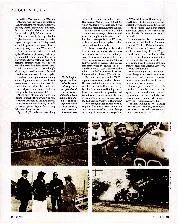
Wingard and Gould behind the wheel
“After leaving college I entered the building business, but I was still interested in cars and saw opportunities. The first one I bought was a 1904 Fiat, which I restored and took to Pebble Beach. I still own it.”
The current fleet – “about 16 or 17” – includes the 1911 Fiat S74 he ran at this year’s Goodwood Festival of Speed, the Ballot that finished second at Indy in 1920 and a 1913 Mercer. “The Ballot is a marvellous car,” he says, “with a very original chassis. Its engine, though, had been transferred to a speedboat so I had to have another made. I was very fortunate in being able to get hold of the last remaining car that wasn’t in a museum. I found it in England and offered to restore the car for the owner if he would let me copy the engine, so that’s what we did. The new unit had the same horsepower on the dyno as the first one did in 1920. I like to keep things that way, rather than trying to find power they didn’t originally have.”

From rear view mirrors to jaw-dropping engines, the Indianapolis 500 has seen plenty of innovations – James Elson picks out just a few
Is there a reason he favours cars from this period? “Well,” he says, “I owned a Maserati 300S for a while, but took it to Laguna Seca and found I wasn’t really a 180mph guy. I traded it for a 1913 200hp Benz…”
Approaching 80, he claims to get the same buzz from working on cars as he did when learning his craft on that Model T. “My current project is a 1916 Buick,” he says. “I was the second owner and am now the sixth. I sold it for $273 to pay for my first year’s tuition at the University of Oregon, but didn’t see it again until a guy called a couple of years ago and asked if I’d like to buy back my Buick. I said, ‘What Buick?’
“I wanted to donate it to the museum in Lakeview, Oregon. That’s where I grew up and the car was originally sold there on Flag Day [June 14] in 1917. I called and was told they didn’t have space, so I guess I’ll keep it…”
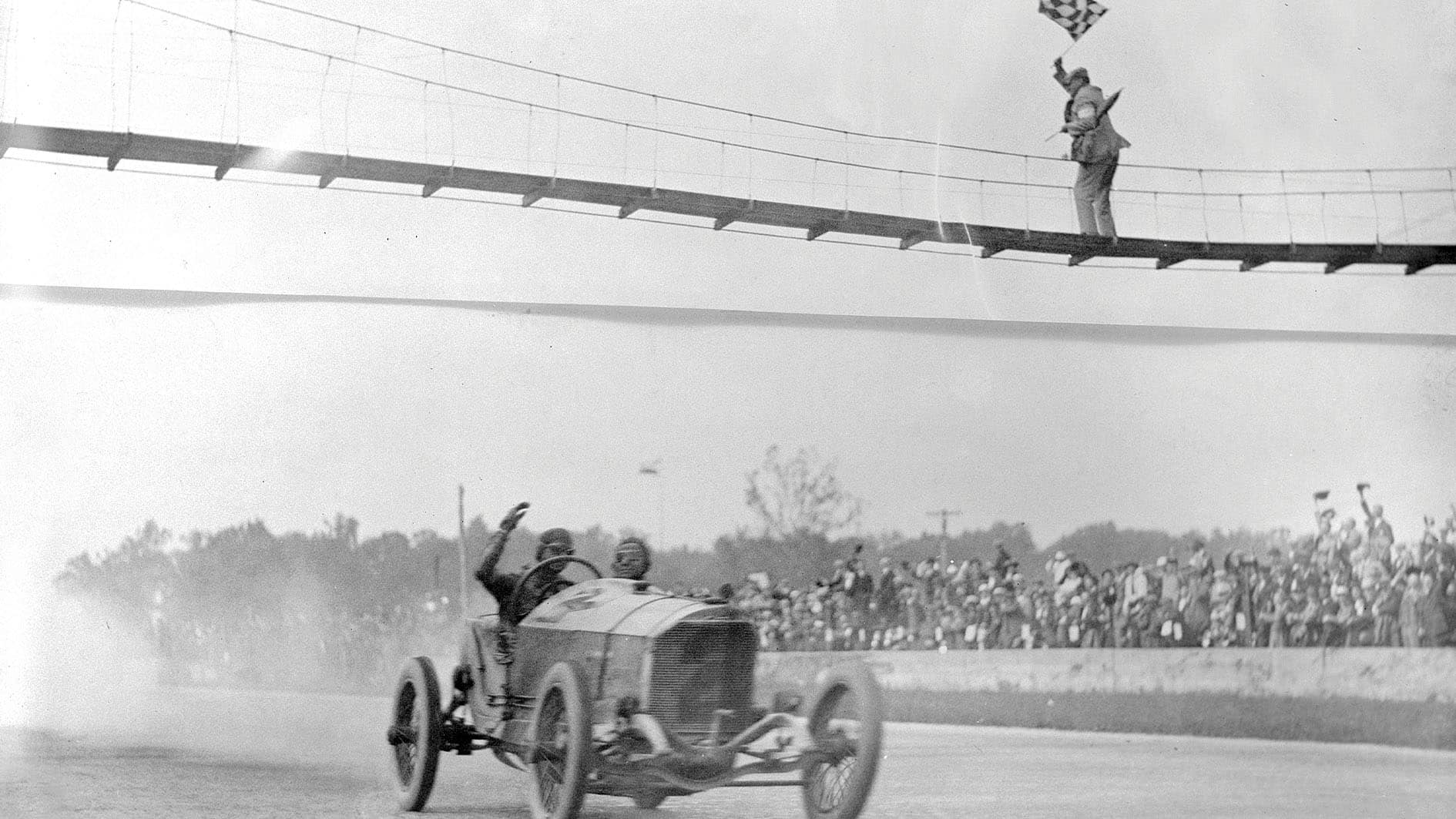
Born in Troia, Italy, on December 31 1882, Ralph de Palma was nine years old when his parents emigrated to the United States. He began his competition career on two wheels – bicycles first, then motorbikes – before switching to cars and earning a reputation as one of the best in the business. He won the 1912 Vanderbilt Cup in a 140hp Mercedes – and was on course to scoop that year’s Indy 500 until a conrod broke with three laps to go. He continued at a crawl until the engine quit completely, then with riding mechanic Rupert Jeffkins attempted to push the 1.3-ton car to the finish. Joe Dawson won, but de Palma took 11th place and most of the plaudits.
Three years later de Palma qualified second to Stutz driver Howdy Wilcox, but assumed the lead for keeps on the 135th lap of 200. With the finish almost in sight, there were echoes of 1912’s painful defeat when a conrod again broke. The engine held, however, and de Palma completed the race at an average speed of 89.84mph, defeating Dario Resta’s Peugeot and collecting a $22,600 purse.
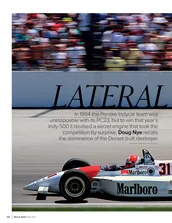
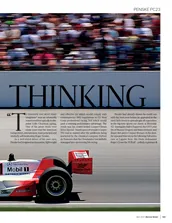
It would be the last Mercedes-powered victory at Indy until 1994, when Al Unser Jr triumphed for Penske.
That one was worth $1,373,813…

From Jim Clark’s historic 1965 triumph to Marcus Ericsson’s recent victory, a select group of Formula 1 stars have etched their names into Indianapolis 500 lore by conquering IndyCar’s legendary race

The Indianapolis 500 is a merciless challenge, and even some of racing’s greatest champions have failed to make the grid on the race’s notorious Bump Day – we select the biggest scalps
From rear view mirrors to jaw-dropping engines, the Indianapolis 500 has seen plenty of innovations – James Elson picks out just a few

The Indianapolis 500 has been witness to many great one-off cameo drives – we pick five of the best

I just want a picture of the boys.” Hazel Chapman, Colin’s widow, lifts her camera and ‘the boys’ stop talking. Boys. Their bus passes are dog-eared now, but they were…
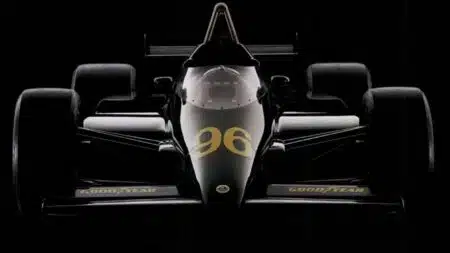
It’s tough being a new kid on the block, especially if you come from somewhere far away. That’s what Lotus found when Colin Chapman decided to tackle Indianapolis. He was…

 Great Read
Ray Harroun spent seven hours on the three million bricks of Indianapolis getting his bones beaten to powder winning the inaugural 500-mile sweepstakes. Called upon to say a few words…

June 21 produced one of those ‘Is the glass half-empty or half-full?’ moments for IndyCar fans. The IndyCar Series formally confirmed a new car to replace the ancient Dallara chassis…
To innovate you must first imaginate” was an unusually constructed but typically to-the-point Colin Chapman saying. One of his great rivals over many years was the American racing driver, entrepreneur,…