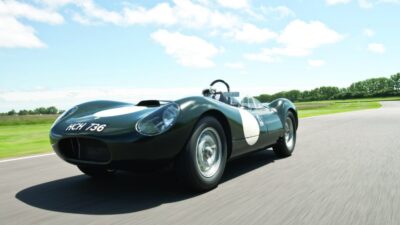
Lee campaigned HCH successfully until 1962, when he sold it to the Hon Richard Wrottesley, who raced it well but hard. It then passed to Julian Soddy before Lee eventually reacquired the now battered Lister. Having rebodied it, he raced HCH 736 into the 1970s. Later still Robert Cooper bought it (and Richard Bond drove it) before it went briefly to Anthony Bamford, back to Cooper, then to Italy where it was raced by Adelmo Fossati. Sadly Fossati was kidnapped and subsequently murdered after which the car was owned for decades by the late Federico Dubini.
Ultimately Kidston SA offered it for sale for the family, and Chris Keith-Lucas of CKL Developments researched the Lister’s period engine and gearbox. “When the car came to CKL from Italy,” he says, “it had a 1970s Forward Engineering-prepared wet-sump E-type engine and gearbox, but rather wonderfully it also came with a lovely old dry-sump wide-angle 3.8 unit covered with proper original bits including an original Borg & Beck multi-plate clutch and a set of Weber 45DCO3s. It was quite evident to me there must have been an original D-type gearbox bolted to it and I sent a request that they look again to see if one could be found. I was thrilled to receive a grainy mobile phone photo of the world’s scruffiest D-type box. ‘We found this, is that what you are looking for?’
“It turned out to be perfect inside and had not been used for 40 or 50 years. Once Steve had acquired the car, I popped over to the store in Italy to see if there were any other remnants. The only item that could be found was a beautiful chronometric tachometer, clearly from the car, and worth every penny of an EasyJet ticket!”
When former Lister mechanic Colin Crisp came to view the car (he’d attended HCH at Le Mans in 1958), he was astounded to find the still-damaged chassis tube where he had hammered flat the brake pipes to prevent fluid escaping.
Exiting the chicane it is all too easy to hang the tail out
And so to a dry, sunny day at Goodwood, to drive this earlier evocation of the Lister Jaguar.
There is nothing to compare with these fabulous relics from an earlier era
It has a small, somewhat cramped cockpit, with a kneepad to protect against the proximity of the exposed gearbox and starter motor. The Jaeger rev counter is upside down in familiar racing fashion, to swiftly indicate maximum revs. Under the bonnet the engine is canted over to the left while at the rear the vertical sliding gate de Dion rear suspension is typical of all factory-built Jaguar-powered Listers.
Having contorted myself into the driving seat, being long of leg, I found it was quite comfortable, although the large diameter wood-rimmed steering wheel was rubbing against my thighs. As happens after a few minutes, though, one seems to change shape accordingly and it was no longer a problem.
The view out is dominated by the relatively high nose, but the thing that really grabs your attention is the sheer power of the CKL-built 3.8-litre wide-angle engine with Crosthwaite & Gardiner components, the most potent I have experienced. Its relatively light weight renders the acceleration exceptional – the scenery appears to be fired at you rather than the other way around.
It is more responsive to the throttle in terms of handling and attitude than its successor, the renowned ‘Knobbly’. Exiting the chicane it is all too easy to hang the tail out and there are plenty of opposite-lock opportunities around Madgwick, Lavant and Woodcote if you are the owner, such is the obliging handling.
At seven or eight tenths it is relatively easy to drive and there is no hint of the heavy front end that most Jaguar XK-powered cars suffer to a lesser or greater degree.
By the end of the day myself, Keith-Lucas and owner Steve Boultbee Brooks had big grins on our faces. There is nothing to compare with these fabulous relics from an earlier era, where the throttle is the ultimate means of control – in the dry, at least.






 Great Read