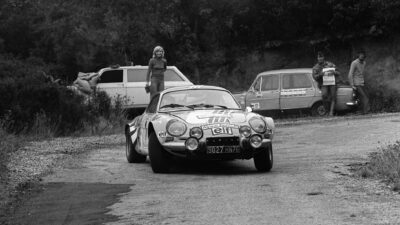
It took to competition like a duck to water, Jose Rosinski posting its first win, on the 1963 Rallye des Lions. Equally at home on mountain or track, the A110 racked up good placings and class wins. But it was not powerful enough, despite its 650kg all-up weight, to make a big impression on the major rallies. It was also, as Jean-Pierre Nicolas commented when choosing it as his favourite rally mount, “a car built more for circuits and Tarmac roads but we made it into an all-rounder”.
Why did the Alpine A110 not dominate earlier than the beginning of the ’70s? It seemed to have everything going for it: light, small, low centre of gravity, rear engine, plenty of traction. It helps to understand if one assesses the performances of the R8 Gordini and the A110 in that strenuous 24-hour test known as the Tour de Corse. The R8 Gordini, with its 1100cc engine boosted to 1300cc, won Corsica in 1964, and again in ’65. On the latter occasion, an A110 with a 1143cc engine came in second. In ’66, an R8, this time with a 1440cc engine, won again.
On each occasion, the R8s were in the prototype category, which meant bumpers, seats, trim — anything not needed — could be removed. They were not quite as light as the A110, but were light enough to make best use of their power advantage.
“Once the A110 1600S was recognised in Gp4, the rally results started to come”
The trusty Renault engine was a single camshaft pushrod, while its international opposition was lining up with twin-cams and 50 per cent more horsepower.
Help was on its way. The arrival of the R16 engine, with its five-bearing crank and superior construction, led to a 1500cc, and eventually a 1600cc version, of the A110. And Renault’s help wasn’t just technical, it was commercial, too. The supply of engines, powertrain and suspension parts, plus PR and distribution, enabled Redele to produce cars in sufficient quantities for homologation. And once the A110 1600S was recognised in Gp4, thanks to annual production in excess of 500, the rally results started to come.
Its international debut was on the 1970 Monte Carlo, where Jean-Claude Andruet missed a passage control and Vinatier crashed. But it went on to win the San Remo and Acropolis with Jean-Luc Therier and Corsica with Bernard Darniche. The following year, it won Monte Carlo, San Remo, Austrian Alpine and Acropolis with Ove Andersson, while Nicolas won Geneva and Portugal, and Vinatier won the Coupe des Alpes.






 Great Read


