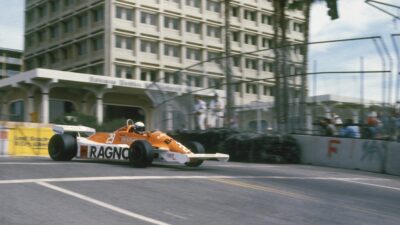
It’s funny how a throwaway remark can sometimes boomerang. Walking into the Shadow team’s garage at the 1978 Silverstone International Trophy meeting, I caught my first glance of its new DN9. And stored up a whole lot of grief for myself.
“Good God, it’s an Arrows!” I blurted.
Four months later I found myself in the rather more formal surroundings of London’s High Court on the Stand in a witness box, to be precise.
“Mr Henry,” said a sharply suited barrister, “is it true that, when you first saw the Shadow DN9 in my client’s garage at Silverstone, you, and let me get this right, remarked spontaneously, ‘Good God, it’s an Arrows’ or words to that effect?”
I took one look at Arrows’ directors – Jackie Oliver, Alan Rees and Tony Southgate – giving me the beady eye from the dock directly opposite the witness box, and said something like, “Er, um, yes.” This was one of the strangest episodes of my F1 reporting career.
As Arrows, by now owned by Tom Walkinshaw, went through what must surely have been its death throes in the closing weeks of 2002, it’s difficult to imagine the mood of upbeat optimism which surrounded the team’s birth 24 years ago. More specifically, on the form it demonstrated during that first season, 1978, the thought that it would go 372 races without a win, before sinking almost without trace, was impossible to contemplate.
“Oil, water, everything was perfect. I just change up from second to third gear and the engine goes bang!”
However, this is running slightly ahead. To understand the convoluted story of Arrows, one first has to recall the Shadow F1 team, which was founded at the start of 1973 by entrepreneur Don Nichols. An American with an engaging character, a dry sense of humour and a pleasant air about him, Nichols’ Tony Southgate-designed F1 cars notably the DN5 of 1975 – were among the most competitive Cosworth-engined machines of their generation. You will already have read in this issue that Jean-Pierre Jarier (see page 46) very nearly won the 1975 and ’76 Brazilian GPs in one of these cars. Yet by the end of 1977, Shadow had lost that initial impetus. Rees, Oliver and Southgate felt they would do better to strike out on their own and duly left the team late that year. Trouble was, Southgate tucked the drawings for the new Shadow DN9 under his arm as they closed the door behind them.
In retrospect, their actions smacked of naivety rather than wholesale deceit. Southgate firmly believed that, in his role as an independent consultant, the drawings were his, and he never really discussed the matter with Oliver until they were embroiled in their legal problems.
Anxious to become members of the F1 Constructors’ Association in 1978, Arrows had to get its skates on if it was to qualify, for the rules of Bernie Ecclestone’s club permitted them to miss just one non-European round of the world championship if it was to gain the valuable commercial benefits such as subsidised air freight. At its new premises in Milton Keynes, the new team worked flat out to ready the first Arrows, FA1, which was unveiled to the press in a snow-covered Silverstone pitlane just days before it was flown out to Rio for the Brazilian GP, second round of the world championship.
The new car ran particularly well in only its second outing, at Kyalami, where Arrows team leader Riccardo Patrese stormed through from seventh on the grid to snatch the lead from the Wolf of local hero Jody Scheckter. But with only 15 of the race’s 78 laps left to run, the Cosworth engine in the Arrows expired and a tearful Patrese soon reappeared in the pitlane. “Oil, water, everything was perfect,” he reported. “I just change up from second to third gear and the engine goes bang!”
Two weeks after the South African race came the International Trophy, my casual remark — and the resultant court appearance. Being a devout coward, I made it clear to the Shadow team that I really didn’t want to be involved. Its response was to send round a man with a High Court subpoena at 12.45am the night before the hearing. So that was that.