Immediately a difficult situation faced Brooks. Should he stay with the Connaught team, as Rodney Clarke wished him to, or move to BRM where the Stuart Tresilian/Peter Berthon 4-cylinder engine was proving intensely competitive (while it kept running!). The Connaught had a beautifully handling chassis, but a sadly uncompetitive engine, while vice versa was true of the British Racing Motor. After much serious thought, Brooks decided it was in his interest to sign for the BRM team. He stayed for just one season, but he’d proved to himself that the 2 1/2-litre BRM was a particularly nasty car to drive. “The BRM had the sheer speed, but it wouldn’t go round corners. In fact, Mike Hawthorn and I led the British Grand Prix in 1956 with ease for the first three laps until everyone also suddenly woke up. Then we had to race the cars; you had to corner the things like bicycles, they were absolutely hopeless. As I’ve said before, the Connaught had a competitive chassis with an uncompetitive engine while the BRM had a competitive engine and diabolical chassis . . and I mean diabolical. It was an absolute danger.”
Brooks’ relationship with BRM came to an unfortunate head when the car turned over at Abbey Curve during the British GP after the throttle stuck open. “It threw me out, somersaulted a couple of times and then set itself on fire, which was about the best possible thing that could happen to that motor car. It did the only decent thing, committed ‘hari-kari’.” [I remember giving Brooks a lift back to the Paddock immediately afterwards.—ED] At the end of the season, he left to join Stirling Moss and Stuart Lewis-Evans in Tony Vandervell’s Vanwall team.
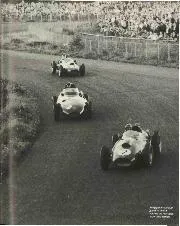
The Vanwall era is well-chronicled and needs no detailed history here, but Moss and Brooks shared the winning car, in the 1957 British Grand Prix at Aintree and then went on to win the Constructors’ Championship for Vanwall in 1958 with victories in the Belgian, Portuguese, Dutch, German, Italian and Moroccan Grands Prix. Out of this impressive tally, Brooks took the Vanwall to first place at Spa-Francorchamps, Nürburgring and Monza and took third place in the World Championship with 24 points to Hawthorn’s 42 and Moss’ 41.
“But by this time I was fed up with sports cars and had made my mind up that I didn’t want to drive at Le Mans again.” Things now looked set for Brooks to stay with the Aston-Martin sports-car team for 1959, but the shock news that Tony Vandervell was withdrawing his Vanwalls at the end of 1958 shed a new light onto the situation. Mike Hawthorn’s retirement as World Champion, followed by his tragic death in a road accident, meant that the Ferrari team had a vacant spot for a team leader. Brooks took up the offer “but I insisted that I wasn’t going to drive at Le Mans, a condition which Ferrari agreed to. I suppose that this was something of a precedent, because Ferrari doesn’t usually permit his drivers to opt out of sports car commitments. But I’d raced there four times and got precisely nowhere and I thought if I ever drive in that race again, well, I’ll want my head seeing to Brooks frankly admits that by this time his interest in racing was confined to the “purest” category: Formula One.
The 1959 season held much the same fortunes for Brooks as the previous year, further emphasising his opinion that the World Championship wasn’t something one should hang one’s racing ambitions on, to the exclusion of all else. The front-engined Ferrari was pitted against the agile rear-engined Cooper-Climax of Jack Brabham and the Australian came out World Champion with 31 points to Brooks’ 27. However, Brooks points out that Ferrari missed the British Grand Prix owing to industrial strikes in Italy and he was forced to make do with an uncompetitive interim Vanwall, especially made ready for the occasion, while the Belgian event was cancelled “which was a pity, for I’ve always gone well at Spa and the Ferrari would have been at less of a disadvantage than anywhere else”. Nonetheless, “the name of the game is winning”, and Brooks had won six Grands Prix in the space of eighteen months, “which pleased me, at least to think that I could keep up with the best”. By this time, Brooks’ thoughts had turned towards retirement and the establishment of his garage business in Byfleet, within sight of the old Brooklands banking. [But I don’t think he realised the historic site his premises occupied.—ED] He fully realised that Ferrari was working on a brand new V6 engine which would be the engine to beat when the 1 1/2-litre formula came into being in 1961, but he also wanted to be based in England so that he could supervise his business. “I felt that it was being unrealistic to run a proper business in Britain whilst driving for a team baked in Italy.”
Thus Brooks came to an agreement that he would drive in a single-car Vanwall team with a new rear-engined chassis that Vandervell’s organisation had produced. “This arrangement suited the dawn to the ground, hut, unfortunately, the car didn’t materialise. I was rather annoyed about this, as I held, myself available to Tony Vandervell without any written contract in view of our previous association and, when it became clear that the car wasn’t available, all the good drives had been snapped up. Really, after Lewis-Evans’ death after Casablanca, I don’t think Vandervell sustained any enthusiasm for racing at all. It’s just a feeling I have, but I haven’t any proof.”