“Geentair! Alors, un nouveau record du tour pour Reeshi Geentair!”
May 14 1961, Monaco, by common consent the greatest drive of Stirling Moss’s life. In Rob Walker’s old Lotus 18, he held off a barrage of assaults from Ferrari, eventually winning by a little over three seconds. It was not, though, Phil Hill or von Trips, Maranello’s established stars, who put Stirling under the greatest pressure that day, but Richie Ginther, driving in only the fourth grand prix of his life.
Any mention of Ginther brings back that afternoon at school, when a bunch of us sat around a ‘transistor’, tuned to a French station. Moss, we understood from the syrupy Gallic voice, was leading, but surely could not resist Ferrari…
I met Ginther just once, at Hockenheim in ’77, 12 years before he died, tragically young, of a heart attack.
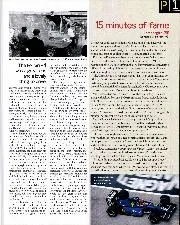
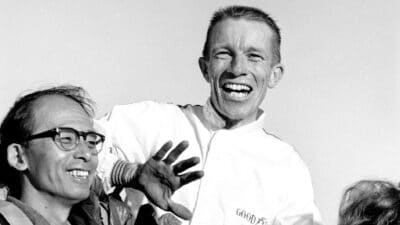
The American rated Monaco ’61 as his greatest drive
Bernard Cahier/Getty Images
“Well, without any doubt,” he said, “my best drive was at Monaco in ’61. The race was 100 laps at that time, and lasted going on three hours. I was on the limit all the way, and I think Stirling was, too. He and I were first and second in qualifying, and in the race we got three seconds under that! Believe me, when you did well against Stirling, you knew you’d really done something; he was the greatest I ever saw by a long way.”
The bare statistics of that race almost beggar belief. In practice Moss and Ginther lapped in 1 min 39.1sec and 1 min 39.3sec, respectively, Richie driving Ferrari’s famed 156, a replica of which is tested elsewhere in this issue. In the race, on a hot afternoon, their average lap time was 1 min 39.5sec, and they left the fastest lap at 1 min 36.3sec. If those 100 laps were Moss’s greatest ever, they took Ginther only three seconds longer.
Ginther, born in Hollywood in 1930, became involved in motor racing through a chance meeting with Phil Hill, a friend of his elder brother. The two men became close buddies, and when Hill needed a riding companion for the 1953 Pan-American Road Race, Ginther was asked along.
Their car for this long, long, race was Allen Guiberson’s 4.1-litre Ferrari, which Ginther recalled as having only two faults: “It didn’t stop, and seemed to have a tremendous aversion to going around a corner…” Hill got the car onto the leader board, however, before it ‘refused’ at a downhill right-hander, plunging down a steep drop, end over end. Neither man was hurt, and they returned the following year to finish second.
After racing a succession of Healeys, Aston Martins and Porsches, Ginther began driving Ferraris for wealthy enthusiast John van Neumann. It was a successful association, and in 1960 he was invited to join Ferrari’s factory team, where he established himself as a superb test driver, with remarkable mechanical sympathy.
“I never could bring myself to abuse an engine,” he recalled. “If I felt the thing tighten, I’d shut it down rather than run another lap and blow it to hell. It was something that the Ferrari people found hard to understand…
“At Reims in ’61, for instance, I knew the engine was going to blow and I came into the pits and, hey, I was leading at the time! Of course, they insisted I go back out, so I shrugged and did it. In half a lap the engine was wrecked, and I had a long walk back!
“It’s a funny thing, you know how many senses do we have? Five, right? Well, the Ferrari people always thought I had six. That went back to a test at Monza in 1960, the last year of the front-engined Dino 246. It was before the Italian Grand Prix, and we were using the full circuit including the banking. I was meant to do a series of laps but I came in early, because I could sense something was wrong. They got agitated, and said, ‘It’s not time yet, don’t you know?’.
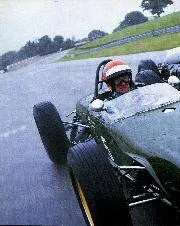
BRM stint brought a joint-second (on points) in 1963 F1 title race
Grand Prix Photo
“I said ‘Wait a minute. This thing’s going to blow up there’s a vibration in there that’s not right.’ But the mechanics fired it up again – wham, wham, wham – they revved the hell out of it, then said everything was OK, and I should go back out. I said no, and so they put someone else in.”
Ginther tried to be discreet, but I had to know. He burst out laughing. “Well, you asked! It was Mairesse. Poor old wild Willy. Before he went out, I said to all the guys, ‘That thing is going to blow in 12 laps.’ And, would you believe, it did! Not on the 10th, not on the 6th, not on the 20th… but the 12th. I mean, I’d just picked a figure out of the air, but from then on they thought I was magic! They really believed that I had some sense that nobody else had.”
Back then, you drove for Ferrari for love. “Oh, that’s right,” Ginther said. “It was a joke, really. I used to get $400 a month, as I recall.”
Overall, his memories of Ferrari were good, but he left in unhappy circumstances, having taken a BRM offer for ’62. “The Commendatore was so angry I wasn’t even allowed to go round the factory to say good-bye. Fortunately, the mechanics came to my apartment to see me.”
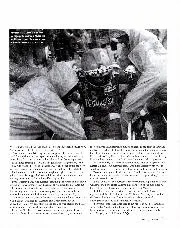
Day of days leading Gurney en route to victory at 1965 Mexican GP
Grand Prix Photo
On his day Ginther was as quick as anyone in the business: at the 1962 Oulton Park Gold Cup, for example, he beat Jimmy Clark to pole position, having never seen the circuit before. The next year he finished equal second (with team-mate Graham Hill) to Clark in the World Championship.
The BRM years, however, brought no wins, and Richie moved to Honda in 1965. “Unquestionably,” he said, “my best memory of racing is the time I spent with the Honda people. They tried so goddam hard for you, and in a short time achieved a hell of a lot.”
Throughout the year, the Japanese car became ever more competitive, but if Ginther qualified well, he rarely finished. In the altitude of Mexico, though, the Honda seemed to thrive, and Richie led all the way. “My car was just flat better than anything else. When Dan [Gurney] began to catch me towards the end, there was no problem. I was letting him come at me, because I was saving my car, and knew how much I could let him have. I had a mixture control and ran at full rich to protect the engine. If I needed, I could have anything up to full lean – the difference was 300 revs on the straightaway.”
He left Honda to join Gurney’s Eagle team in 1967. Dan’s ambitious plans included F1 and Indianapolis, and Ginther would drive in both teams. The cars made their debut at Brands Hatch, in the Race of Champions, and Gurney won, while Ginther – faithful to his creed – shut down the Weslake V12 towards the end, when lying a solid second.
It was to be his last race. “Monte Carlo was part of it, because I didn’t qualify. I had a lot of problems but I was really upset by that. I loved the place, and had usually done well there.
AAR Eagle debut in 1967 Race of Champions at Brands Hatch
Grand Prix Photo
“Then we went to Indianapolis. I had never been there before, but got along fine, and was about fifth in practice. Then, on the first qualifying day, I was in the car, waiting in line in the pit lane, and suddenly I called Gurney over and said, ‘Dan, I just don’t want to start this race.’ There were no questions from him. He just said, ‘OK, fine, I understand,’ and I was really moved by that. I thought his understanding was remarkable.
“I got back to my room, and in my mind was the thought that if I don’t want to start that race… I’m a race driver, I should… I decided to get out before I couldn’t; if I kept going with that kind of mentality, I was going to hurt myself. I never raced again.”
I found Ginther an engaging fellow, full of humour. At the time of our meeting, he’d dropped out and was living in a motorhome, having sold not only a very successful company, but also his house. He was happy, he was free.
“I loved my time in racing,” he said. “It’s one of the very few adventurous lives left, isn’t it?”
It’s been Formula 1 all the way for Nigel – he started covering the sport in 1971. In the mid-1970s he worked for Graham Hill’s Embassy F1 team, before joining Autosport for whom he has written over 400 Grand Prix reports. Nigel joined Motor Sport full-time on January 1 2008.





 Great Read