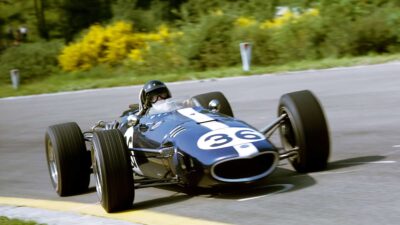
Dan Gurney’s 1967 Belgian Grand Prix-winning Eagle-Weslake is widely regarded as one of the most beautiful grand prix cars ever constructed. From the tip of its shapely Eagle beak, through its compact Gurney-Weslake V12 heart, to its exquisite titanium exhaust header tail feathers it was a work of mechanical art. Designed by Len Terry, the All American Racers — or Anglo American Racers, if you will — Eagle Mark 1 made its competition debut in the rain at the old Spa-Francorchamps circuit in June 1966, resplendent in its national livery of dark blue with a single white stripe.
For that inaugural outing in Belgium and the next four races that season, Gurney’s car was powered by the venerable 2.7-litre Coventry-Climax FPF four-cylinder engine while awaiting completion of the 3.0-litre Gurney-Weslake V12 for which it had been designed. A year later, with the V12 in place, Gurney’s Eagle carried him to the top step of the podium at Spa on the anniversary of its debut — and only the fourth race in its definitive V12-powered configuration.
That Spa success remains the only grand prix victory ever scored by a car built in the United States. It also allowed Gurney to stand alongside Jack Brabham and, later, Bruce McLaren as the only men ever to win a GP in their own car.
Because that particular Formula 1 Eagle, chassis 104, uniquely and extensively employed the lightweight metals titanium and magnesium, it was known as the Ti-Mag car. An earlier aluminium Eagle, chassis 102, had won the non-points Daily Mail Race of Champions at Brands Hatch that spring, but those would turn out to be AAR’s only F1 wins.
In September 1968, his Formula 1 budget cut off, Gurney reluctantly abandoned his quest and returned home to concentrate on the American National Championship where his cars would enjoy considerable success in the decades ahead. By then, constant progress in vehicular dynamics had dated Terry’s original design, and the grand prix Eagle’s once svelte shape had begun to sprout supplemental aerodynamic appendages as a means to keep pace.
Sitting back home in California on a fabrication bench at the AAR factory, however, was the basis of what would have been its replacement. Designed by Tony Southgate, who had taken over the chief designer’s chair from Terry back in 1967, the new car’s design objectives included a more reclined driving position and suspension geometry that minimised camber change from bump to droop while providing zero bump-steer.