When next I saw Reutemann, I mentioned it to him, and he, too, was shocked. To win a title like that, he said, wouldn’t have been winning anything. No-one would have known, the other driver had said. “I would have known,” said Carlos.
Through most of that 1981 season, he had driven wonderfully, and I thought him well worthy of the World Championship. By the time of the British GP, he had 17 points over anyone else, yet it was at Silverstone that I began to detect the return of the flawed confidence that was always Carlos’s major shortcoming. “Six races left,” he mused. “A long way to go…” But everything, I pointed out, was going well for him. “Hmmm, I know. Too well, in fact, and that worries me. To be honest, I feel a little bit alone.” The Williams motorhome was not a place of calm that summer. It was rare to find Jones and Reutemann in there together, and if you did, chances were they were sitting far apart. This had its roots in a rainy day in Rio at the beginning of the season. Carlos had joined Williams as the number two, but in Brazil he had led all the way, Alan awaiting an invitation to pass which never came. Afterwards Jones was livid, and, given the terms of Reutemann’s contract, he had good cause. “Jones had reason to be upset,” Carlos agreed. “I saw the pit signal three laps from the end, and I knew the terms of the contract. But I always started every race with the intention of winning it and now I was being asked to give it away. ‘If I do that,’ I thought to myself, ‘I stop the car here and now, and leave immediately for my farm in Argentina. Finish’.”
You could see his point, but you could see Alan’s, too. And if you liked both men, as I did, your predicament was very real when you braved the icy portals of the motorhome. “In terms of equipment we gave Carlos exactly the same as Alan,” Frank Williams says now. “But Carlos needed more psychological support than most drivers, and I’ll admit that we didn’t appreciate that sufficiently.” After Silverstone, Reutemann’s season began to unravel. At Monza, he qualified over a second faster than Jones, but in the race it rained, and he trailed in well adrift of his team mate. In Montreal, also wet, he was nowhere, and thus we came to Vegas.
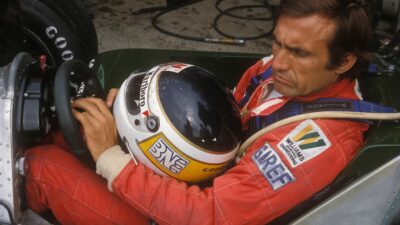
Such a complex and enigmatic man, Carlos. On his day, he was as good in a racing car as anyone I have ever seen, but too often he squandered his gift, fell prey to the mind games he played with himself. Perhaps his happiest season was with Ferrari in 1978, when Villeneuve was his teammate. “I like Gilles, and I envy him so much,” he once said to me, “because he really belongs here, in a Formula One paddock.”
Two years ago, before practice for the Argentine GP, Reutemann, now 53, took to the track once more, in a Ferrari 412T. It was a demonstration, nothing more, but his best lap was actually the 11th fastest of the day. “Amazing, isn’t it?” murmured John Watson. “Same style, same timing, same flair. It’s all there still.”
“Give him a bit of time and he’d qualify in the top 10, no problem,” said Bernie Ecclestone, “It’s the old thing: if you can do it, you never lose it. And he really could do it.”
So he undoubtedly could. When the mood took him.





 Great Read
