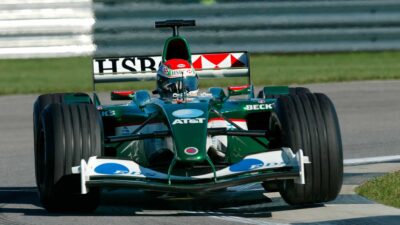
He found it with previous backmarker Dale Coyne Racing, whose fortunes he helped transform. He finished third first time out at St Petersburg and scored a memorable victory at Watkins Glen in July 2009.
“That was really special,” he says, “because nobody expected it or even believed it possible. We had a fuel problem that whole race. The tank was supposed to hold 22 gallons but we could only put in 19.5. The car was very quick, but I constantly had to save fuel in order to do a two-stopper. I was thinking, ‘If ever I have the opportunity to go flat out, I know I’ll be able to drive away’. The others were sat behind me the whole time, but I was lifting on the straights and hardly braked for two-thirds of each lap. I’d coast into the corners, then get a good exit, but it was all about saving fuel. It was only with seven laps to go that I was told we had enough to make the finish. At that point I did a couple of quick laps, built up a lead of about four seconds and cruised to the flag.”
“The Daytona 24 Hours in 2012, that was special”
Was that the best win of his career?
“Possibly,” he says. “It was either that or the Daytona 24 Hours in 2012. That was special, as the 50th anniversary race, but they stand out for different reasons.”
That Daytona win – with Michael Shank Racing – was a perfect comeback tonic, for Wilson had been sidelined by a fractured back since the previous August, when he crashed during practice for the Indycar race at
Mid-Ohio – his final event with Dreyer & Reinbold after 18 months that yielded two podiums, but no wins.
Since then he has been back in the Coyne fold, running at the front and scoring his most recent victory at Texas in 2012 – his first on an oval – while also dabbling in sports car racing with Shank. After fracturing his pelvis in the 2013 Indycar finale at Fontana, he hoped history might repeat itself with another comeback victory at Daytona this year, but transmission trouble put paid to that.
His main target for 2014 is to ensure Coyne’s team remains a thorn in the side of its wealthier rivals. Does he relish the underdog role?
“I’ve been in this position for so long,” he says, “that I wonder if I’d be able to adjust my mindset if I had a target on my back, as the guy everybody had to beat. But with the way Indycar racing is right now, if you have a good engineer and a solid crew behind you, as I do, you can still achieve a lot. For the past couple of years we might have been underdogs as far as the wider world was concerned, but that’s not how it felt to me. If we got everything right, I always believed I had an opportunity.
“Dale wants to build his team. Our weakest area last year was pitstops. We should have won at Sonoma (Sears Point), but lost two seconds during a stop and got stuck in traffic. The other front-runners pulled out right ahead of me when I should have been a few seconds up the road. Dale has been working hard, pushing the team and practising stops all winter. If we can improve that and make sure everything else is as good as it was, we should be OK. But there’s so much to it when every team is using the same chassis and we’re chasing thousandths rather than tenths.”
It didn’t help that his team-mate changed from race to race. “With some of the bigger teams running four cars, they have one guy working on shocks, another on springs and bars, another on aero settings and the fourth on the diff. At the end of a session you just need one solid bit of information from each driver and you put the pieces together to create a fast car. With a one-car set-up, or a changing roster of team mates, you have a relatively limited amount of information. That’s something else we need – two consistently competitive cars.”
One of the upsides was an opportunity to race alongside brother Stefan, 11 years his junior, in Baltimore. “It was fun,” he says, “because we’d never raced on the same track –
I was already in F3000 when he started karting. Unfortunately, he had an opportunity to do one race and it happened to be at the toughest track. Baltimore is incredibly bumpy – it’s basically a motocross track for Indycars…”
Time spent in America has buffed a few edges from his Sheffield accent and he admits he’s in no rush to head home. “You do pick up a certain way of speaking,” he says, “but there are some things I won’t accept. I prefer tomatoes to to-may-toes, for example, but sometimes it’s just easier to adopt the American way.
“Will I stay? I’m not sure. My wife Julia would like to return eventually to the UK, but there’s a good standard of living where we’re based in Colorado, it’s a nice environment for our two young daughters and I’m far from done with racing.
“I’m 35 now and feel I can be competitive in Indycars for at least five or six more seasons. After that, I don’t see why I can’t race in sports cars for another 15 or so. I’m as enthusiastic as I’ve ever been and still feel withdrawal symptoms when I’m away from the racetrack.
“Indycar is a bit like Formula Ford, in a way, in that the racing is hugely serious but off the track the drivers all chat and muck around together. It’s a friendly environment and things are much more relaxed than they are in Europe, where people seem to age really quickly in the cut-throat atmosphere.
“Just look at Scott Pruett – he’s still going strong here in sports cars at the age of 54.”