Barnard recalls the engine testing well: “Ronnie came up with this and I put it in quotation marks – ‘dynamometer’. The back of the arch was like the black hole of Calcutta, and Ronnie decided that this was the place for his dyno, so he cleared it all out. Patrick would spend days and nights just fiddling and farting around. He was driving a van of some sort it may even have been a Minivan and there were a good few nights when he’d finish off sleeping in the back of this thing…”
At the same time, there was progress on the chassis front. The Lola worked well, but Barnard reckoned he could make it better.
“He wanted to change it from a spaceframe into a monocoque but keep the suspension and so on,” says Ronnie. “It would be much better, because the original Lola was a cobbled up Formula Ford thing.”
“The blokes that built the chassis were three of the fabricators who worked for Lola,” says Barnard. “They were moonlighting, and we found this little barn or garage around Huntingdon way somewhere. I did the drawings and they knocked a couple of chassis out. Actually it was quite a nice little aluminium monocoque. I think he had a big shunt in it at one time, and it stood up very well.”
“It looked bloody good,” says Ronnie. “I’d never seen a proper monocoque up close. It was a difficult job, it wasn’t like he could just draw a new car. He had all the suspension and everything else, and he had to make that fit his monocoque. He used to come over every night, and if something didn’t fit he’d alter it. It was bloody marvellous really. John was so far advanced even then. They worked all over the winter, and then we had to find a name for it. We called it a Taurus because John was born in May and my girlfriend Sheila was the end of April.”
“My dad and I used to have the odd dust up that was quite amusing for the rest of them”
Could the designer have named it a Barnard? “I could have,” says John, “but it didn’t sound right to me. Yes, I suppose there was this thought that we could start selling them and that kind of thing. The problem was we didn’t have time.”
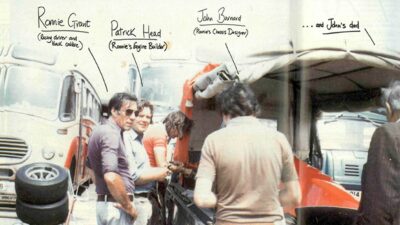
John’s father was also always in tow, making bits. Head recalls Barnard ordering his old man around.
“I tended to be the one who directed operations,” says Barnard. “My dad and I used to have the odd dust up that was quite amusing for the rest of them, the way we used to go at it.”
But was the Taurus any good? Patrick Head is not so sure. “If the truth be told, I don’t think that it actually made the car any quicker, though it probably made it a little bit safer from Ronnie’s point of view.”
It worked alright,” says Grant. “I won a few races with it. It was a bloody good car, and got better and better. It progressed a lot. John altered it, and Patrick got more speed out of the engines. Patrick was very cautious he’d run something for two days on the brake to make sure it really worked. But we did have a valve bending thing when he accused me of overrevving the engine. I said, ‘No. you’re taking too much metal off!’”
“I don’t think the engines produced were particularly good,” smiles Patrick. “They were good in many areas, but the camshafts were poor.”
“John never got a penny for all his work,” says Ronnie. “I paid for the bits, but he never ever said to me ‘I’ve worked 40 hours this week, I want so and so.’ And nor did Patrick. The only thing Patrick ever said to me was ‘Can you change a cheque?’, and he’d write out a cheque for cash or whatever. Patrick didn’t need to be paid because he had his own money, but John was struggling, really.
“I don’t think they used to argue. John was ‘We’ll do it that way,’ and Patrick said, ‘Oh well’. But Patrick was going to go places. He was very well educated, miles above my head. I knew that some day he would make it.”
Grant would race the Taurus all over Europe, often in GP support races, until he sold it in 1978. It went to Sweden. Inevitably, Head and Barnard had long drifted away from the Clapham arches, although they remained in touch as their careers progressed. In 1979, Patrick’s Williams won the British GP. A year later John’s Chaparral took victory in the Indy 500.
“We were all nobodies,” says Barnard, “coming up, scratching away. We went racing because that’s what we liked. Patrick came from a very different background to me, but basically we lived and breathed racing cars, and that’s what it was all about. You never considered Ronnie’s age. He’s got such a vitality about him, and even today you don’t consider Ronnie’s age. He was a quick driver – we weren’t quite so sure how quick he was! – but you just did the best you could. It was educational, looking back on it. You were learning all the time.”





 Great Read