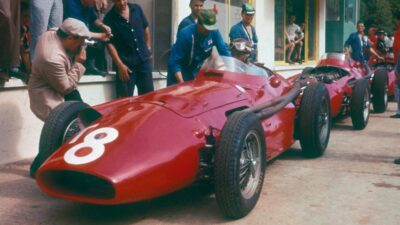
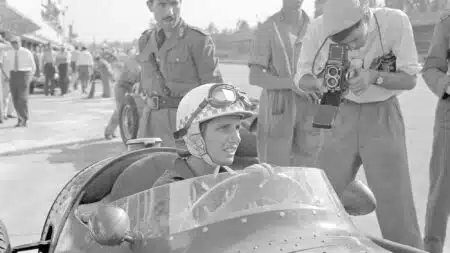
It seems so improbable: a century has elapsed since Alfieri Maserati set up shop in Bologna, initially carrying out general engineering work and perfecting his own brand of spark plugs.
Scroll forward to the present, and his surname is synonymous with exotic GTs and illustrious racing cars. Alfieri and his siblings forged a legend, one that cannot be distilled into an attention-grabbing soundbite. For all the trackside glory and showroom success, there have been just as many calamities, pratfalls and bankruptcy hearings. It’s what makes the Maserati narrative so compelling: the soap opera boomerangs of serial ownership, Italy’s political machinations and the pressure of outside forces have shaped one long fantastical yarn, one that is festooned with enthralling details.
As Maserati celebrates its 100th year, it is chasing new markets (think of a Modenese SUV, and then stop thinking) and German opposition in the premium saloon car sector. It craves big numbers and there is every possibility that it will give rivals a bloody nose. That said, the old guard is understandably concerned about Maserati’s cross-pollination with ‘lesser’ brands, and with good reason, but Maserati has rarely been on a firmer footing in its entire existence.
A is for Alfieri, Giulio
This Parma-born engine designer and chassis engineer was once the heart of the competition department. Alfieri devised most of the great Maserati road and race engines prior to leaving for Lamborghini in the mid-70s (he helped turn the firm around with the Quattrovalvole V12). His bulging CV included the Tipo 61 ‘Birdcage’, the V8 that powered the 450S sports-racer and the compact V6 inserted into cars such as the Merak and Citroën SM. He also had input into the V12 F1 engine employed by Cooper in 1966-67, and engineered the fabulous Bora supercar, if only in part.
B is for brothers
Officine Alfieri Maserati was founded on December 14, 1914 in Bologna, Italy by Alfieri Maserati, with brothers Ernesto and Ettore Maserati joining the firm at the end of WW1. Bindo Maserati joined the company in 1932 following the death of Alfieri. The brothers stayed on after the marque was acquired by Adolfo Orsi in 1937, under a 10-year contract, but their relationship with the new regime wasn’t a happy one. Ernesto, Ettore and Bindo left in 1947, setting up shop in a disused part of the original factory in their home town of Bologna to build small-capacity racing cars. Because Orsi owned the rights to their surname, they contrived the extravagant alias Officina Specializzata per La Costruzione di Automobili – Fratelli Maserati SpA. Or OSCA to its friends. With Ernesto as designer, Ettore the artisan and Bindo running the show, the trio ushered in their first model, the MT4 (Maserati Type 4), in 1948. OSCA was soon at the forefront in the 1100cc tiddler class, often in contention for outright wins, too. After dabbling in Formula 1 (and F2), the brothers wisely stuck to sports cars, the highlight being victory in the 1954 Sebring 12 Hours for Stirling Moss and Bill Lloyd aboard their MT4 1450.
C is for Chrysler
Much has been made of Fiat’s Chrysler and Maserati brands sharing DNA, not least within the motoring media. There is every reason to worry: marque types remain traumatised by the last time Chrysler and Maserati collaborated on a project; one that remains a lesson from history. The risible Chrysler TC by Maserati (to give the car its full title) married a modified Chrysler K-car platform with assorted four- and six-cylinder engines, only one of which was made by Maserati. Production began in 1989 and ended in ’90. Shock