



Red Bull learns lessons from rocky Singapore GP
Red Bull believed the bumpy Singapore Grand Prix would be its toughest test of 2023, and so it proved
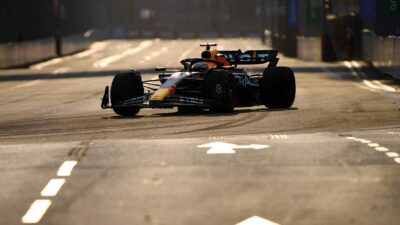
Low ride height is the RB19’s advantage at most tracks, but Singapore’s uneven surface is Red Bull kryptonite

The simulator had already suggested that Singapore was going to be the most difficult circuit on the calendar for the Red Bull RB19. What wasn’t anticipated was just how much of a struggle it turned out to be, with the previously unbeaten car not even making Q3, Max Verstappen and Sergio Pérez complaining of oversteer, bottoming out, locking brakes and lack of tyre temperature. Inevitably such symptoms are interlinked and it became clear as the weekend went on that the underlying car traits which made the track difficult were exacerbated by some key set-up decisions taken as the team tried to get around the basic limitations.
“There’s never a silver bullet with any of these things,” said Christian Horner in Suzuka the following week. “It’s a combination of how is your interaction with aerodynamics and mechanical set-up; it interacts, obviously, with the tyres and the layout of the circuit. It’s about how you run the combination of your set-up with that. And if we were to go there again now I think we’d be probably a little different to where we started and there’s a lot of lessons that we’ve taken out of that.”
The combination of the car’s underfloor and rear suspension allows it to run lower than any other car at most circuits, and this is part of its inherent aerodynamic superiority. But at tracks where bumps or compressions require the ride height to be increased so as not to wear the underfloor plank below the legal thickness, the Red Bull loses a lot of performance. Its aerodynamic map is clearly not optimised around such ride heights. There were already suggestions of this difficulty at Monaco and Spa, but at the latter track they got around it by getting the drivers to manage the issue at the only point on the track at which it was a problem – the Eau Rouge compression, where both Verstappen and Pérez were deliberately backing off in the race. But around the bumps of Singapore that wasn’t a viable option. Furthermore, the softer suspension they’d arrived here with to handle those bumps, meant the car was bottoming out in the grippier newly resurfaced section. The various practices suggested that inherently the car was only around 0.3sec off the Ferrari pace, but in trying to find that 0.3sec into qualifying the team’s choices took the car into that vicious circle initiated by not being able to generate good tyre temperatures.


×