Zeltweg, Austria, August 10th.
After less than two years’ work the new racing circuit in the foothills overlooking Zeltweg was opened with a small sports-car race, before the 1,000-kilometre race, and this acted as a test-run for the circuit and the organisation. After struggling manfully for a number of years with a rather poor circuit on the Zeltweg airfield the local branch of the Austrian Automobile Club were more than pleased to put on a 1,000-kilometre race on their brand new 5.911-kilometre circuit. Carved out of virgin farm land and forest, the Osterreichring is a fine example of what can be done when enough finance is raised to build a circuit from scratch. It has many climbs and descents and all the curves are fast ones, some of them completely blind, and lap speeds are over 120 m.p.h. The only criticism one might make of the layout is that it lacks any sharp corners and some of the curves lack character, but set in undulating countryside with a back-cloth of pine trees and mountains the overall effect is extremely pleasant and agreeable.
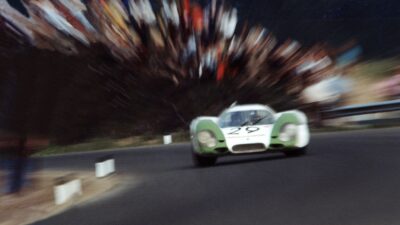
The Austrians have been calling their premier motor race the Austrian Grand Prix, whether it was for Formula One or sports cars, so this was officially the Seventh Austrian G.P., though a better title would have been the Austrian 1,000 Kilometres, and it was the last round in the 1969 Sports-Prototype Championship. Some idea of the esteem in which the Austrian organisers are held by the racing world can be judged by the excellent entry they received for this first long-distance race on the new circuit. Official works entries came from Alfa Romeo, Matra, Gulf-Mirage, and a veritable armada of Porsches from the Stuttgart factory, although none were official works entries. Maintaining their official policy of having withdrawn from racing for the rest of this season, Porsche team personnel, technical staff, works mechanics and team drivers were at Zeltweg in force, racing under the entries of private owners. The Austrian branch of Porsche entered three 908 Spyder models, all with the latest more-streamlined bodywork, one of them having the short Manx-type tail and the other two the longer tail that extends beyond the gearbox and covers all the mechanism. The factory people also had two 917 coupés, without the long tails but retaining the suspension-controlled spoiler flaps. One car was under the entry of Karl von Wendt and the other under that of David Piper Racing, these two having options to buy the cars at a later date. Works drivers Siffert, Redman, Attwood, Ahrens, Larousse, Lins, von Wendt and Kauhsen were spread amongst the five cars during practice, the final driver/car combinations being decided the night before the race.
At midday the one and only Fangio dropped the Austrian flag and sent the field on their way
Autodelta were out in force, with three 3-litre V8 cars the latest, Tipo 33-3 models, with Casoni/Zeccoli, de Adamich/Vaccarella and Giunti/Galli driving them. Matra sent a 650 Spyder V12-cylinder car for Servoz-Gavin/Rodriguez and the Gulf team had their open cockpit Mirage with Cosworth V8 Grand Prix engine, the drivers being Ickx/Oliver. There should have been one works 3-litre Alpine-Renault, but it was withdrawn at the last moment. Most of the European private teams were entered as well as numerous regular long-distance racing private entries. Piper was sharing his green Lola-Chevrolet V8 with B.M.W. driver Quester; Bonnier and Muller were driving the red Filipinetti Lola-Chevrolet V8; Pilate and Slotemaket had the Belgian V.D.S. team 2½-litre Alfa Romeo 33; there were three privately owned Snyder 908 Porsches, Neuhaus and Fröhlich with one sponsored by the Gesipa rivet manufacturer, Koch and Dechent with the German B.G. Racing team car, and Masten Gregory and Brostrom with one loaned from the factory while their own was being repaired. Nearly every Porsche 910 built was entered, a few early 906 models, and the Chevrons of J.C.B. Ltd and TOR Shipping Line, while four 911 Porsches made up the GT category.
Practice on Friday and Saturday took place from 2 p.m. to 5.15 p.m. each day, and the first part of each session was untimed, allowing plenty of opportunity to experiment before the serious business began. Only a handful of drivers had competed at the inaugural meeting two weeks before, so practice saw quite a lot of drivers finding their limit the hard way, by spinning off, though no serious damage was done. Siffert dented the back of one of the long-tailed 908 Spyders, Muller crumpled both left side corners of the Filipinetti Lola, and an old 906 Porsche was very crumpled around the rear end. On Saturday afternoon Oliver in the Mirage and Ahrens in a 917 collided nose with tail and there was quite a lot of straightening out to be done that night. The time-keepers made no attempt to differentiate between the pairs of drivers, merely giving the times for each car; and Siffert seemed to try all the works cars in turn, while Ahrens also did considerable practice, especially with the von Wendt-entered 917. Ickx was undoubtedly the fastest driver, getting the Mirage-Cosworth V8 round in 1 min. 47.46 sec., and no-one else broke 1 min. 48 sec., although Siffert, Bonnier, Rodriguez and Giunti were all in that bracket. In spite of trying all the Porsches Siffert wound up with the fourth fastest overall, credited to the von Wendt-entered 917 Porsche. The Porsche team manager announced that Siffert/Ahrens would drive the von Wendt 917, Attwood/Redman the Piper-entered 917, von Wendt/Kauhsen the newest long-tailed Spyder 908 with small vertical rudders on the tail, and Lins/Larousse the Manx-tailed 908.