The experimental Garage 56 category offers innovative technology and ideas a home at Le Mans, the world's biggest endurance race – we chart its history
Garage 56 gives an opportunity for cars using innovative technology to take on Le Mans
Ever since its inception, Le Mans has been a testbed for new technology, pushed to the limit for 24 hours at the world’s greatest race.
However, as rules became more prescriptive over the years, innovative approaches and ideas struggled to find a home at La Sarthe.
In recognition, the Le Mans’ governing bodies the ACO and FIA introduced ‘Garage 56’ in 2012, a one-car category ostensibly for prototypes using innovative technology lesser seen in other disciplines of racing, driven in the motor sport laboratory of the blue riband endurance event.
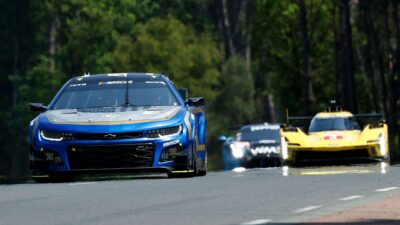
This year NASCAR, celebrating its 75th anniversary, will take the slot, using its Next Gen Cup Series car – with F1 champion Jenson Button, NASCAR legend Jimmie Johnson and Le Mans winner Mike Rockenfeller at the wheel.
However, the category has seen a diverse variety of competitors take on Le Mans since it first began – we chart the brilliantly eclectic progression of Garage 56.
2012 – Nissan Deltawing
Deltawing takes on Le Mans in 2012
Getty Images
Garage 56 debuted in 2012, and the car chose was the Nissan Deltawing, designed by Ben Bowlby with a distinctive narrow front axle track.
Jenson Button will compete in three NASCAR Cup Series races this year, as well as at Le Mans in a (modified) stock car. it all stems from watching Tom Cruise in Days of Thunder as a youngster, he says
By
Adam Cooper
Originally conceived as a submission for the 2012 IndyCar design tender process (which ultimately went to the Dallara DW12, still used today), Bowlby, with backing from Nissan, Don Panoz and Chip Ganassi, changed tack and went to Le Mans for 2012.
With Garage 56 running for the first time, the Deltawing made it into the field, qualifying a respectable 29th with Marino Franchitti, Michael Krumm and Satoshi Motoyama at the wheel – faster than some LMP2 cars.
However, the Deltawing was eliminated on lap 75 at the Porsche curves after colliding with Kazuki Nakajima’s Toyota LMP1 car.
2014 – ZEOD RC
DeltaWing morphed into ZEOD RC
Getty Images
Not to be deterred, 2014 saw the entry of the ZEOD RC, Ben Bowlby’s successor to his Deltawing.
Using a chassis similar to its predecessor, the car was powered by a hybrid electric drivetrain with lithium-ion batteries, with an output of 220kW (295bhp). Accompanying it was a 400bhp three cylinder combustion engine.
The car performed reasonably in qualifying, setting 27th-fastest time, and managed to set a lap using purely electric power in the warm-up. However, a gearbox issue meant the car promptly conked out on lap five of the race.
Panoz and Ganassi sued Bowlby over use of intellectual property, with the matter eventually settled out of court.
2016 – SRT 41
Sausset takes the flag in 2016
Getty Images
In 2016 Garage 56 returned and broke yet more ground as the first ever quadruple amputee took on Le Mans.
Four years prior, businessman Frédéric Sausset tragically lost all his limbs to a vicious infection, but the Frenchman fought back to set incredible records at La Sarthe’s 2016 race.
Using an adapted Morgan LMP2 car, Sausset operated a throttle and braking system which with his thighs his thighs, while the steering column was directly attached to his right arm limb.
With his two team-mates Christophe Tinseau and Jean-Bernard Bouvet able to drive the car using the standard apparatus, the car qualified 32nd before finishing a highly commendable 38th.
Getty Images
Getty Images
Getty Images
2021 – La Filliere by SRT 41
Bailly gets ready to race in his adapted car for 2021
Sausset returned five years later, this time as team boss to the SRT 41 team.
Nigel Bailly lost the use of his legs in a motocross accident, but within weeks he was racing – now incredible journey now takes him to Le Man this weekend
By
James Elson
Breaking boundaries again, this time the team featured two disabled drivers, Nigel Bailly, a motocross competitor who became paralysed from the waist down after a crash, and Takuma Aoki, a grand prix motorcycle rider who became similarly injured in a crash motorbike crash – both again using an LMP2 car with adapted hand controls.
Completing the team was Matthieu Lahaye who used standard controls.
“All we have been trying to do is to remove the stereotype of guys with disabilities racing,” Bailly told Motor Sport.
“I’m hoping in the future disabled people can race in the ‘normal’ class, but we’ll have to see how the evolution of the sport goes. Myself and Aoki, we’re the only two disabled drivers in racing. We’re doing this with the help of the FIA, but we have to stay humble.”
The SRT 41 team qualified 29th, before 32nd in another impressive performance from a Garage 56 competitor.
2023 – NASCAR
NASCAR’s Garage 56 entry aims to broaden the series’ appeal
NASCAR
NASCAR, the US’s most popular form of motor sport, celebrates its 75th birthday this year
To mark the momentous occasion, America’s premier stock car championship will enter Le Mans with its new-for-2022 Next Gen car.
NASCAR is going racing at Le Mans in the Garage 56 category – we look at why it’s doing it, who’s driving it and what changes have been made to the car
By
James Elson
The car chosen is the Chevrolet Camaro, run by Hendrick Motorsports – NASCAR’s most successful team.
The American machine has been modified for the stresses and strains of 24 hours running round La Sarthe, including the use of carbon fibre body elements, carbon brakes and bigger wheels.
“From the early days of NASCAR, it was important to my father that we played a visible role in international motor sport, and there is no bigger stage than the 24 Hours of Le Mans,” NASCAR CEO Jim France stated.
“In partnering with Hendrick Motorsports, Chevrolet and Goodyear, we have the winningest team, manufacturer and tyre in NASCAR history. We look forward to showcasing the technology in the Next Gen car and putting forward a competitive entry in the historic race.”