


Archive
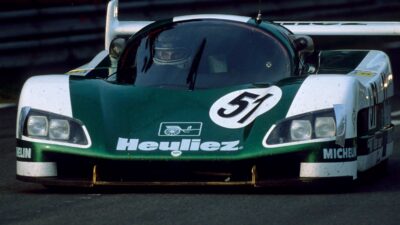
The WM team at Le Mans: Straight Fighters
The rear wing was wound down and the boost wound up. Duct tape was strapped across almost every bodywork orifice and some brave soul was strapped into the cockpit. The…

Le Mans has witnessed incredible one-lap heroics over its long history
DPPI
The Le Mans 24 Hours Hyperpole showdown will be a veritable smorgasbord of speed at the 100th running of the world’s greatest endurance challenge.
The fastest competitors from each class in practice yesterday will go into a shootout to decide the top running order in their respective categories.
The Ferrari’s will have to see off the might of Toyota, not to mention Porsche and Cadillac, but will today’s fast laps live up to the heroics of yesteryear?
Below we look at some of Le Mans’ greatest one-lap efforts – the legends who hit blistering speeds at the world biggest race.

Dorchy broke the 400km/h in 1988
DPPI
Roger Dorchy’s 1988 effort actually came in the race – but what he achieved is so astounding it bears a mention.
A pair of Peugeot engineers, Gerard Welter and Michel Meunier, began tinkering with racing prototypes in 1969, making their Le mans debut in 1976 with the quirky WM P76.
After it dawned on them that they probably weren’t going to overcome the might of Porsche et al to win the overall race, they settled on another target: top speed, breaking the 400km/h (250mph) barrier.
By 1987 they had a car ready to take on what they called ‘Objectif 400’, but reliability problems meant they never quite reached their target.
Not to be deterred, they went for it again with the P88 the following year, qualifying 36th out of 50 entries despite technical issues.
Come the race, more gremlins struck but the team spent three hours in the pits repairing the car. Once fixed, driver Roger Dorchy was told to go out and turn up the boost.
He achieved the team’s goal, and then some: after almost immediately breaking the 400km/h barrier on the formidable Mulsanne Straight, he then hit an astounding top speed of 407km/h (252mph).
Almost inevitably the car gave up again not long after, but it mattered not – with the addition of chicanes, Dorchy and WM’s incredible achievement has never been broken.

Kobayashi set Le Mans fastest ever lap in 2017
DPPI
The 2017 Le Mans was a heavyweight LMP1 showdown between Toyota and Porsche, with qualifying a forerunner of things to come.
When Kamui Kobayashi went out for another run on the Thursday’s qualifying’s ‘golden hour’, the rapid Japanese driver already held pole from the previous day – for a diehard racer like himself, it mattered little.
Porsche had led early on, but Kobayashi soon dethroned the Stuttgart marque with a 3min 18.793sec, and was then intent on going even faster.
Seizing the moment of a clear track, the Toyota man also took advantage tailwinds propelling his LMP1 on – and the results were simply stunning.
A 3min 14.791sec smashed the Neel Jani’s previous lap record of 3min 16.887sec, securing a pole position for the Toyota team.
They would lose out on race day to Porsche, but Kobayashi’s lap is a record which still stands and will live long in the memory. This was only the third time that the average speed of a Le Mans lap has gone over 250km/h (155mph) with Kobayashi’s effort standing with Jackie Oliver’s 1971 attempt (3min 13.6sec) and Hans-Joachim Stuck’s 1988 lap (3min 14.88sec – 251.712 km/h)

Oliver clocked an incredible speed at Le Mans 1971
Porsche
In terms of speed, the Porsche 917 was a groundbreaking Le Mans prototype and the perfect drivers with which to wield it: Jacky Ickx, Vic Elford, Pedro Rodriguez, Brian Redman, Jo Siffert, Derek Bell and Jackie Oliver.

It was a record that stood the tests of time and distance for almost 40 years: 3315.21 miles in a 24 Hours of Le Mans. Yes, significant changes to the…
Elford’s 3min 19.8sec’s qualifying lap in 1970 was stunning in its own right, 14sec faster than Jo Siffert had managed in a 908 two years earlier.
However it’s Oliver’s effort in the 917 LH the following year which stood out in the history books. His 3min 13.6sec in testing – the first 250km/h lap – stunned observers, and he did similarly in qualifying, clocking a 3min 13.900sec, before hitting 250mph on the Mulsanne during the race, which would eventually be won by Porsche stablemates Gijs van Lennep and Helmut Marko.
“It’s easy,” Oliver told Motor Sport. “When you’re confident and leading everything starts to fall into place. At night, warm orange lights glowing on the dashboard and strong headlamps, the impression of speed isn’t there. You have done it many laps before – and even the Mulsanne Kink was flat in that car.”
A landmark car with gladiators at the wheel.

Enge clocked a cult lap at Le Mans ’04
Tomáš Enge, the Czech prodigy with a handful of 2001 Prost F1 starts, became notorious for being stripped of his 2002 F3000 title for a failed drugs test.
However, the man from Prague never lost his speed, as he showed with five consecutive GT1 poles from 2002 to 2007, and another in 2010.
However, it’s his 3min 49.438sec lap driving for Prodrive in 2004 which will stand as an all-time great tour of La Sarthe.
Typically of Enge’s up and down story, the Czech driver arrived late on the Wednesday before the race due to a F3000 commitment, touching down in David Richards private jet – before promptly crashing heavily at the Porsche Curves not long after getting into the car. It required a rapid repair job for the team to be able to get even one qualifying lap in before the session closed.
“We had people changing whole bits of cars and they started to work straight away,” Enge recalled to Autosport. “The guys were pushing like crazy. I was with my head like this [in hands].”
The Czech first had to be persuaded to get back in the car for one last-gasp effort by tech chief George Howard-Chappell, and when he set out found that the twisted car was scraping along the Mulsanne – and then bizarrely producing more downforce through the Porsche section with the nose pointed downwards.
Enge tried to radio in to say the car was undriveable, but pressed the wrong button and was sent out for a fast lap anyway, hanging on for dear life as he ultimately went a second quicker than the Corvette of Oliver Gavin.
The reliability issues would drop the car to fourth in class for the race, but Enge had already sealed his cult Le Mans status.

Blundell on his way to an all-time great Le Mans lap
Getty Images
The 1990 Le Mans event had been nothing short of a nightmare for Mark Blundell before his single qualifying run.
The Nissan R90CK might have looked the Group C part, since acquiring a special place in the heart of Le Mans fans, but its reliability issues were many and varied.
“It was not the best car in terms of balance,” Blundell said to Motor Sport. “Aerodynamically we had quite a big porpoising problem. We had to cut out big vents in the front wheel arches to try and get the airflow out and stop it.

 Great Read
Mark Blundell’s astounding 1990 Le Mans lap is often held up as the greatest ever round the legendary circuit – he remembers it to Motor Sport
Issues curtailed almost any practice session running for Blundell and his Nissan team-mates though.
“The problem was that every time we got out on the circuit, literally every time, the thing would over-boost.
“Immediately the Nissan engineers would be on the radio asking us to abort the lap because, culturally, they didn’t want to have egg on their face,” he said.
“They didn’t want to have something that was out on circuit and blew up and made a mess – that wasn’t what Nissan was there for.”
Blundell knew that the same thing would happen in qualifying, so he decided to overide the heirarchy on the one qualifying lap run the team did, simply by pulling out his radio.
The turbo-wastegate on the car stuck shut once more, meaning the engine was delivering 1,100bhp.
“The whole lap is completely reactive,” Blundell said. “From getting on 100% throttle and approaching the first corner under the brakes, it’s the first time ever that car had done any anything in anger [at Le Mans].”
The resultant 3min 27.020sec took pole by over six seconds, the biggest margin ever at La Sarthe, and remains for many Le Mans’ greatest lap.

Nothing like it has been seen before: Ferrari's 499P Modificata is a version of its Le Mans-winning Hypercar with more power and bonus features for buyers prepared to pay millions on a track-only car that can't be driven on the road or raced

The GT40 remains a Le Mans icon - dominating Le Mans from 1966-1969 - but its true origin story begins further back than Hollywood would lead you to believe
 Great Read
It won five Le Mans 24 Hour victories and launched an era of single-manufacturer domination: the Audi R8 conquered endurance racing in the early 2000s, and Audi threw everything at its development

Le Mans celebrated its 100th centenary race with a brilliant parade featuring the likes of the Ford GT40, Porsche 917 and Bentley Speed 8

