They call it progress. This year’s 1000cc MotoGP bikes make around 280 horsepower and are good for 220mph/355km/h. These machines are the pinnacle of 125 years of development of the internal-combustion engine and motorcycle chassis and electronics technology. In some ways they are easy to ride, but in other ways they are not.
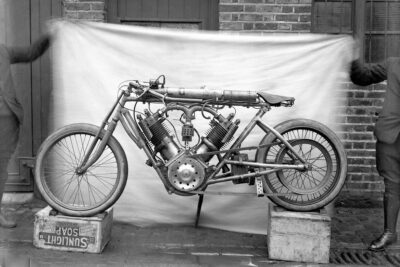
One hundred and ten years ago Londoner Will Cook turned up at Brooklands – the world’s first purpose-built racetrack – aiming to become the first motorcyclist to break the 90mph barrier.
His secret weapon was a huge JAP engine (manufactured at JA Prestwich’s factory in Tottenham, north London) which had been rejected by TT racers because it was too much of a handful on the Isle of Man roads. The 80-degree v-twin had a capacity of 2714cc (!), with a bore and stroke of 120mm.
The engine had direct drive to the rear wheel, so the wheel turned at engine speed. There was no clutch, no gearbox, no brakes and no suspension
“It is a fearsome looking object, mostly engine,” wrote a reporter from Motor Cycling magazine.
The JAP was anything but easy to ride and just starting it was a bit of a nightmare: First find a steep hill, then remove a blanking plug from the top of each cylinder and poke in a wheel spoke to check the position of each piston. Next squirt some neat fuel towards the inlet valves, open the valve lifters of both cylinders, push like buggery, drop one lifter as the first cylinder fired (with a bit of luck), drop the other lifter as the second cylinder fired.
This is when things got really difficult. Once the engine was alive, the rider had to constantly juggle with the ignition advance/retard lever, the air-mixture lever and the throttle lever. These were the only ways to control his speed, because the engine had direct drive to the rear wheel, so the wheel turned at engine speed. There was no clutch, no gearbox, no brakes and no suspension.
Cook was a brave man and knew what he was doing. He surpassed 90mph at Brooklands, but a technicality denied him the official record.
(Interestingly this entire motorcycle was manufactured in three different factories in London: JAP in Tottenham, North London Garages in Highbury and Chater Lea in Finsbury. The 2714cc engine was later used in an aeroplane.)
Was the NLG JAP difficult to ride? Christ, yes! Would a Honda RC213V be easier to ride around Mugello? Of course.
But there is a great misunderstanding about the ease of use of racing motorcycles. When a rider comes into his team’s garage and tells his engineers that their latest modification has made his motorcycle five per cent easier to ride it doesn’t mean they’ve made his job five per cent easier.