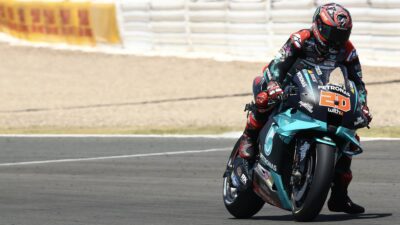
Reducing rear ride height also increases rear load, but creates lazier steering geometry, so will that hurt the rider or help him overall? The Yamaha turns well, so perhaps this is an easier compromise with the M1 than some other bikes.
Engineers can also play with the swingarm pivot point, raising or lowering it to adjust chain force and thereby increase squat at the rear. And then there’s clutch set-up, engine-braking mapping and brake spec. MotoGP riders have a range of rear-brake equipment they can use – steel disc sizes from 210mm to 250mm, solid or vented. Then there are different master pumps to adjust feel and different hoses, steel or rubber, again to provide a different feeling, according to rider preference. A myriad number of combinations.
There are also choices for controlling the rear brake – foot-operated brakes, thumb brakes and scooter-style brakes. More and more riders are moving towards hand-operated rear brakes because the lever is easier to get at when the rider wants to turn at full lean in a right-hander or when he wants to keep the front end down during acceleration. Also, hands are much more sensitive than feet.
Recent developments in aerodynamics have also played a part in changing braking techniques and settings. When front downforce is increased the front end will initially dive more violently when the rider hits the brakes, which unloads the rear quicker. Bikes have been rebalanced in recent years to deal with this and this is one reason why factories don’t want to increase downforce – to reduce wheelies and therefore improve acceleration – any more
The main point to take away from all this is that the compromises that riders and engineers now work with to improve rear braking have to be fed into the huge number of compromises they were already dealing with in their search for the ultimate sweet spot for Sunday afternoon.
I asked Ducati for clarification on its ride-height adjuster. “Petrucci already said too much,” said a team spokesperson.
Finally, and this may just be me hallucinating due to lack of contact with the paddock and pit lane… but what about Ducati’s ride-height adjuster? The factory’s so-called shapeshifter squats the rear under acceleration to increase traction. Might it also play a role during braking, by loading the rear tyre?
When a GP20 rider presses the lever on the left handlebar the rear of the bike compresses. The rear stays low on the straight and still has that attitude when the rider hits the brakes, so if the rider uses the rear brake first might he get more deceleration from the heavily loaded rear tyre before he hits the front brake, which disables the shapeshifter?
“We use this system when there’s a big acceleration area and a big braking area,” explained Danilo Petrucci at Brno. “When we brake for sure the bike is lower, then we need to brake really hard to disable the system.”
I asked Ducati for clarification on this point, but the company didn’t make an engineer available. “Petrucci already said too much,” said a team spokesperson.
Ducati riders used the shapeshifter three times per lap at Brno, usually exiting Turns Four, Nine and 12. At Jerez they used the device twice per lap, exiting Turns Five and 13.