Final pre-season testing confirmed that Ducati is stronger than ever, leaving the other four factories struggling to keep up. Plus how BMW might have joined the 2023 MotoGP grid
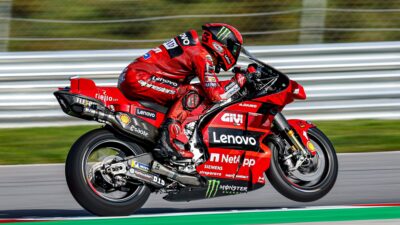
Bagnaia’s speed at Portimao was ominous. He says he’s 100% ready, which is something you never usually hear riders say
At Sepang the Squadra Bolognese had seven bikes in the top nine, at Portimao it was six bikes in the top seven, so you’d better get used to it: if you thought Ducati ruled last year – winning the riders’ title, the constructors’ championships and more than half the races – the factory is likely to be even more dominant in 2023. For a multitude of reasons…
Ducati again has eight bikes on the grid, with at least six riders capable of winning or challenging to win races. Plus, its factory line-up is stronger, the Pramac team has better engines, Luca Marini is totally dialled into his GP22, VR46 team-mate Marco Bezzecchi has a GP22 instead of the GP21 he rode last year and Alex Márquez is faster than his big brother aboard a Gresini GP22.
“It looks like we have more of an advantage compared to last year”
And it gets worse, or better, depending on which end of pitlane you are, because the advantages of having so many bikes on track are snowballing. Data has always been important in MotoGP but never more so than now, because it allows electronics engineers to build more accurate computer-models and simulations, which allow them to make their bikes even better by running thousands of virtual laps, from which AI and machine learning suggests improvements.
Rivals complain that it’s impossible to match the Desmosedici in two vital areas: on the brakes and getting the power to the ground exiting corners. These have always been the bike’s strong points, but now it leaves the rest even further behind in these areas, while its old Achilles Heel – entry and mid-corner – is pretty much history.
Ducati made a horrible start to last season, struggling to coax maximum performance from its GP22, but the GP23 is already better than its predecessor. Considering that Pecco Bagnaia won last year’s championship from a mid-season 91-point deficit, that is horribly ominous for the other four factories on the grid.
Ducati test rider Pirro tried this new triple-clamp arrangement, designed to improve turning, without losing stopping performance
Oxley
Bagnaia ended the Sepang tests with a smile on his face, because his engineers had quickly tweaked the GP23’s torque maps to soften a too-peaky engine, leaving him only one concern, that the new bike didn’t handle as sweetly as its predecessor. His stunning speed at serpentine rollercoaster Portimao proves that that issue has also been fixed. His best lap was almost eight-tenths of a second inside the circuit’s pole-position record and his second-fastest lap, recorded during a sprint-race simulation, not a time attack, was still faster than anyone else’s best.
“Last year’s tests were a disaster – now we are 100% ready,” he said. “It looks like we have more of an advantage compared to last year.”
That’s really something, because I don’t think I’ve ever heard a rider say he’s 100% ready at the conclusion of pre-season testing.
There’s a good chance that factory Ducati team-mates Pecco Bagnaia and Enea Bastianini will fight each other for the 2023 MotoGP crown, so what are their strengths and weaknesses and will it get nasty?
By
Mat Oxley
New team-mate Enea Bastianini had a low-key weekend, following a Saturday complicated by technical glitches and a crash. He improved on Sunday to sixth overall, four tenths down, just behind Marini and Bezzecchi and just ahead of Alex Márquez.
Meanwhile, further down pitlane Michele Pirro and the Ducati test team were working hard on the next generation of gadgets coming out of Borgo Panigale, most noticeably a reimagined triple-clamp design, with the upper and lower pieces separated. The bottom triple clamp appears to be conventional, with its bearing inside the steering head, while the top clamp is separated via a bearing outside the chassis. The idea could be to improve turning, without losing stopping performance.
Quartararo and Yamaha seemed deep in a downward spiral on Saturday, so they did what any sensible team would do: they went backwards to go forwards. The 2021 MotoGP champion found 1.3 seconds by reverting to 2022 chassis settings and aerodynamics. That put him third, three-tenths behind Bagnaia and four-hundredths behind Pramac’s Johann Zarco.
Yamaha’s YZR-M1 may have more horsepower this year, but so does the V4 opposition from Ducati, Aprilia, Honda and KTM. Thus MotoGP’s sole-surviving inline-four was 3.6mph (5.8km/h) slower than the fastest bike, Jorge Martin’s 213.5mph (343.7km/h) GP23, and had 12 V4s ahead on top speed.
Binder and KTM languished near the bottom of the timing screens for much of the weekend, until the hard-charging South African put it on the line on Sunday afternoon, shooting up to eighth, albeit half a second behind Bagnaia.
“That lap didn’t come easy,” he grinned.
Binder gave it everything to put KTM in the top ten. He ended the tests with a big crash, which left him relatively unscathed
KTM
Meanwhile new team-mate Jack Miller ended his first pre-season with KTM down in 17th, 0.941sec behind his former Ducati team-mate. The Aussie knows it’s going to be a hard slog getting the RC16 to the front of the pack but his relationship with crew chief Christian Pupelin, who came with him from Ducati, is already paying dividends, especially on electronics.
“We’re getting there,” said Miller. “Lap after lap I’m feeling more and more comfortable, leaning the bike over more, carrying more speed, releasing the brakes earlier and so on. The electronics need a bit of polishing – we’ve been rewriting code between exits.”
“At the moment Ducati and Aprilia are unbeatable”
The speed of Quartararo and Binder reflects their own skills more than the performance of their motorcycles, which leaves Aprilia the only factory that currently has Ducati in sight.
Like the Bolognese, the crew from Noale has drunk heavily from the cup of F1 aerodynamics, from where the two Italian brands are leaving the others far behind, if only because those other factories never wanted to fight an aero war and now find themselves reluctantly giving chase. They may catch up, but it won’t happen for a while.
At one point on Sunday afternoon the entire top ten was Desmosedicis and RS-GPs. No wonder Bagnaia added: “At the moment Ducati and Aprilia are unbeatable”.
The last two days of pre-season testing were an aerodynamics riot, with wings, diffusers and all manner of aero accoutrements sprouting from here, there and everywhere – from fairings, swingarms, front forks, seats and probably a few other places I missed.
Viñales tries Aprilia’s latest aero kit: a seat wing and fork wings
Honda and Yamaha also evaluated numerous aero fitments, working to close the aero gap. Marc Márquez tried another ground-effect fairing, while test-rider Stefan Bradl evaluated a revised diffuser fairing.
Yamaha had a new Ducati/KTM double upper fairing wing, multiple side winglets and a seat wing that won its aero engineers the Portimao ugly-duckling prize. This huge wing resembles early 1970s F1 aero efforts, or perhaps a top-box mount. Quartararo’s crew told him they hoped it didn’t work, so they’d never have to commit the aesthetic crime of bolting it to the bike again.
Comparing 2022 race times of all six manufacturers reveals just how ridiculously close their machines are in overall performance
By
Mat Oxley
Aprilia’s aero updates began with an extra pair of wings attached to the RS-GP’s forks, then ground-effect sidepods either side of the swingarm, matching those bolted to the front wheel since Sepang, and a seat wing, briefly seen at Mugello last May.
The idea of the seat wing, now incorporated into the rear-facing camera, is to increase rear load, especially during braking, so riders can better use the rear tyre to help them stop the bike. At Sepang, Aleix Espargaró had complained that lack of rear contact was costing him time on the brakes.
Espargaró was the fastest Aprilia, in tenth, six tenths behind Bagnaia, and a fraction ahead of indie RS-GP rider Miguel Oliveira and fellow factory rider Maverick Viñales. Oliveira was close to the top throughout the weekend, confirming his status as dark horse of 2023.
Espargaró is probably undergoing surgery as you read this, to clear up fibrosis (thickening of tissue) in his right arm, which is pinching nerves, causing a serious loss of strength.
Honda seems to be the busiest with chassis work, its factory riders Márquez and Joan Mir trying yet another new frame on their RC213Vs. At Sepang all four Honda riders had two new frames each, first seen at the end of last year, with deeper beam sections. This suggests that Honda is chasing more lateral flex for better turning, while maintaining good longitudinal rigidity for braking stability and so on.
Honda’s first 2023 frames (above) have deeper beam sections…
…than the 2022 frame (above), suggesting engineers are chasing more lateral flex for better turning
At Portimao there was another frame, which showed some similarities to that used on Suzuki’s GSX-RR, so perhaps this was the input of HRC’s new technical director Ken Kawauchi, formerly of Suzuki, showing results. The lower beam area is relatively shallow but seems to widen going forward to create a super-deep upper beam area, which again delivers good longitudinal rigidity, while allowing lateral flex when the bike is at high lean angles. This should allow the bike to more accurately track the road surface for more grip and also gives some self-turning effect to help the bike turn through the apex.
Making the bike turn better obviously improves mid-corner performance, but most crucially it gets the bike around the apex quicker to allow the rider to pick up the bike earlier, so he can get onto the fatter part of the rear tyre and start accelerating harder and sooner.
Honda’s latest frame, seen at Portimao, looks similar to the frame used so successfully on Suzuki’s GSX-RR (inset). Could this be the input of ex-Suzuki engineer Ken Kawauchi?
Oxley
Márquez ended the tests 14th, a fraction behind team Mir, both of them eight-tenths behind Bagnaia and a fraction off Álex Rins, the other Suzuki refugee, on his LCR Honda. This confirmed that Honda still has a way to go before it’s competitive again, although both Repsol riders were so busy testing new parts and combinations that neither tried a time attack, which should’ve taken them further up the order.
Finally, Suzuki’s GSX-RR might have continued to race in MotoGP this year, albeit with different badges. While senior Suzuki team staff worked during the latter half of last season to rescue the project by finding outside backing, rights-holder Dorna had its own designs on the bikes. Dorna management tried everything they knew to convince BMW to join the championship, by rebadging Suzuki’s unwanted GSX-RRs. However, the German manufacturer wasn’t interested.
As a racer, Mat is an Isle of Man TT winner and lap record holder. As a scribbler, he’s been at it since the late 1980s and has written acclaimed biographies of Valentino Rossi and Mick Doohan – plus he’s an award-winning commentator too.