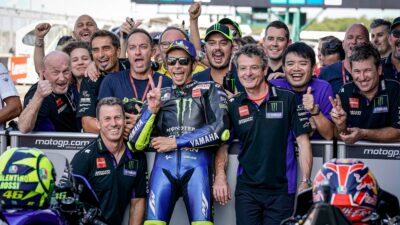
The weekend’s biggest news was hardly news at all but it was the biggest story of the weekend anyway.
After 21 years as a factory rider for Aprilia, Honda, Yamaha and Ducati, seven-times MotoGP world champion Valentino Rossi finally gets demoted to an independent team in 2021.
It had to happen, of course. Time waits for no man – not even a superhuman like Rossi – so his career could only end two ways: via retirement or via relegation from a factory team that need to sign the fastest riders with the best futures.
All racing careers are like mountains. You climb to the top, enjoy the view for as long as you can, then you descend the other side, either by tripping and falling, then plunging to the bottom with a broken body, or by gracefully taking your time, acknowledging the cheers of the crowd with every downward step.
Rossi’s mountain has been more of a plateau: he has been sauntering along elevated ground for two decades or more and he has yet to commence his comedown to join us mere mortals on ground level.
Factory riders start anew every season, building data & knowhow. Year-old bikes have a full season’s development behind them
The big question is this: is his move to Petronas Yamaha SRT really a demotion? In theory, yes. His contract remains with Yamaha Motor, so he is a full-factory rider, but he has been placed in a non-factory team, like Jack Miller’s current Ducati/Pramac contract and Cal Crutchlow’s current HRC/LCR deal.
He will therefore start the 2021 season with a full-factory YZR-M1, but all update parts will go to factory Monster Yamaha Maverick Viñales and Fabio Quartararo.
This is not necessarily a bad thing. It could be the best thing ever.
You would think that a regular supply of hardware and software improvements from the factory would help riders constantly improve their performance.
In fact, this is not always the case. In the second decade of the 21st century there is no such thing as a bolt-on part that instantly makes a significant improvement to performance. MotoGP bikes are too advanced, too refined for that. Each new part must be endlessly analysed on track and via data. And if the part does offer an infinitesimal advantage in one area it may well give a negative at another. This all adds up to wasted time and potential confusion.
I’m not criticising the factory Yamaha team, because it’s no coincidence that the squad has been in trouble ever since the switch to Michelin tyres in 2016.
The rider-friendly YZR-M1 needs friendly softer-carcass tyres to go carve its smooth, arcing cornering lines, but in early 2016 Michelin introduced a harder-carcass rear slick, after Scott Redding popped a rear in Argentina, and a year later the French company introduced a harder-carcass front slick. This was despite protests from several riders who preferred friendlier front tyres with a softer carcass.