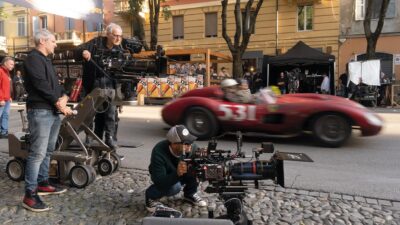
We’ve seen the movie. Now a new archive has been launched that takes us behind the scenes and unveils the making of Michael Mann’s Ferrari.
The Enzo Ferrari biopic, which is available on Sky, stars Adam Driver, Penélope Cruz and Shailene Woodley and focuses on events in the lead up to and during the final Mille Miglia in 1957. More than 30 years in the making, the project became a personal quest for influential filmmaker and car enthusiast Mann.
Now the director has chosen Ferrari to launch an archive that will eventually feature behind-the-scenes content for more of his movies. Whatever your critical view of Ferrari, and its reception was certainly mixed, Mann’s impressive and easy to navigate website certainly highlights the dedicated care, attention and genuine love for the subject that he personally invested and passed on to the team around him.
There is a maze of detail, and it represents a treasure trove for students of film and fans of movie-making. There is also plenty for us racing enthusiasts too.
Twenty mini-documentaries are available to view behind a $65 (£53) paywall, capturing the process of how (and why) Ferrari was made. They include Mann and his actors’ work on character development from rehearsals through shooting, details on set design, camera and art strategies, copies of heavily annotated scripts, notes on plot and character development, meticulous shot by shot descriptions, and – of particular interest – how the replica cars featured in the movie were made.
As Mann says in one of the videos, using real Ferraris and Maseratis for the action sequences just couldn’t be an option, because “any two of them could have financed the whole motion picture”. Others such as the Ferrari 801 Formula 1 car – in which the violent death is depicted of Eugenio Castellotti, played by a surprisingly adept Marino Franchitti – simply doesn’t exist today. The cars were made accurate by 3D scanning, research from original design drawings and even a toy model. Footage of the artisans at Campana of Modena hand-beating aluminium into body shapes shines a light on just how much effort goes into such a project. Even the cars that were crashed had to be made this way, so the damage inflicted upon them looked accurate.