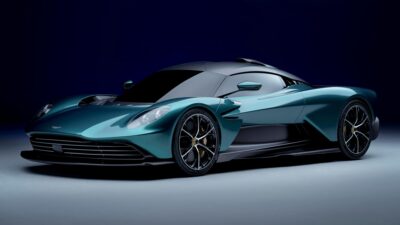
Two years ago Aston Martin announced the follow-up to the Valkyrie hypercar. It would be called Valhalla, it would be powered by a brand new 3-litre V6 engine with hybrid power attached, just 500 would be built and each would be sold for £1.2 million. To Aston Martin it was part of a carefully formulated strategy that combined with the Valkyrie project and its return to Formula 1 to ensure that by the time it launched its first series production mid-engine car – the Vanquish – the Aston Martin brand would be fully accepted as a mid-engined supercar manufacturer.
Why? Because that’s where the money is in the ultra-luxury sector of the market, around £200,000 where even posh SUVs fear to tread. Look at the core offerings therein from Ferrari, Lamborghini and McLaren and you’ll see what I mean. Before Valkyrie, the only mid-engined Aston Martin had been the Bulldog concept of over 40 years ago.
But even as the covers were being pulled off the Valhalla, the company was in trouble: sales were stalling, debt was mounting and the IPO on the London Stock Exchange had been a disaster. In time and inevitably in such unprepossessing circumstances, Andy Palmer departed the boss’s chair.
And almost a year ago now, in swept Tobias Moers from AMG and started to make the changes he felt necessary to return Aston Martin to profitability. And in few places are those changes more clearly seen than the Valhalla, the first all-new car to be signed off for production on his watch.
Yes, it’s still a carbon-fibre two-seater, but just about everything else about its specification and positioning has changed. For a start, it’s no longer powered by a brand new 3-litre V6, but a rather familiar 4-litre V8, sourced from Moers’ chums back in Affalterbach. Moers says the V6 was ‘a concept engine’, a mile away from being production-ready, let alone being able to meet the emissions challenges of the future. So what would have been the first engine designed in-house by Aston Martin since Tadek Marek’s V8 fired up 56 years ago got canned.
The V8 has 740bhp all by itself, thanks to a flat-plane crankshaft configuration first seen on the AMG GT Black Series. To that, front and rear electric motors add a further 201bhp to create a total system output, says, Aston Martin, of 937bhp. Plenty in other words.
But while it has no less power than would the Palmer Valhalla, the Moers car is going to cost about half the money with prices starting at around £600,000. How can this be done? Simply, by building at least twice as many. The Valhalla is no longer a limited edition, but a series production car. That said, I am told it is unlikely that more than 1000 will be built, not least because a roadster version will be difficult to engineer.