The word was that Mercedes-Benz might let Stirling Moss win at home as a logical way of building bridges between the two countries. There were, however, no official team orders for the 1955 British Grand Prix at Aintree forthcoming from M-B’s famed fat controller Alfred Neubauer.
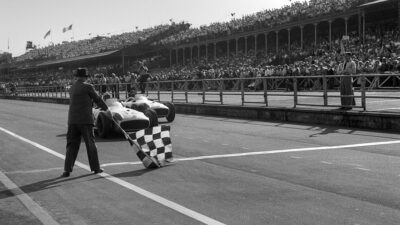
Moss crosses the line half a car length ahead of Fangio
A series taken from the 162-page Motor Sport special 100 Greatest Grands Prix
If the young Englishman were to be helped by his inestimable number one Juan Fangio, he would have to earn it. Pole position – two-tenths faster than the Argentinian superstar – was, therefore, a good start.
Moss had spent the preceding 100-lap Dutch GP grooved in Fangio’s wheel tracks: mainly learning, partly proving a point and always convinced that the maestro could pull away at will should he so wish. Aintree was different: he took the lead on the third lap. ‘Okay, let’s see what you can do.’
Fangio certainly kept him on his toes. Moss, running a shorter final drive than his team-mate and more at ease with the car’s ‘back to front’ gearbox now that an interlocking mechanism had been fitted to prevent botched changes – was driving as hard as he knew how.
The silver machines were soon in control. Only the Maserati of Jean Behra was able to harry them, and it gave up the ghost with a cracked oil pipe after only 10 of the 90 laps. Thus the way was open for another display of German superiority, albeit softened by a British twist. Moss had displayed indisputable patriotism in the frustrating early stages of his GP career. Now, if he – and Britain – were to progress at the highest level, he needed to show that he could win in top-quality machinery.
Fangio moved ahead again for eight laps – mainly teaching, partly proving a point – before Moss repassed. With clever use of backmarkers, the local hero was then able to establish a 10-second lead a little beyond half-distance.
Neubauer hung out ‘Regulare’: hold position. Was that the sign?
Then ‘Piano’: gently. No, was that the sign?
Moss throttled back, Fangio less so, and they were nose to tail once more.
On lap 88, Moss matched his pole time to set a new lap record – definitely making a point: fast and fit. Exiting the last corner of the final lap, however, and unsure of the etiquette on this loaded occasion, he hesitated, glanced and gestured. If there was a plan, be it Fangio’s or otherwise, he was not privy to it. Fangio drifted wide and crossed the line still two-tenths in arrears, neither man going flat chat.
Although nothing was said in the immediate aftermath, Moss’s gesture of placing the laurel wreath over his team leader’s shoulders spoke volumes. Many years later, he asked directly if he had been allowed to win. Fangio replied, ‘No. It was your day.’
Perhaps Fangio could have won. Perhaps Moss could have pressed home his advantage in the second half. Undoubtedly, the respect between them was total. Fangio considered Moss a worthy winner. And Moss was a worthy winner because it had not been handed to him on the plate.
Mercedes-Benz finished 1-2-3-4 that day – but it had crushed with a velvet glove. Moss and Fangio, team-mates Karl Kling and Piero Taruffi, Neubauer and designer Rudi Uhlenhaut had struck a perfect balance in every respect. That’s a rare thing in GP motor racing. PF
Gallery
Stirling Moss’s victory in the 1955 British Grand Prix at Aintree – in the words of Denis Jenkinson
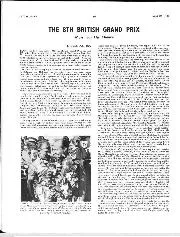
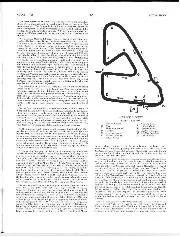
Aintree hosted the 1955 British Grand Prix, on a hot July 16. Juan Manuel Fangio arrived on a two-win run in his Mercedes-Benz W196, but rumours suggested his British team-mate, Stirling Moss, would be allowed to set the pace. Denis Jenkinson takes up the story – quotes from his original race report
Bernard Cahier/Getty Images
Qualifying: “Moss and Fangio set the pace, and they were comfortably faster than [Maserati’s] Behra, the former recording 2 min 00.4 sec, fractionally faster than the race lap record, while Fangio managed 2 min 00.6 sec”
Grand Prix Photo
Race: “On the front row were Moss, Fangio and Behra, in that order… In his usual manner Fangio shot into the lead, with Moss close behind, and Behra made a hesitant getaway.”
Bernard Cahier/Getty Images
“Rounding Country Corner Mercedes-Benz were 1-2-3-4 in the order Fangio, Moss, Kling and Taruffi. Behra swept through the field after a hesitant start and was third at the end of the opening lap, but already Fangio and Moss were off on their own.”
Keystone-France via Getty Images
“On lap three, Fangio let Moss go by and it became pretty obvious that the British Grand Prix was under control by the Mercedes-Benz team”
Daimler
“Although the first two cars were running round unchallenged they were not going slowly and Moss was having to drive impeccably to be allowed to stay in front of the World Champion”
Daimler
“On lap 17 Fangio retook the lead, probably from force of habit, or else to remind ‘the boy’ that he was still about the place”
Bernard Cahier/Getty Image
“Moss had a go to regain the lead as they rounded Tatts Corner but Fangio did not give way…”
Bernard Cahier/Getty Images
“…On lap 26 he got by at the end of the long straight and it was clear that if Moss was going to be allowed to win, he was going to have to work for it.”
Bernard Cahier/Getty Images
By lap 40 Moss had twice lapped his own [privately-owned] Maserati, driven by Macklin. On the next lap Moss increased his lead to nine seconds due to nipping through some gaps in the traffic, while Fangio had to wait”
Bernard Cahier/Getty Images
“The comparatively slow Aintree circuit, plus the heat, was taking its toll and as one car rejoined the race so another would fall out… The leaders were now signalled to slow down”
Grand Prix Photo
“Nose to tail the two short, squat-looking Mercedes-Benz completed the closing laps and as they approached the finishing line, Fangio drew up alongside Moss finishing half a car’s length behind him”
Bernard Cahier/Getty Images
“After the prize-giving Moss paid a nice tribute to Mercedes-Benz for giving him the opportunity to be the first Britisher to win the British Grand Prix…”
Bernard Cahier/Getty Images
“…and especially to Fangio for allowing him to do it.”
Having spent much of his formative years soaked and sideways in his father’s 1933 Frazer Nash TT Replica, Paul has long been in thrall to old cars and past – and current – motor racing. He joined Motoring News as junior rally reporter in 1990 and went freelance in 2005, having edited Motoring News, F1 Racing and Motor Sport in the meantime.