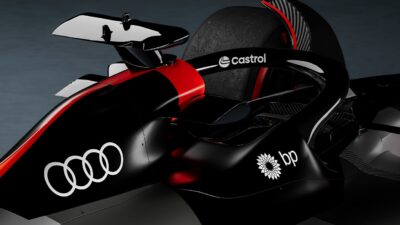
With just over a year to go until Audi's first Formula 1 car is revealed, the team has confirmed that it will set up a British outpost, joining nine of the 11 teams on the 2026 grid with a presence in 'Motor Sport Valley'
Since Audi confirmed its purchase of Sauber over the Belgian GP weekend back in 2022 there’s been a consistent line from the critics – you can’t create a successful Formula 1 operation in Switzerland, mainly because it’s so hard to tempt the best engineering talent away from British rivals.
Earlier this week the team announced an intriguing initiative that could help to make the difference. By the summer what is currently called the Sauber Motorsport Technology Centre UK, and which will no doubt eventually be given Audi branding, will be up and running.
In essence it’s a satellite engineering hub that will serve as a base for folk who are reluctant – or not able – to move to Hinwil.
It’s such a blindingly obvious solution to the perennial problem of attracting top staff that one wonders why it wasn’t the first thing that Audi did when it kickstarted the process of building up its new acquisition. Suddenly a whole new pool of talent is accessible to the team.
Sauber has struggled to attract top F1 talent, despite scenic surroundings
Sauber
And it’s a hugely competitive marketplace. Including Cadillac there are now eight UK-based teams, although Haas bucks the trend and operates a design base in Maranello to be close to the Ferrari wind tunnel.
It was tunnel access too that led to the team now known as Racing Bulls to set up a UK base in Bicester, in essence for its aero guys. However, a move last month to a brand new facility in Milton Keynes has seen an expansion to include folk with a much a wider engineering brief. Indeed chief technical officer Tim Goss is based there rather than in Faenza.
The only team with no UK presence now is Ferrari, who kickstarted the concept of a satellite operation in the John Barnard era – first with the Guildford Technical Office, and then after a break, Ferrari Design and Development.
F1 teams can now develop their 2026 cars at full pace as they aim to dominate under a new ruleset. Adam Cooper reveals the work going on in wind tunnels, and the tortuous decision facing bosses of when to pull the plug on 2025 upgrades
By
Adam Cooper
Neither is regarded as having ultimately been a success, in large part because Barnard was such a strong personality and a “them and us” culture developed. In addition communications have moved on apace since those days, and managing bases in different countries no longer as difficult as it was.
Sauber’s staffing problem stretches back to its early days. The Hinwil area is pleasant enough, but Switzerland is not for everyone, even for single people who don’t face the issue of arranging schools for kids and jobs for spouses. Also in the past it wasn’t always easy to fit in with the culture of the team itself, and the way that founder and former boss Peter Sauber liked to run things.
Some well-known names have passed through the doors over the years. Harvey Postlethwaite spent 1991 helping to set up what he thought was going to be the Mercedes works F1 team, but he left when that support didn’t materialise.
Mercedes F1 project became the Sauber team, arriving on the grid at the 1993 South African GP in the hands of JJ Lehto and Karl Wendlinger (pictured)
Grand Prix Photo
His right-hand man Mike Gascoyne stayed behind to design the first car in 1993, but he didn’t always find it easy.
“The first thing I said was, ‘We are going to be making 50-60 undertrays a year, because we’ll wear them out.’” he recalls. “And Mr Sauber said, ‘On the sports car we used to glue the undertray to the chassis and never change it all year.’
“He couldn’t get his mind around it. We designed the car, we did winter testing with it, and it was pretty quick. I then came up with a load of modifications for the first race, and Mr Sauber couldn’t get his mind around that either, and just said, ‘It’s going to cost money, and you’re just changing it for the sake of it, you’re just trying to make it look as though you’re the clever one.’
“I kept telling him, ‘It’s pretty quick now, but halfway through the season, you’ll be nowhere.’ And if you look at the results, halfway through the season they just got swamped, because they didn’t understand the rate of development.”
Monaco GP crowd gets a view of Sauber’s undertray wear in 1993
Grand Prix Photo
In late ’93 Gascoyne didn’t hesitate when Postlethwaite invited him to join Tyrrell. McLaren and Ferrari veteran Steve Nichols was also at Sauber at the time, and had a similar experience.
“We’d done this deal where I’d gone there to replace Harvey Postlethwaite, but it wasn’t working out very well,” says the American.
“I don’t know why Peter Sauber hired me, because I went there and I’m saying, ‘Well, here’s what we got to do to change the way you work, and improve things.’ And he took the attitude that I had to adapt to them!”
Audi completed its full takeover of Sauber in early 2025 and has since restructured leadership as it prepares its 2026 Formula 1 factory team debut. Here’s everything you need to know about the project
By
Pablo Elizalde
Over the years many more British-based F1 personnel would make the trip to Switzerland, but even those who enjoyed working at the team and who adapted to the local culture rarely stayed long.
Sauber was usually a line on a CV, a springboard back to greater opportunities in the UK. It’s worth noting that down the decades a high proportion of Sauber’s top technical folk have been drawn from neighbouring EU countries.
Audi’s recent recruitment drive really brought home to Mattia Binotto and the rest of the current management that moving to Switzerland was an ongoing issue for potential candidates, which is why the idea for a British base began to formulate.
Binotto (left) saw British base as crucial for recruitment
Gongora/NurPhoto via Getty Images
A new UK company was registered on December 23, with its directors listed as Markus Massouh (a longtime Audi man recently named as Sauber’s chief financial officer) and Michael Moritz (a Sauber director and Audi’s top legal guy), and the search for a suitable site began.
Sauber candidly says that it is “evaluating potential locations within ‘Motorsport Valley,’ including Bicester, Silverstone, and Milton Keynes.” The fact that the new base will be operational in the summer confirms that it will simply be an existing office building with workstations and a connection to Sauber’s IT system. An initial headcount of 40-50 is envisaged.
There’s no intention to undertake any manufacturing, which was the case with the Barnard organisations. And in contrast to the Racing Bulls UK base the aerodynamic R&D focus inevitably remains in Hinwil, where the team has a very good tunnel.
However, there’s still scope for aero people to work remotely in the UK. A LinkedIn post from a team member suggests that there are opportunities “from aerodynamic development to CFD methodology, structural analysis, technical software, and performance modelling”, adding that “senior and principal roles” are open.
Cadillac has a Silverstone base ahead of its first F1 season
It’s worth noting that incoming team principal Jonathan Wheatley knows a lot of people in the sport, and not just at his former team Red Bull. It will now be a lot easier for him to persuade them to come on board.
The Sauber news comes at an interesting time, with the arrival of Cadillac at Silverstone and expansion of the Racing Bulls Milton Keynes operation creating more opportunities and thus even more competition for talent.
That in theory should drive up salaries – however at the same time there have been rumblings on social media about the need to stay within the cost cap obliging some F1 teams to keep salaries in check, and potentially below what engineers can earn in other categories.
There’s also an unspoken cost cap element to Audi’s move. It takes a big salary to attract people to Switzerland, and employment costs are high anyway, a fact acknowledged when rivals were left frustrated last year after the team was given some leeway within the FIA’s financial regulations.
Jonathan Wheatley will arrive as Audi team principal from Red Bull later this year
Red Bull
Logic suggests that Sauber will now get more bang for its Swiss Francs by employing people in the UK. It will also be much easier for those hired on short term contracts, perhaps for special projects, to come and go. Even folk who are willing to work in Hinwil could be based temporarily at the UK office while the logistics of their move are worked out.
Will the new hub really make a difference? Only time will tell, and ultimately the team’s form in 2026 and beyond depends entirely on the performance of the power unit currently under development in Neuberg.
However in a world where marginal gains count Audi has at least cleared one of the biggest hurdles it faced.
Adam has covered the Formula 1 beat for more than a decade, attending every Grand Prix and becoming one of the most respected journalists in the paddock.