For all that grand prix racing has welcomed a clutch of bright young stars in recent seasons – Max Verstappen, Charles Leclerc, George Russell and Lando Norris have all made their mark, to various degrees – success is by no means restricted to products of the internet age.
It’s a truth that extends across the whole sport.
Lewis Hamilton is now 37 – and arguably driving as well as he has done at any point over the past 15 seasons. Fernando Alonso celebrated his 40th birthday in 2021, while performing with great distinction during his F1 comeback campaign. Sébastien Loeb recently scored his eighth Monte Carlo Rally win at the age of 47… partnered by Isabelle Garmiche, an experienced part-time co-driver who had recently turned 50. There is no reason to suppose Scott Dixon, 41, will be anything other than competitive as he pursues a seventh IndyCar title this season.
Jacques Villeneuve qualified for this year’s Daytona 500, then said, “To be able to make such a big race at such a high level is amazing. When I’m in the race car I don’t realise I’m 50, which is good. As long as it carries on like this, I can’t imagine myself stopping. It’s satisfying because there are quite a few times where I’ve been hearing, ‘Come on. You’ve passed it. Just give it up.’ No, the hunger has never stopped…”
And if it’s ill advised to be chasing further Dakar Rally wins just short of your 60th birthday, nobody seems to have told Carlos Sainz…
Top-level motor sport has never been the exclusive preserve of exuberant youth – after all, Juan Manuel Fangio was already 39 upon the motor racing world championship’s inauguration and 47 by the time he secured his fifth title. Luigi Fagioli was 53 – born in the 19th century – when he shared Fangio’s winning car in the 1951 French GP, though it would be his final world championship start. He stormed off afterwards, angry that Alfa Romeo had ordered him to hand his car over to the Argentine.
“It isn’t possible to drive at 100% for a full race around Monaco or you’ll simply crash”
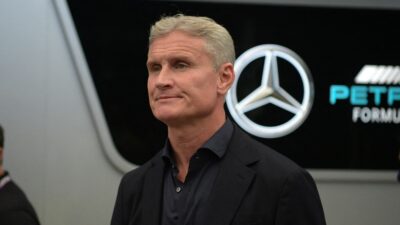
David Coulthard made his grand prix debut at 23 and stepped away in 2008, aged 37, though he raced on in the DTM touring car series from 2010-2012. He describes himself as “long since retired”, but continues to compete in the annual Race of Champions multi-discipline event and won it in both 2014 and 2018.
“I’ve no idea about the physicality of a full rally,” he says, “but when I’ve driven rallycross cars in the Race of Champions – for short distances, admittedly – I’ve found there’s nothing like the physical load on your body that you get in a Formula 1 car. Perhaps that’s why drivers such as Carlos Sainz Sr and Sébastien Loeb are still able to perform so well.
“If you have mastered the art of driving at say 99.9%, you are probably only operating at 95 or 96% in the less physical sports – and I absolutely don’t want to upset rally drivers, because I have the utmost respect for what they do. I’ve always felt they are by far the most versatile performers in motor sport because of the amazing range of conditions with which they have to cope. In F1, it’s basically hot or cold, wet or dry – and that’s it! But I do wonder whether that small margin perhaps explains why drivers are able to succeed for even longer in other disciplines.
“I think the same numbers apply on street circuits. I won in Macau and took a couple of grand prix victories in Monaco and can promise you that I wasn’t performing at 100% at any time. In my opinion, it simply isn’t mentally or physically possible to drive at 100% for a full race distance around Monaco or you’ll simply crash.”