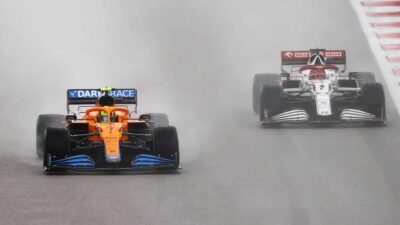
Norris in Sochi; Alonso at COTA; Räikkönen in Mugello – sport will always have its grey areas, which is why stewards should be allowed to use common sense in deciding penalties, writes Chris Medland
Stewards decision not penalise Lando Norris came in for criticism from various quarters
I’m going to leap to the defence of Formula 1 stewards today, which probably means I should be ready for some ‘feedback’ in my Twitter mentions, but this is something that has been building up a little bit over a number of races.
F1 likes to try and put everything into a black and white regulation to avoid confusion or controversy, but that’s something that is rarely going to work. Sport by its very nature often includes grey areas, and at times you have to embrace them rather than simply write more rules to try and address every single minute detail.
What that approach has done in terms of the stewarding is often back them into a corner. There can be a number of situations where an incident leads to a breaking of a rule in the way that it is worded, but quite clearly needs a bit of common sense applying. And while there are regularly calls for a ‘Common Sense Rule’ to be used in other sports, it appears to be something that F1 isn’t so keen on.
At least, Fernando Alonso definitely doesn’t seem to be keen on it.
Slip slidin’ away: Norris ended up crossing the pitlane entry line, but not intentionally to gain an advantage
Sergei Fadeichev\TASS via Getty Images
Let’s start with the catalyst of why Alonso is central to this column – The Russian Grand Prix. After Lando Norris escaped penalty for crossing the white line at the pit entry, Alonso stated: “The next one that crosses the white line on the pit entry, let’s see which nationality he is and which penalty he will get.”
I should be fair and state that Alonso wasn’t alone in raising the pit entry issue (though he was suggesting it was about nationality) as Alfa Romeo team principal Frederic Vasseur similarly felt Norris should have been penalised, citing Kimi Räikkönen’s penalty at Mugello the year before as proof.
Räikkönen got a five-second time penalty for crossing the white line at the pit entry in 2020, demoting him a position. If Norris had got the same penalty, Räikkönen would have benefitted in Russia. But I don’t think the stewards were being unfair, or even inconsistent.
Fernando Alonso’s one-man war against the stewards has built up throughout the season, spilling over in Sochi and Austin – but, as Mark Hughes writes, this apparent campaign for on-track justice makes him who he is
By
Mark Hughes
In Räikkönen’s case, he simply reacted to the safety car being deployed for an incident and dived into the pit lane after passing the entry point he should have used. It was to gain an advantage despite being beyond where the rules say he must enter the pits.
When you look at what happened with Norris, he had always intended to pit on that lap, had arguably been a danger to other cars when trying to keep his car out of the barriers on slick tyres as rain fell heavily, and he entered the pit lane at the right point. The issue was, the conditions were so bad he slid wide again at very low speed and ended up outside the pit entry, before returning to the pit lane.
Running wide lost Norris even more time, so he clearly wasn’t trying to gain an advantage – unlike Räikkönen – and the rule doesn’t address when a driver has already entered the pit lane at the correct point before ending up outside of it. What was he supposed to do, drive another lap in even worse conditions and very likely have or cause an accident? That’s where common sense was applied, because in that case the driver shouldn’t be penalised for doing the right thing. The stewards used common sense to work out if anything Norris did required a penalty – such as if he had taken the corner at a higher speed than normal to try and gain time and risked crossing the line – and decided it didn’t.
But it provoked Alonso’s comments, and the Alfa Romeo ones, and then in Austin there were similar ones from Alonso due to an incident with, err, an Alfa Romeo.
Räikkonen was penalised last year for also crossing the pitlane entry line
Grand Prix Photo
When Räikkönen tried to overtake Alonso around the outside of Turn 1, the Spaniard had to leave space because the Finn was fully alongside. But he didn’t and ran Räikkönen out beyond the edge of the track. Räikkönen attempted to stay within the lines – the pair touching as a result – and then held the inside for Turn 2 where he completed the move.
Alpine’s protests were that Räikkönen overtook Alonso off the track, when in reality Alonso forced Räikkönen off the track and the Finn overtook him anyway one corner later despite losing time.
Related article
Once again, common sense was needed. The stewards could have been as blunt as stating Räikkönen crossed the white line during a battle and therefore can’t come out on top. But that then allows drivers to defend the inside line when they’re going to be overtaken, drive the attacking car off the road on the exit even if they’re fully alongside, and ensure they can’t be passed.
It was a very different scenario to the later ones when Alonso took far too much speed into Turn 12, forcing Antonio Giovinazzi to move out of his way before he ran wide on the exit. In that case, Alonso was never completing the move by staying on track, because braking in time to make the corner would have meant he didn’t get alongside Giovinazzi. He was rightly told to give the place back, as Carlos Sainz was when defending on the outside from Lando Norris and running wider to carry more speed and keep the place.
By allowing Räikkönen’s move to stand and dismissing Alonso’s complaints, in a similar way to the Norris incident the stewards judged each case on its own merits rather than shoehorned them into a category that requires a penalty. You could even argue they’re encouraging racing, by protecting the ability of a driver to keep fighting if forced off track.
Stewards exercised their own judgement not to penalise in the Alonso/Räikkonen COTA incident
Florent Gooden / DPPI
I’d also much rather see drivers settle it themselves on track as Räikkönen and Alonso did, rather than watch the attacker back out and complain on the radio, knowing the stewards were going to tell the defending driver to move over for them as they hadn’t left space.
It’s still not a perfect solution, because there won’t ever be one. And there will always be arguments among those involved and fans alike as views on what constitutes ‘common sense’ differ, especially when the stewards change each weekend.
But the stewards shouldn’t be criticised for actually looking up from the rulebook and judging what they see before them in context. If anything needs adding to the regulations, it’s a clause allowing them to use common sense. After that, we can continue debating whether it was correctly used or not.
Going freelance in 2015, he's now RACER's F1 correspondent, works with Formula 1's channels as well as SiriusXM's broadcast coverage in the US, and made far too many appearances in the first season of the Netflix F1 documentary.