While the Dutchman is 12 points behind Norris, with Piastri four further back, history has shown that fate often favours the underdog, the challenger with nothing to lose.
In 1950, 1964, 1986, 2007 and 2010, the driver in prime position heading into the final race hasn’t capitalised, 1959 being only the time the championship leader with one round to go has ultimately been crowned.
A small point to note is that Didier Pironi was still mathematically in with a chance of winning the 1982 title in the final round against Keke Rosberg and John Watson, but the Frenchman had stopped competing midway through the season due to his serious accident at Hockenheim.
Here are the incredible tales of F1’s three- and four-way title battles.
While Fangio’s Alfetta expired, Farina cruised home to the victory, becoming a unique champion who left a lasting impression on his competitors.
“He was a great driver, and I loved his style at the wheel – that relaxed, arms outstretched way he had. I thought it looked so good that I copied it!” Stirling Mosstold Motor Sport.
“On the track, though, Farina was a bastard, completely ruthless – dangerous.
“And the worst of it was that he’d behave exactly the same way with an inexperienced guy. If he was lapping you, boy, you’d better make sure you didn’t get in his way – he’d just push you off the road.
“In those days there genuinely was a different attitude to what we used to call dirty driving, and you really didn’t come across it very often. But he was something else.”
On the race start, Brooks had to pit early after Ferrari team-mate Wolfgang Von Trips on lap one, while Moss pulled out a gap on Brabham to lead before gearbox troubles hit.
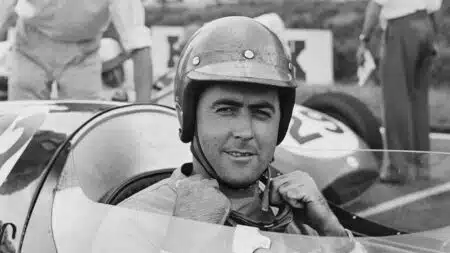
Brabham was leading when his Cooper ran out of fuel on the last lap, but wanted to finish — so he pushed it over the line in the sweltering heat for the last few hundred yards.
“Jack just knew that he had to get across the line,” his son David told Motor Sport. “And at the time, he didn’t know that he’d won the world championship, not a clue. He didn’t know where everybody really was, where he was positioned. He just knew he had to push the car and get across the line to get a result.
“He was making sure no-one touched the car (to avoid disqualification), he pushed, got across the line and to his surprise…
“You’ve got to remember they were long races back then. The radiators were in the front of the car, so there’s a lot of heat coming through to their feet.
“They had different issues to what we have today. Okay, so now there’s more Gs, there’s more load, but they still had their pain thresholds.
“It was hot. You can see by the picture of him sitting on the ground, with people around him – he was toast, absolute toast. He would have been toast before he even ran out of fuel.”
Clark led from the start, while Surtees’ team-mate Lorenzo Bandini rear-ended Hill, taking him out of the reckoning.
With two laps to go, Clark was leading with Surtees in fourth, enough for the Scot to secure his second title. Then, as was often customary with Lotus, mechanical disaster struck, an oil line failing on his 33.
The Scot’s competitors rushed past, leaving the order as Dan Gurney – Bandini – Surtees. Hill would have been champion with the cars placing in that order, but Ferrari quickly cottoned on.
The Scuderia ordered Bandini to slow to allow Surtees into a championship-winning position. The Brit clinched a sensational title win, making him the first — and still only — world champion on two and four wheels.
Such was the furore, people barely noticed that Gurney had just taken the Brabham team’ss first ever world championship race win.
Two-time champ Piquet had taken umbrage at the fact Williams refused to impose team orders on Mansell, while the Brit felt the Brazilian’s mind games simply weren’t cricket.
Heading into the season finale, the Brit was in the box seat. Mansell only needed to finish third to clinch the title, while his two rivals needed at least a race win to stand any chance.
After a frantic race start Mansell was running third, and on course for his first championship.
Things got better when Prost got a puncture while running second – the first sign that all was not well with the Goodyear tyres.
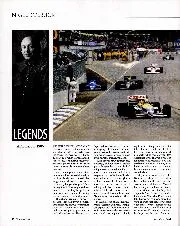
“Problem was, we had quite a big power advantage — and therefore we were also able to run more downforce than anyone else,” former Williams technical director Patrick Head told Motor Sport.
“Honda couldn’t tell us how much power we had, because they didn’t know themselves! Their dyno only registered up to 1000 horsepower — which they were reaching at 9300rpm. We were revving them to 13,500 or so! I’ve no doubts that it was because we were able to run so much downforce that we encountered tyre problems.”
Keke Rosberg, leading his last ever F1 race, then got a puncture too, before disaster struck for Mansell a lap later. His left rear exploded on the Decquetteville Straight at 190mph, and his race was over.
Williams immediately stopped Piquet for a precautionary tyre change from a title-winning race lead, allowing Prost home to first place and championship glory.
“It was the right decision to stop,” Piquet said. “I knew I was maybe losing the championship, but I didn’t care; I was alive.”
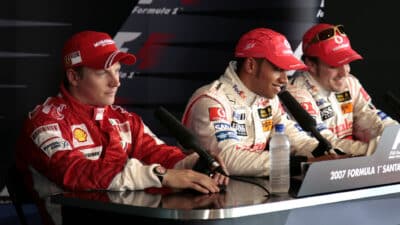
Kimi Räikkönen beats Lewis Hamilton and Fernando Alonso
Raikkonen claimed victory in a fierce 2007 season
Grand Prix Photo
Not only a famous three-way title scrap, 2007 is remembered simply as one of the best championship fights of all time.
In a similar way to the Williams bout 21 years earlier, two-time champ Fernando Alonso had expected his new McLaren team to give him preference.
However, such was the brilliance of his rookie team-mate Lewis Hamilton, the team felt obliged to allow the pair a fair run at it.
The joker in the pack was Ferrari’s Kimi Räikkönen, who was some way behind the McLaren pair but still in contention.
With Fernando Alonso crashing out of the wet Japanese GP at Fuji, Hamilton went into the penultimate round at China with a 12-point lead on Alonso and a 17-point margin the Finn.
The Shanghai race ended in disaster for Hamilton, as he slid off into the gravel trap and out of the race at the pit entrance on worn wet tyres after his McLaren team left him out too long.
Räikkönen won China with Alonso second, meaning Hamilton had four points on his team-mate and seven on the Ferrari driver heading into the finale in Brazil.
Though he qualified second for the deciding GP, ahead of Räikkönen and Alonso, Hamilton had a horrific first lap, going off track and falling to eighth. A few laps later he had a gearbox issue which dropped him further back to 18th.
The gremlin then appeared to resolve itself, and Hamilton began fighting back up the order, but only up to seventh, at the time worth two points.
Ferrari then imposed team orders to secure the title, Räikkönen having been second behind team-mate Felipe Massa.
The Scuderia ordered a switch to give him the points he needed, and the Finn managed to clinch an unlikely title victory, leaving McLaren stunned.
Sebastian Vettel beats Fernando Alonso, Mark Webber and Lewis Hamilton
Vettel clinches a thrilling 2010 title
Red Bull
The only four-way title finale in history.
The rise of Red Bull, the return of McLaren and Fernando Alonso pulling Ferrari up by its bootstraps, meant that the Spaniard, Sebastian Vettel, Mark Webber and Lewis Hamilton all had a chance of taking the 2010 championship.
Alonso was in prime position with an eight-point lead on Webber, with the Australian’s Red Bull team-mate Vettel seven points further back. Hamilton’s prospects were remote, needing a win, and for Alonso to finish out of the points.
Vettel led at the start from Hamilton with Alonso in fourth and Webber fifth. Alonso elected to pit early on lap 15, in a decision that would prove disastrous.
He emerged in 12th behind Renault’s Vitaly Petrov — and would be stuck there for another 30 laps. This gave Vettel, who had only the third-best title prospects going into the race but was now leading, a clear run at the title.
“Use the best of your talent. We know how big it is,” implored now-McLaren boss, then-Alonso’s race engineer Andrea Stella on the radio, knowing that the Spaniard desperately needed to overtake Petrov and press on.
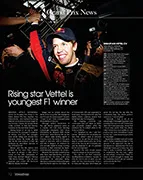
It was to no avail though. Alonso simply couldn’t get past the Russian, and Vettel became F1’s youngest ever champion.






 Great Read