


Archive
1960 Monaco Grand Prix race report: Stirling streets ahead
Being the first major Grand Prix of the European season, everyone was out in full force and the entry list was one of the most interesting seen for some time.…

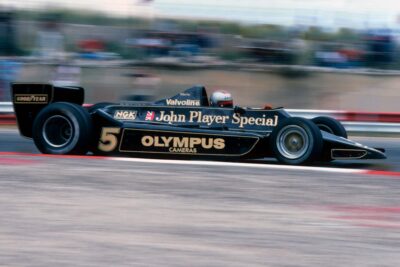
Mario Andretti during the 1978 French Grand Prix
DPPI
At the 1960 Monaco Grand Prix, 60 years ago today, a Lotus won in Formula 1 for the first time. It wasn’t a success for the Team Lotus works squad, rather the win was taken by Rob Walker’s privately-entered Lotus piloted by none other than Stirling Moss. The works team indeed had to wait nearly another 18 months for its first F1 world championship Grand Prix victory.
But Team Lotus since can be said to have made up for the tardy start, as Lotus chassis went on to take 79 wins while Team Lotus claimed 13 world championships. And there was much more to Lotus even than these great results, as the history of Lotus F1 cars also plots much of F1’s string of key technical innovations.
The pioneering engineering and breadth of invention can be shown with five of the cars, starting with the Lotus 18, which claimed that first historic win.

Moss leading the 1960 Monaco GP on the way to a dominant victory
Grand Prix Photo
Let’s start at the beginning, with the car that was taken to the first Lotus F1 win. Stirling Moss in a Rob Walker Lotus 18 won the 1960 Monaco Grand Prix imperiously by almost a minute – despite intermittent rain and an unscheduled pitstop to sort a detached plug which dropped him a cylinder – having claimed pole position by a second.
And, of course, one year on at the Principality Moss again used a Lotus 18 to beat Ferrari to Monaco victory in a drive that firmly entered folklore, before then doing something similar at the Nürburgring Nordschleife.
Yet the 18 was a significant car in of itself too. It was Lotus’s first mid-engined competitor and was a marked improvement on its predecessors. And it helped Lotus get runner-up in the F1 constructors’ table in both 1960 and ‘61. Though, it has to be said, this also owed much to Moss.
The 18 had success outside of F1 too, particularly in Formula Junior and it is thought that some 125 FJunior Lotus 18s were turned out…

Jim Clark tackling Spa in 1964
Getty Images
The monocoque – that is, using a car’s outer skin as its structure – is now standard in Formula 1. But F1 cars instead used to have a spaceframe, made up of a network of tubes.
The monocoque long existed elsewhere before anyone in F1 thought to use it, for one it had been standard in aviation for half a century. Lotus boss Colin Chapman, though, got the idea to use it when he was surprised how stiff the monocoque of the Lotus Elan sports car was for its weight when torsion testing it.
The Lotus 25, introduced in 1962, was the first monocoque F1 car. Somehow though, Chapman neglected to mention its benefits to Lotus customer teams, which he’d just sold spaceframe Lotus 24s to and assured them there was virtually no difference with the 25. John Cooper, upon looking into the 25’s cockpit, said: “I see what you mean, you just forgot to put the chassis in this one”.
The monocoque had several benefits. It was much stiffer as well as allowed the car to be lighter and much more compact. The last point was Chapman’s main motivator, as he wanted to achieve a smaller frontal area – he got it down by 17 per cent – and make up for F1’s 1.5-litre engine spec brought in the previous year which left cars somewhat breathless on the straights.

Ronnie Peterson gets some airtime at the Nürburgring in 1973
Getty Images
One can only imagine what contemporaries must have made of the Lotus 72 when it was unveiled in 1970. And as is appropriate for such a giant forward stride, the car stood the test of time in every sense.
You can make the case that this is the first machine with what we would consider the look of the modern F1 car. Chapman and Maurice Philippe had the idea to move the water-cooling radiator from the front of the car to the sides, allowing a wedge-shaped nose to reduce drag and lift as well as improved airflow over the car to the rear wing. The 72 even had a very modern-day-looking airbox behind the driver’s head.
Jochen Rindt in ‘70 took a crushing, but posthumous, title. And the car was still winning multiple grands prix as late as 1974. In total it bagged three constructors’ titles, two drivers’ crowns and a full 20 world championship grand prix wins. It is reckoned to be F1’s most successful car, as well with its five-year spread of victories the most enduringly successful. Team Lotus still was using it at the conclusion of the 1975 season.

Mario Andretti leads team-mate Ronnie Peterson at Zandvoort
Getty Images
When F1 first employed negative-incidence aerodynamics in earnest in the late 1960s it was almost entirely via airflow over the car. But not everyone saw it that way. Designers Peter Wright and Tony Rudd at BRM explored turning the entire car shape into a wing.
For various reasons their initial efforts didn’t work, nor did a similar attempt on the March 701. Yet by the mid-1970s Wright and Rudd were at Lotus, with access to its resources as well as had a boss in Chapman who, with the team amid a barren spell, was keen to find the next unfair advantage. Wright and Rudd after extended hours in Imperial College’s wind tunnel discovered that sealing the sides of the car to keep the low pressure sealed in was crucial, which in time was done with flexible sliding skirts. The increases in downforce were astonishing and the drag penalty was minimal.
The Lotus 78, raced in 1977, was the year’s pacesetter and should have won the championships, but had unreliable engines. But come 1978 this, plus a few other problems such as the car’s high drag, was sorted with the Lotus 79. Lotus cantered to a championship double. It was, it turned out, the team’s final titles.

Ayrton Senna during practice for the 1987 Monaco GP
Getty Images
Unlike most of the rest of this selection, this one didn’t achieve lavish success. But it demonstrated that Lotus’s capacity for important innovation carried on almost to the end.
‘Active’ computerised suspension kept the car at an optimum ride height over bumps, through corners and the like, instead of using more standard dampers and springs. Lotus first developed the system from 1981, in a ground effect era wherein consistently shallow pitch-free ground clearance was vital.
It was used on one Lotus car in 1983’s opening two rounds; Chapman had reckoned its one non-turbo powered car needed an extra something. But it proved heavy, underdeveloped and unreliable and therefore returned to the backburner.
Come 1987 Lotus brought active suspension back on the 99T – largely at the behest of then-owner General Motors which perceived benefits for Lotus cars – and Ayrton Senna bagged two wins while Williams somewhat honoured it by imitation with its ‘reactive’ system late in the year. Yet Senna’s success was widely considered to be in spite of active suspension, which remained weighty and cost both power and developmental attention. It wasn’t a dead duck, however, as come 1992 the mighty Williams FW14B got its system right and trounced all opposition.

Try to imagine your ideal street track, and the only limits are your imagination. It would be fast and challenging; a touch daunting. It would have sharp gradient changes –…

Just when Formula 1 is feeling really predictable, it serves up a reminder that nothing is a certainty in this sport. Max Verstappen reminded his race engineer Gianpiero Lambiase to…

Formula 1 celebrates the 70th Anniversary of the World Championship at Silverstone this weekend: where seven decades ago the first points were awarded following the Grand Prix d'Europe. The rules…

Formula 1 returns to Silverstone to celebrate 70 years since its first World Championship race this weekend. The circuit has hosted many a grand prix thriller through the years —…