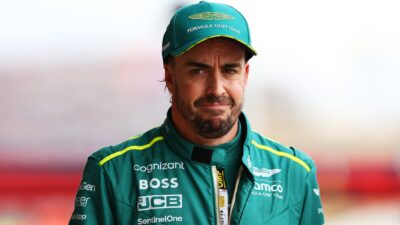
Fernando Alonso enters his 400th F1 grand prix this weekend. He's dwelling less on the past and more on how to win a third championship with Aston Martin, still feeling "privileged" to drive every lap
"Every lap you do, you feel privileged to do it" — Alonso at his 399th grand prix in Austin
It will be hard to miss the fact that Fernando Alonso reaches an impressive landmark in Mexico City this weekend as he logs his 400th grand prix.
It’s easier these days to rack up high numbers given the length of the F1 calendar, but consider too that the Spaniard has missed three complete seasons since his debut with Minardi in 2001.
He sat out at the following year as a Renault test driver waiting for a vacancy to open up, and then in 2019 and 2020 after leaving McLaren he sampled other forms of motor sport, notably WEC with Toyota. Those three years out of F1 cost him 55 more potential starts
The plan is that he’ll race at least to the end of 2026 with Aston Martin, which should take him to 452 races. Thus without those lost years he would potentially have reached 507 at the end of his current contract.
The flipside is that had he raced in F1 in 2019-’20 he might not be competing now, never mind in 2026. Only he knows for sure, but that little diversion into WEC almost certainly extended his career.
A Le Mans winner, alongside Kazuki Nakajima and Sebastien Buemi in 2018. They won again the following year
Toyota
Minardi gave Alonso his F1 debut in 2001
Getty Images
Aston Martin is Alonso’s sixth F1 team
Aston Martin
Two years away from the relentless grind of the grand prix schedule, while keeping his hand in other forms of racing, provided enough of a reset to ensure that he came back hungrier than ever. The other world champions who raced into their 40s in the modern era, Michael Schumacher and Kimi Räikkönen, also returned from timeouts that ultimately helped them to compete in F1 for longer.
Among the many remarkable statistics associated with Alonso’s career is that it’s been 18 years since he won the second of his two world championships with Renault. He came close, of course, losing out at the final round in his first McLaren season in 2007, and finishing runner-up three times in his Ferrari years.
In 2001, Paul Stoddart took the Minardi F1 team from meltdown to Melbourne in six weeks. He tells James Elson how they created the beautiful PS01 and gave Fernando Alonso his grand prix debut
By
James Elson
It’s that burning desire to win a third title that has kept him going, and that has driven his career decisions, even if some of them look a little misguided in retrospect.
He believed that the McLaren-Honda reunion in 2015 would repeat the glories of the Senna era, he believed that Alpine would at the very least give him a race-winning car in 2021, and he believed Aston Martin could only make upward progress on the back of Lawrence Stroll’s ambition.
The run of podiums he earned last year with Aston suggested that he’d finally got his timing right, although the team has fallen back this season, and it’s been a bit of a struggle. However, he has his sights firmly set on the bigger picture of 2026, with Honda and Adrian Newey. At that stage he really could be in the right place at the right time.
Another 2023 podium for Alonso at Zandvoort
Aston Martin
Reflecting on his impending 400th race in Austin last weekend, Alonso made it clear how much having a winning package would mean to him.
“This is obviously nice, and I acknowledge the number,” he said. “Some of these statistics you are not really interested in. I would love to race half of the 400 and win one more championship, or win more races. That’s the important statistics that you want to achieve.
“But at the same time, it shows my love for the sport and the discipline of trying to perform a very high level for 20-plus years.
“And, yeah, hopefully I can celebrate in Mexico a good weekend, and not as we normally say cheering for the next 400, because it will never happen, but at least 40 or 50 more with the next two years coming.”
Fernando Alonso admits that he’s not the fastest F1 driver in qualifying, nor the best in the rain. But it’s his ability to drive close to the peak in almost any car, in any condition, that keeps him at the sharp end of the grid, says Mark Hughes
By
Mark Hughes
His celebrations in Mexico had a low-key start after Alonso pulled out of his Thursday media appearances due to illness, but he’s expected to be at the track for Friday practice and extend his record of the most GP entries in F1 history (he’s already 46 ahead of Kimi Räikkönen who sits second on the list).
As noted, last year he was in a position to challenge for podiums at the majority of the races. You’d think that hunting for the odd point or two, as he has been obliged to in 2024, would sap his motivation. However, he doesn’t see it that way, and for good reason. It’s all about the future.
“The hope that is always there,” he said. “Obviously, in terms of positions and efforts, you will say that it’s not worth fighting for P12.
“But if that P12 gives any insight to the team of what we are missing, if you are fighting with other cars, and you see some weaknesses, some strengths, you can feed back to the team and you can improve for next race or next year, that’s already worth doing it.
“And it’s that hope that next year is going to be your year, it keeps you alive and it keeps you motivated. As well, with the 900 people working at the factory, they are not really counting on P12 or winning races.
“They are doing the best they can every single day, from 8-to-5, to provide the best car possible.
“So every lap you do there, you feel privileged to do it, and you represent a team and a brand, in this case, with Aston Martin, and you’re happy to give your 100% every lap for whatever position is at the end.”
Alonso has consistently been Aston Martin’s leading driver, regularly outqualifying and outscoring team-mate Lance Stroll
Aston Martin
Given that he continues to outperform Lance Stroll, and is often the fastest of the drivers outside the top four teams over one lap, you don’t doubt that commitment.
Alonso has raced through a bunch of different regulation eras, and he’ll sample yet another in 2026.
As much as he’s been able to adapt along the way he does miss the early days, having won his first title with V10 power.
An unexpected bonus during the Abu Dhabi GP weekend was the appearance of Fernando Alonso in the Renault R25 with which he won the 2005 World Championship. It was supposed…
By
Adam Cooper
Asked in Austin what he misses he didn’t hesitate: “Refuelling, fast cars on Sundays, the sound of the engine, bigger sponsors, grid girls – and grid boys because we have had both, I think I remember in Valencia in 2012!
“I don’t know, it was some different marketing. And now it’s all about social media and things like that. Before it was a little bit more into the real world.”
Perhaps realising that he was in danger of biting the hand that feeds him he switched to glass half-full mode.
“I think we’re in a good place now,” he continued. “Sport and F1 is very popular now around the world, especially in the US. This is thanks to Liberty Media and all the actions that they are making.
“Teams are now very professional, a lot of discipline, budget caps, so I think we are probably in the best moment of F1.
“But it’s true that in the past, especially with the pitstops giving you a lot of strategy possibilities, starting with higher fuel loads or lower, going for three stops, one stop, we didn’t have to manage as much as we do now.
V10 power and less tyre management: Alonso in the halcyon season of 2006 with Renault
Grand Prix Photo
“We raced with 30 kilos for pole, and the qualifying versus race pace was one second slower, something like that.
“Now between the battery and the fuel load, sometimes in the races we are seven seconds slower or something at the beginning of the race. And that is a little bit less motivating. As I said, different eras, different technology. But the best moment of the sport probably is right now.”
He also offered an intriguing insight into the physical impact of having raced for so long – suggesting that latterly it’s not actually been as hard as it once was.
“Not good for your back, for your neck, for your spine,” he said. “I think F1 technology also changed in the past, and I think the cars are now a little bit more friendly with the driver.
“It’s true that the ground effect cars, they are a little bit harder, but apart from the last two years, I think technology did change as well, seat comfort, safety equipment, helmets, everything has been evolving into a better place for the drivers. So that’s a good thing.
Related article
“And then I think the pace of the car on Sundays is so slow compared to the past, when we put the fuel, we have to save tyres and save energy and so on, so that the only stressful time in the weekend, physically or demanding, is normally qualifying.
“And it’s very short, so it’s not a problem of keeping up with the youngsters in terms of physical conditions.
“It’s more mentally and travelling and events and pressure, that is probably the thing that hits you harder at this time, and probably stops you racing at one point.”
The 400 GP tally is an impressive number, but there are plenty more to come in the Alonso career. The start of the 2026 season will mark an astonishing 25 years since his grand prix debut, the equivalent of Lewis Hamilton and Sebastian Vettel being on the grid in 2032, or Max Verstappen in 2040. Or indeed Franco Colapinto and Ollie Bearman, both born long after Alonso first raced at the top level, still competing in 2049.
In July 2026 he will hit 45. The prospect of him enjoying a winning package – perhaps the winning package – at that age is an enticing one, not just for the man himself, but for all of us too. What a remarkable sporting story that will be…
Adam has covered the Formula 1 beat for more than a decade, attending every Grand Prix and becoming one of the most respected journalists in the paddock.