Speaking in this month’s F1 season preview podcast, Motor Sport’s grand prix editor emphasises how the Scuderia’s solution to its power unit issues will be the key to unlocking the performance it needs to take on the reigning world champions, in an period of technical regulations when performance upgrades are not permitted.
Motor Sport’s expert panel explore the big questions ahead of the first grand prix of 2023 — stream our Formula 1 season preview podcast now
By
Motor Sport
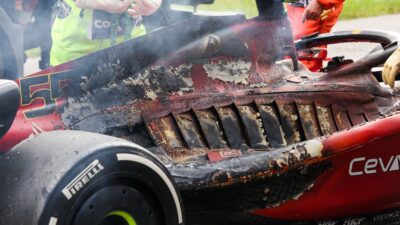
Last year Ferrari had several high-profile engine failures, including while Charles Leclerc was leading in both Spain and Azerbaijan, and when team-mate Carlos Sainz was heading for the runner-up spot in a Scuderia 1-2 in Austria.
Thereon, the Italian team reportedly had to turn its engine down, running at a lower horsepower output so it could make to the end of races.
Now it’s widely thought the issues holding Ferrari back has been overcome, apparently putting an extra 30bhp on tap.
“I think Ferrari was saying that’s how much they detuned it by,” remarks Hughes, emphasising how reliability equals performance.
“What they’re getting at is a very sensitive subject, isn’t it? Because in theory, you can’t do performance developments, but you can do reliability developments. But of course, if it’s more reliable, you can run it harder.”
Leclerc will be hoping to challenge the Red Bulls via a full-force power unit
Ferrari
The grand prix editor also highlights where the bhp figure initially came from.
“Ferrari was implying that it was two tenths slower after Baku because it had to protect the ERS-H, and I think that’s been translated to about 30bhp,” he says.
“But it’s not really like that with hybrid units, because it’s about where the power is, and where you fill it in with the electrics and all that.
“So it’s maybe not 30 horsepower but it will, I think, be significantly better than it was post-Baku back [last year]. Pre-Baku of course, it was clearly the fastest engine and the best engine but of course, there’s not much point in that if it doesn’t last.”
However, despite optimism from the Ferrari camp that it has fixed its engine gremlins, Hughes warns that there’s always potential for new problems to present themselves.
“It’s conceivable that Ferrari hasn’t properly nailed the reliability problems or the strategy problems,” he says.
“It’s still up in the air and I think that’s why this is always such a fascinating point of the year, where you’re thinking ‘How’s it going to be?’
“Because once it’s happened it becomes the norm very quickly, [even] if there’s like a shock like last year, just how quick that Ferrari was at the start.”