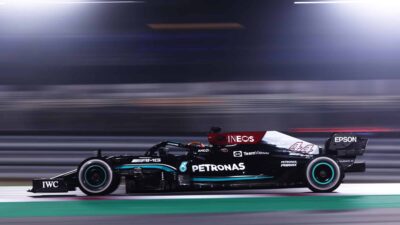
There remains much intrigue as we head into the final two races, with Mercedes and Lewis Hamilton in the ascendancy, about just where that big performance leap between Mexico and Brazil came from. Commonly cited in Brazil was a potent fresh power unit and/or a flexible rear wing.
But at Qatar a week later we know that neither of those things applied – the old high-mileage PU4 from Turkey, Austin and Mexico was back in the car there and the experimental new FIA flex test introduced there (to cover off what Red Bull believed Mercedes was doing) was comfortably passed by everyone. Yet still Hamilton was conclusively faster than title rival Max Verstappen by the second-highest margin he’s enjoyed all year, second only to Brazil and not by much. Yet the Mercedes appears to be identical and hasn’t benefitted from any outward development parts since Silverstone.
Why has it suddenly been able to put Red Bull-Honda and Verstappen on the defensive? Without any apparent upgrade to either car, Mercedes has found around four-and-a-half tenths on its rival. A little of that (0.13sec) is down to the Red Bull being off song at those two races compared to its seasonal average if we reference it to the best of the non-Mercedes field. That still leaves Mercedes having found over 0.3sec from somewhere in one step.
“When we looked at the aero package, the mechanical package, the power unit, couldn’t see why were we so poor”
Toto Wolff referred to events in Brazil – where Hamilton was disqualified from qualifying for a DRS infringement and made to start from the back – having ‘released the lion’ in Hamilton and while there’s probably some title fight propaganda about that comment, there probably is a measure of driver performance to it. So that means he wasn’t performing as well prior to these two races and he’s suddenly stepped it up, revealing his earlier performances to be sub-par? Not quite, no.
There is an important difference between a driver getting the most from a car and a driver experiencing a car which behaves in exactly the way he can best express himself and finding more. It can be as simple as a better baseline set-up which might be worth next-to-nothing in theory, but which allows the driver access to his own special abilities which were otherwise irrelevant with the car as it was.
In preparation for Brazil this year, Mercedes did do a fundamental rethink on set-up. Specifically for that track, as related by trackside engineering chief Andrew Shovlin at the time.