


F1
What are F1’s fastest circuits?
The Formula 1 world championship has 24 of the fastest races on earth – but which tracks are the quickest of them all?

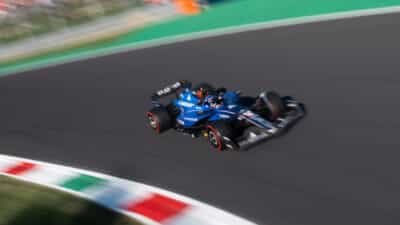
Albon has the highest top speed of 2025
Grand Prix Photo
Across the 2025 Formula 1 season, top speeds through the speed trap and record-breaking average laps have shown just how quick the current generation of cars really is, despite increasingly complex regulations.
At the sharp end, some circuits have produced speed trap figures nudging past the 223 mph (360 km/h) mark.
The fastest of the year so far came at Monza, where the slipstream effect and low-drag set-ups saw drivers crest 225 mph (362.4 km/h).
High-speed venues like Baku and the Red Bull Ring weren’t far behind, with readings consistently above 217 mph (350 km/h) – a reminder that the cars’ straight-line performance remains phenomenal.
It’s not just about top speed, though. Average lap speeds provide an even clearer picture of performance evolution.
Monza retains its reputation as the “Temple of Speed” with the highest average race lap of the season – over 160 mph (259 km/h) – but other circuits such as Silverstone and Spa have also posted incredible averages.
Car: Red Bull RB21
Driver: Max Verstappen
Event: 2025 Italian Grand Prix qualifying at Monza
Average Speed: 164.496 mph (264.681 km/h)
The fastest lap ever recorded in Formula 1 – based on average speed over an entire lap – now belongs to Max Verstappen in the Red Bull RB21.

Verstappen set a new fastest-lap record at Monza in 2025
Grand Prix Photo
During qualifying at the 2025 Italian Grand Prix, Verstappen clocked a record-shattering lap of 1min 18.792sec, averaging 164.4 mph (264.681 km/h) at Monza, beating the previous record set by Lewis Hamilton in 2020.
Car: McLaren MP4-20
Driver: Juan Pablo Montoya
Event: 2005 Italian Grand Prix at Monza
Top Speed: 231.52mph (372.6km/h)
The fastest official F1 race speed remains Juan Pablo Montoya‘s 231.52 mph (372.6 km/h) set at Monza in 2005 with a McLaren-Mercedes.
Achieved on Monza’s long straights in low-downforce trim, that benchmark came during the V10 era, when cars were at their most aerodynamically efficient and engines revved well beyond 18,000 rpm – a combination that has yet to be matched in race conditions.
Unofficially, Valtteri Bottas exceeded that at Baku in 2016, hitting 234.9 mph (378.03 km/h) on telemetry, though not as a race weekend record.
The top speed was reached during practice, aided by Baku’s 2.2-km main straight and a powerful slipstream, meaning it didn’t count as an official race weekend record but still stands as one of the highest speeds ever recorded by a modern Formula 1 car.

Honda’s RA106 holds the fastest top speed of any F1 car
Bonhams
A modified F1 car, the Honda RA106 from 2006, reached an outright record of 246.908 mph (397.360 km/h) at the Bonneville Salt Flats in 2020, but this was a special non-GP run with unrestricted V10 power.
This was a specially prepared high-speed run, with the car fitted with minimal downforce, long-gearing, and an engine producing well over 900 bhp. The attempt, part of a record-breaking project by Honda team, remains the highest verified top speed ever achieved by an F1 chassis.
The highest speed recorded so far this season was 226.4 mph (364.1 km/h), set by Alexander Albon at Monza.
The figure came through the speed trap at the end of the start-finish straight, where the cars reach their maximum velocity thanks to Monza’s low-drag aerodynamic set-ups and long DRS zones.
Albon’s benchmark underlines just how efficient current ground-effect cars have become, despite carrying more drag than the V10 and V8-powered cars of the 2000s.
Below is a table looking at the top speeds on each race of the 2025 season.
| Venue | Driver | Team | Speed trap |
|---|---|---|---|
| Australia | Lewis Hamilton | Ferrari | 194.1 mph (312.5 km/h) |
| China | Lewis Hamilton | Ferrari | 218.6 mph (351.4 km/h) |
| Japan | George Russell | Mercedes | 193.4 mph (311.6 km/h) |
| Bahrain | Kimi Antonelli | Mercedes | 211.3 mph (340.2 km/h) |
| Saudi Arabia | Isack Hadjar | Racing Bulls | 213.6 mph (343.8 km/h) |
| Miami | Alex Albon | Williams | 214.4 mph (345.1 km/h) |
| Emilia Romagna | Oliver Bearman | Haas | 190.7 mph (306.9 km/h) |
| Monaco | Lance Stroll | Aston Martin | 181.2 mph (291.5 km/h) |
| Spain | Esteban Ocon | Alpine | 213.4 mph (343.3 km/h) |
| Canada | Gabriel Bortoleto | Sauber | 214.2 mph (344.4 km/h) |
| Austria | Oscar Piastri | McLaren | 199.9 mph (321.8 km/h) |
| Britain | Oliver Bearman | Haas | 213.8 mph (344.1 km/h) |
| Belgium | Nico Hülkenberg | Sauber | 199.8 mph (321.6 km/h) |
| Hungary | Nico Hülkenberg | Sauber | 198.3 mph (319.0 km/h) |
| Netherlands | Lance Stroll | Aston Martin | 209.3 mph (337.0 km/h) |
| Italy | Alex Albon | Williams | 226.4 mph (364.1 km/h) |
| Azerbaijan | Lando Norris | McLaren | 207.6 mph (333.9 km/h) |
| Singapore | Pierre Gasly | Alpine | 190.0 mph (305.8 km/h) |
While top speeds continue to edge close to historic highs, laptimes in 2025 paint a more nuanced picture.

Some records (like Leclerc’s at Baku from 2019) still stand
Grand Prix Photo
In many cases, the fastest laps of the current ground-effect cars remain a few tenths shy of the outright circuit records set during the ultra-light, high-downforce V10 and early hybrid eras.
However, at several venues, the 2025 machines have come remarkably close – and in a handful of cases, even eclipsed previous bests thanks to evolving tyre compounds, refined aero packages, and increasingly efficient hybrid systems.
The table below compares this season’s fastest race laps to the standing track records, highlighting where modern performance is closing the gap – and where it still falls short.
| Circuit | Fastest Lap 2025 | Driver (2025) | Absolute Lap Record | Driver (Record) | Year |
|---|---|---|---|---|---|
| Albert Park | 1:22.167 | Lando Norris | 1:19.813 | Charles Leclerc | 2024 |
| Shanghai | 1:35.454 | Lando Norris | 1:32.238 | Michael Schumacher | 2004 |
| Suzuka | 1:30.965 | Kimi Antonelli | 1:30.983 | Lewis Hamilton | 2019 |
| Sakhir | 1:35.140 | Oscar Piastri | 1:31.447 | Pedro de la Rosa | 2005 |
| Jeddah | 1:31.778 | Lando Norris | 1:30.734 | Lewis Hamilton | 2021 |
| Miami | 1:29.746 | Lando Norris | 1:29.708 | Max Verstappen | 2023 |
| Imola | 1:18.589 | George Russell | 1:15.484 | Lewis Hamilton | 2020 |
| Monaco | 1:13.221 | Lando Norris | 1:12.909 | Lewis Hamilton | 2021 |
| Barcelona | 1:15.743 | Oscar Piastri | 1:15.743 | Oscar Piastri | 2025 |
| Montreal | 1:14.119 | George Russell | 1:13.078 | Valtteri Bottas | 2019 |
| Red Bull Ring | 1:07.924 | Oscar Piastri | 1:05.619 | Carlos Sainz | 2020 |
| Silverstone | 1:29.337 | Oscar Piastri | 1:27.097 | Max Verstappen | 2020 |
| Spa-Francorchamps | 1:44.861 | Kimi Antonelli | 1:44.701 | Sergio Perez | 2024 |
| Hungaroring | 1:19.409 | George Russell | 1:16.627 | Lewis Hamilton | 2020 |
| Zandvoort | 1:12.271 | Oscar Piastri | 1:11.097 | Lewis Hamilton | 2021 |
| Monza | 1:20.901 | Lando Norris | 1:18.792 | Max Verstappen | 2025 |
| Baku | 1:43.388 | Max Verstappen | 1:43.009 | Charles Leclerc | 2019 |
| Marina Bay | 1:33.808 | Lewis Hamilton | 1:33.808 | Lewis Hamilton | 2025 |
| COTA | – | – | 1:36.169 | Charles Leclerc | 2019 |
| Hermanos Rodríguez | – | – | 1:17.774 | Valtteri Bottas | 2021 |
| Interlagos | – | – | 1:10.540 | Valtteri Bottas | 2018 |
| Las Vegas | – | – | 1:34.876 | Lando Norris | 2024 |
| Lusail | – | – | 1:24.319 | Max Verstappen | 2023 |
| Yas Marina | – | – | 1:26.103 | Max Verstappen | 2021 |
The table below presents a summary of the highest average lap speeds in F1 history, highlighting the evolution of speed over the years and recent achievements in 2025.
The Formula 1 world championship has 24 of the fastest races on earth – but which tracks are the quickest of them all?
The data showcases the progression from the earliest records set in the 1980s to the record established by Verstappen in 2025.
This ongoing development reflects advancements in car aerodynamics, engine performance, and track conditions that continue to push the boundaries of speed in Formula 1.
The record-breaking qualifying lap by Verstappen at Monza in 2025, averaging an unprecedented164.466 mph (264.681 km/h), exemplifies the peak of modern F1 technology.
Such speeds are the result of continuous innovation in hybrid power units, aerodynamic efficiency, and tyre performance, combined with optimal weather and track conditions.
These factors culminate in the relentless pursuit of speed and precision that defines F1’s constant evolution.
| Driver | Team | Car | Circuit | Average Speed | Year |
|---|---|---|---|---|---|
| Keke Rosberg | Williams | FW10 | Zandvoort | 259.01 km/h (160.94 mph) | 1985 |
| Juan Pablo Montoya | BMW Williams | FW26 | Monza | 259.83 km/h (161.45 mph) | 2004 |
| Kimi Räikkönen | Ferrari | SF71H | Monza | 263.586 km/h (163.78 mph) | 2018 |
| Lewis Hamilton | Mercedes | W11 | Monza | 264.362 km/h (164.27 mph) | 2020 |
| Max Verstappen | Red Bull | RB21 | Monza | 264.681 km/h (164.47 mph) | 2025 (current record) |