


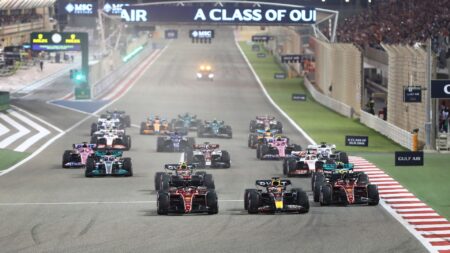
F1
Autolinking test 3: What's new in Formula 1 2023: drivers, team bosses and rules
All the refreshed driver pairings, team principal changes, and subtle regulation tweaks that could shake up the 2023 F1 season


The future of Red Bull and Renault – both as a partnership and as separate entities committed to F1 long term – is now being severely questioned, given the position adopted in an interview by Red Bull’s owner Dietrich Mateschitz on the Red Bull-owned Speedweek website.

“We are losing our motivation. We’re no good at playing the expensive cameo role,” he said. Although his team is contracted to run in the championship until the end of 2020, the financial penalty for not completing on that contract may well be less than the cost of keeping his two teams running for the extra four years beyond the Renault engine contract.
The drinks magnate went on to be highly critical of Renault’s performance in the hybrid formula as the team’s engine supplier.
At the tail end of last year Red Bull recruited – and paid – former Ilmor boss and engine design legend Mario Illien in an attempt to help Renault Sport make progress with its thus-far disappointing hybrid turbo V6. It would be fair to say that it has not been a straightforward integration; a lot of pride is at stake, as can be imagined. Renault Sport is a multiple world championship-winning engine supplier, Illien used to design the Mercedes-badged motors it was competing against in the back of the McLarens. There has been a very definite subtext of ‘we don’t need help in solving this problem’.

Illien meanwhile is convinced that a major part of the power unit’s shortfall lies in its combustion chamber. He has designed a single cylinder prototype that he believes would be the basis for a much improved performance. Renault Sport meanwhile has been pursuing its own development programme, the early dyno results of which are reportedly not as good as had been hoped. In the space between the last race and this one the Illien prototype was finally tested. If the results of this were deemed suitably encouraging, the full V6 version could be running in a matter of months. Red Bull would like it to be towards the end of this year, Renault Sport thinks the beginning of next could be more realistic.
Renault is only contracted until the end of next year. Concurrently, rumours of Red Bull trying to secure a future Ferrari engine supply were not dampened down by Helmut Marko’s comment in Austria of: “Even a B-spec of the Ferrari would be better than an A-version of the Renault.” Coming in direct response to Renault Sport Cyril Abiteboul’s comments a few days earlier of: “When you are not one single team it is more difficult to again build up the confidence in a group than when you are completely integrated. That’s one of the things we are working on. We are trying to get Red Bull to support us rather than bash us publicly.”
It all rather suggests that the relationship is coming to an end – no later than the end of next year. Beyond that, it also leads to the obvious question of what each half of the partnership does if they do part. Renault Sport’s underwhelming response to the turbo hybrid formula it pushed so hard for could yet see it leave F1 entirely and Red Bull’s departure may be as sudden as its rise.
All the refreshed driver pairings, team principal changes, and subtle regulation tweaks that could shake up the 2023 F1 season
All the refreshed driver pairings, team principal changes, and subtle regulation tweaks that could shake up the 2023 F1 season
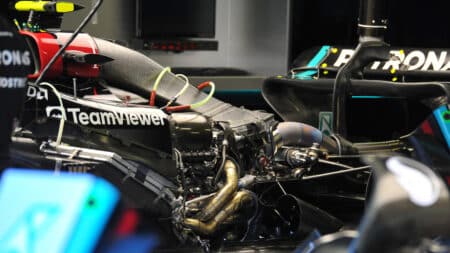
Mercedes is rumoured to have an engine innovation promising a significant advantage over other Formula 1 power units. It could mean rivals are allowed extra benefits to catch up, explains Mark Hughes
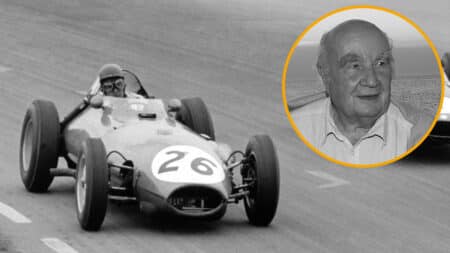
The death last week of Hans Herrmann leaves just four living drivers who raced in 1950s world championship grands prix. The first decade of Formula 1 will soon slip beyond living memory