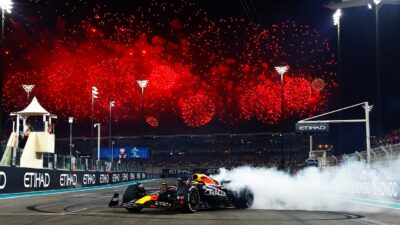
Red Bull's dominance in 2023 was so complete that it shifted focus early to this year's car, cutting back on upgrade plans and even fitting old-spec parts to conserve its resources for 2024, writes Chris Medland
Verstappen won the 2023 season finale in Abu Dhabi — attention had long since shifted to the 2024 car
Red Bull’s dominance in 2023 looked easy at times, but it was far from it. The results were the product of a huge amount of hard work and impressive development, that led to the all-conquering RB19.
What does become easier, is being able to follow that with further performance gains. While there might be diminishing returns at some stage, by having a car that was able to all-but-confirm both championships in the early part of the season, Red Bull could then spend even more time thinking about the next car.
And instead of simply further developing the impressive RB19, it went with a different concept for 2024.
New 2024 Red Bull has impressed rivals
Clive Mason/Getty via Red Bull
“I have to say when I saw the car, I was like, ‘wow’,” McLaren team principal Andrea Stella said. “They certainly were brave in changing some of the shapes that made that car so successful last year.
“I thought they could enjoy such an advantage last year, that gave them the confidence from a timeline point of view to take some risks, because they can take these risks early on to actually see whether it works.”
High praise indeed from a rival team boss, and he hints at the freedom Red Bull had to “enjoy” its 2023 advantage.
Last year’s updates
But just what did Red Bull do with the RB19 to open up the possibility to work on the RB20, and then how did it maximise that opportunity?
“We did three updates,” technical director Pierre Wache explains. “One was a big one that was planned for Imola. That was a quite decent one otherwise we would never do it, because updates are not only to add performance on the car but also try to fix some behaviours that we don’t like.”
We have now seen nine of the 10 new cars (the Williams has yet to be revealed) and given that they have been released approximately in reverse order of the…
By
Mark Hughes
That wasn’t the only piece of development, either. There were further update packages too that went somewhat below the radar, partly because of the timing they were introduced.
“The last one was Singapore, that update was not one many expected and it was a bit of a risk because Singapore is not really a track where you update the car. We had a very bad weekend there and we thought that the update was creating the issue, but we verified it the weekend after at Suzuka and everything came back to normal. We proved it was not massively wrong.
“I think it’s the same for everybody, that clearly we wanted to improve the low-speed performance. That is what we are trying to chase on every update, and in Singapore that’s why we had the doubt because we pushed the boundaries quite far and thought we had an issue. But it wasn’t due to that.”
Singapore saw Red Bull off the pace for the only time in 2023
Rudy Carezzevoli/Getty via Red Bull
The focus with RB19 was on low-speed performance at high ride heights, and Red Bull was working out the best way to spend both the budget financially but also in terms of time spent on the car by personnel.
Planned developments were reduced
“We updated the car. Maybe not as planned at the beginning because based on the relative performance to the others we didn’t want to overspend on the development and have to make savings somewhere else. We just said we would reduce our development to be able to spend the money in a better way for the future.
“Your internal capacity to make updates and manufacture everything is affecting what you do. If you make more internally it costs you less. So first of all if the car is performing well during the first five or six races then you start to plan to do more internally and less externally to not rush the update. If you are in a fight and you need to do anything you can, you do more externally and try to put more updates on the car at the beginning of the season than at the end.”
2024 car quickly became the development priority
Once Red Bull saw it had an advantage that wasn’t going to put it under pressure, then the work on the RB20 could become more intense, with focus on parts that could benefit the previous car tailing off.
“We planned to do 50:50 at one point, and based on our performance we switched it more towards 80:20, and after that even more … But to make this car this year, some aspects of the car could be done last year if you were fundamentally in the fight.”
This year’s concept was fixed, but got more attention thanks to early 2023 success
Clive Mason/Getty via Red Bull
Wache estimates there were a couple of tenths of a second improvement that theoretically might have been achievable from the RB19 had development remained higher on that car, but he also insisted that doing so would not have prevented the RB20 from looking the way it does. Following this year’s concept was not fully contingent on having such breathing room last season.
“I don’t think so, I think it would be the same type of thing, just maybe the details that nobody sees and the performance you can extract from this one would not be at the same level, for sure. Some details would not be as much, but I would say the concept would be similar.”
During pre-season testing it was interesting to hear both Carlos Sainz and Charles Leclerc comment favourably upon the improvement in the Ferrari’s balance compared to last year’s car. Couple that…
By
Mark Hughes
And there were downsides to the way fewer developments were introduced last year, too. Without running upgrades on a track to test them and learn about their performance, certain real-world data is lost.
“Yeah it is a risk. Even more on some parts where it is very difficult to reproduce behaviour in our CFD or the wind tunnel. Certain parts of the car where things are more difficult to anticipate – porpoising for example – then how much you want to do and how far you want to push it you have to test on track. To know what the driver accepts, for sure it helps. but the resource demands to make the parts are very high with the budget cap.”
Even old spares were fast
Balancing the budget cap demands includes having enough parts to end the season, and the RB19’s dominance meant spares didn’t necessarily need manufacturing because reverting to a previous specification instead wasn’t costly in championship terms.
So not only could resource be spent in the development department by focusing on RB20 over RB19, but even more manufacturing costs can be saved, too, and diverted into other aspects of the 2024 project.
2023 car was still fast with old-spec parts, helping to conserve resources for 2024
DPPI
And to add complexity, the reason for this year’s more radical development – that Wache admits was “a big risk” – is because 2025 will see full focus on new regulations in 2026. That means many teams have gambled more at this point chasing the reward of a bigger gain that carries through over the next two years, with less work taking place developing next year’s car because of such limited returns.
So all of the extra time and money that could be diverted onto the RB20 project gave Red Bull a better chance of getting this year’s crucial car right.
“Less wrong, yes! The more time you spend on it, the less risk you are taking. It’s still there, but the more resource you have and the more time you have to think about it, then you have more breathing space to find issues and fix them internally.”
Not only was RB19 the most dominant car ever, it’s having a huge impact on the two that follow it as well.
Going freelance in 2015, he's now RACER's F1 correspondent, works with Formula 1's channels as well as SiriusXM's broadcast coverage in the US, and made far too many appearances in the first season of the Netflix F1 documentary.