Romain Grosjean's escape from his horrific Bahrain crash in 2020 had very little to do with luck. A series of safety features protected him at every stage. Here's how they worked
A series of safety measures helped Grosjean survive long enough to escape the fireball
Romain Grosjean‘s escape from his burning Haas at the 2020 Bahrain Grand Prix was described as a miracle but, as the details emerged, it became clear that it was nothing of the sort.
Behind the Haas driver’s remarkable tale of survival from his horrifying 137mph crash are many decades of work by dedicated individuals, striving continually to improve safety standards in motor racing.
In an emotional press conference after leaving hospital, Grosjean recounted how he tried repeatedly to escape the burning wreckage and had begun to consider that he may not make it out alive, before his final attempt allowed him to leap from the flames.
Romain Grosjean admits there was a point after his horrific crash in the Bahrain Grand Prix when he accepted he was going to die trapped in his car, before thoughts…
By
Chris Medland
That he was conscious to process those thoughts; in a fit state to walk away; and could withstand 28 seconds of intense flames is down to a number of safety features that prevented what is likely to have been a tragedy, just a few years earlier.
Some of the safety standards that Grosjean benefitted from had been in place for just a few months. Others were in the process of being improved further.
We’ve summarised several of the key features below, with links to read in more detail about how each one contributed to the astonishing images of Grosjean returning to the Bahrain circuit, just days after his crash.
Carbon fibre safety cell
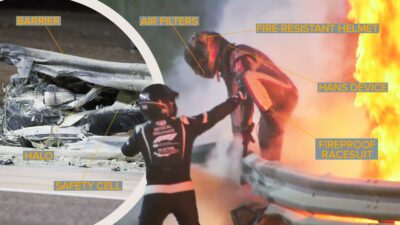
Grosjean’s story of survival begins with the safety cell that surrounded him: the cocoon of carbon fibre and Kevlar that was extensively tested to ensure that it can withstand collisions such as the 53g impact that Grosjean sustained.
Pre-season crash tests in 2020 included hurling the front of cars towards a solid wall to ensure that they protected the occupant’s limbs; and that the fuel cell remained intact.
Another key measure is the energy transferred to the driver. In conjunction with the nose — a sacrificial crash structure that’s designed to absorb energy by crumpling — the safety cell must limit the g-force that an occupant is exposed to.
There are many strands to the backstory to Romain Grosjean’s escaping his 56g fireball in Bahrain on Sunday. The 9kg titanium halo has garnered the bulk of the headlines as…
By
Paul Fearnley
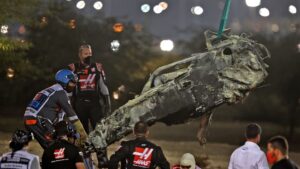
Save for a trapped foot that Grosjean could wriggle free, losing a boot in the process, the protective bubble around him remained intact.
Some credit must go to Roger Sloman, who first proposed carbon fibre F1 chassis in 1974, setting up his own company to make composite components and lobbying team managers to switch to the material. It took until the early 1980s for its widespread adoption, and with obvious safety benefits, it has been the standard ever since.
Improvements have continued to be made. Tougher standards came into force in 2022, with the car’s nose cone having to absorb 130KJ of energy, compared with 90KJ currently. F1’s 2026 regulations have made crash tests more demanding still.
Halo
The picture tells the story: the trackside barrier split open, the blades of the Halo the only obstacle between solid metal and Grosjean’s helmet.
Grosjean was one of the early sceptics of the device but released a post-crash video calling it “the greatest thing we brought to Formula 1“.
Its worth had already been proved in other incidents but this was one of the device’s toughest tests yet — and it wasn’t even close to its limit.
The halo which saved Romain Grosjean’s life on Sunday is designed to withstand impacts with “even greater” forces than the Bahrain crash, says one of the figures who helped to…
By
James Elson
“It’s difficult at this moment to work out what the exact force [of Grosjean’s accident] was, but the fact that it remained intact would imply that it was less than what was actually tested,” said James Watson, manager of the Cranfield Impact Centre where the device underwent tests ahead of its introduction in 2018.
Work was already underway on a next-generation Halo, able to withstand even greater impacts, which has been used since 2022.
HANS device
Romain Grosjean suffered no apparent injuries from his 137mph, 53g impact into the barrier. His harnesses held his body in place, and it may be that the HANS device prevented a serious, potentially fatal neck injury.
The collar, which attaches to the helmet and fits around the neck, is designed for frontal crashes where the car comes to a sudden stop, and the head is thrust forward, with immense energy, while the body is restrained.
The resulting strain on the neck has resulted in fatalities, including Dale Earnhardt during the 2001 Daytona 500.
HANS allows drivers to move their head normally, but prevents abnormal movements in a crash.
Helmet
“Our first thought was flames, smoke inhalation, airway issues, but in fact, nothing went up into his helmet – we’ve had a look at that as well,” said Dr Ian Roberts, the FIA’s F1 medical rescue co-ordinator, shortly after coming to Grosjean’s aid and leading him away from the flames.
Remaining lucid as he dodged through the wreckage to escape, was crucial and can only have been helped by not breathing in the smoke.
There’s little FIA regulation on this matter, but helmet manufacturers do incorporate measures to protect against smoke, including Grosjean’s manufacturer of choice, Bell.
It took 28 seconds for Romain Grosjean to emerge from the flames of his wrecked Haas and leap clear with minor burns and no broken bones. His car’s safety cell…
By
Jake Williams-Smith
It uses a cover to seal the base of the helmet, so most of the air that a driver breathes enters through ventilation ducts containing air filters. At high speed, air is forced in, providing ample fresh oxygen but there’s extremely limited airflow at rest — because drivers rarely spend long at a standstill with their visor down.
In a fire, this also helps keep smoke at bay for long enough to escape.
Despite melted tear-offs on the visor, the rest of the helmet also performed as designed, resisting the flames and heat to keep Grosjean safe.
Racesuit
New, tougher regulations for racesuits were only brought in at the beginning of 2020 and ensured that Grosjean benefitted from vital extra seconds of heat protection in the fire.
Suits must offer more resistance against heat, while underwear must now slow heat transfer for a minimum time too, representing a 20% improvement. Alpinestars, which makes Grosjean’s racewear, said that at a minimum, drivers will have between 17-18 seconds before temperatures rise by 24C — the industry standard. Grosjean’s suit appears to have exceeded the benchmark, given his 28 seconds in the flames.
The temperature of a blazing Formula 1 car can be between 800C to 1000C. Romain Grosjean sat at the centre of such a fire for 28 seconds in the Bahrain…
By
Dominic Tobin
The Nomex the suits are made from won’t catch fire or melt, but does blacken in extreme heat: Grosjean described his gloves going “full black” in the flames.
The charring process uses energy, which helps to delay heat transfer to the wearer, but it only protects for so long, as evidenced by the burns on Grosjean’s hands.
They may be partly due to the reduced heat protection required of gloves: a compromise between safety and the precise steering feel needed by top-level drivers.
Barrier
At first glance, it’s a major failing in the Romain Grosjean story: the trackside barrier that split, allowing the Haas to pierce the metalwork and become lodged. It is suspected to have led to the break-up of the car and the resulting fire.
The result, however, was little surprise to experts who warn that it’s impossible to guard against every type of crash, all of the time.
“You would like the barrier to remain intact as possible, but at some point, when the energy it’s too much, it will break. It’s physics,” said Jarno Zaffelli, an F1 track designer who led the remodelling of Zandvoort.
He pointed out the bent and buckled metal had absorbed a significant amount of energy from the crash to help protect Grosjean.
The mangled barrier, hit by Romain Grosjean’s Haas in the Bahrain Grand Prix, did exactly what it was designed to do, said a leading Formula 1 circuit designer. Jarno Zaffelli,…
By
James Elson
In braking zones, barriers are often formed of several impact-absorbing layers to soften head-on crashes, but rigid barriers are frequently used parallel to the track where cars are more likely to impact side-on. It can be safer for them to slide along the barrier than become caught in a softer material.
“Grosjean’s accident was very unusual,” said Zaffelli. “It’s highly unlikely that you would have cars going almost full speed at that kind of angle into that kind of barrier. The kind of angles you normally have there, it’s better to have something which deflects – but it can only deflect so much.
The barrier has since been modified with rows of tyres and a belt in front but — ahead of the change — Zaffelli warned that altering the design may not improve safety for the next car to crash at that corner.
“You have to appreciate that the accident that happened to Grosjean could happen anywhere in any other form,” he said. “You have to think about whether crashes are likely or not, predictable or not.”