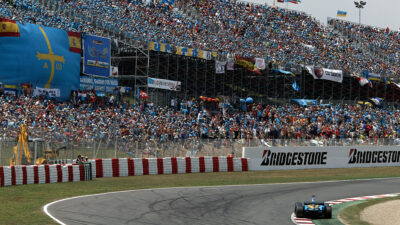
Has it really been that long? Apparently so. Somehow, the Spanish Grand Prix this Sunday will be the 30th to be held at the Circuit de Barcelona-Catalunya, the track situated in industrial Montmeló on the outskirts of one of Europe’s finest cosmopolitan cities. Given the amount of laps drivers and teams have logged in tests there in the past three decades, it’s also become known as the unofficial home of Formula 1.
The circuit was only just finished in time to host its first Spanish Grand Prix on September 29 1991 and indeed still looked like something of a building site when the F1 circus rolled into town. Built as part of a huge development drive for the Barcelona Olympics of 1992, a reasonable crowd of 70,000 turned out for a drizzle-affected race, in a part of Spain where F1 appeared much more popular than it ever was at Jerez, situated in the sherry region in the south, and at Jarama, near Madrid.
They were treated to an incident-filled race that produced one of the great F1 moments, as Nigel Mansell and Ayrton Senna raced wheel to wheel, just inches apart, down the long main straight. Mansell won for Williams, as Senna endured a strange, out-of-sorts race in which he spun on his way to a lacklustre fifth. Briefly, it revived Mansell’s world championship hopes, although they were quickly snuffed out in Japan when he understeered off into the gravel at Suzuka’s first turn, as Senna claimed his third F1 title – while patronising McLaren team-mate Gerhard Berger by gifting him ‘victory’ as they approached the line.
Schumacher’s drive to second place in 1994, despite being stuck in fifth gear is among the most remarkable performances from anyone at any track
The Circuit de Catalunya, as it was known before ‘Barcelona’ was added to its name in this politically combustible region, became part of the F1 furniture in the same year that Magny-Cours first hosted the French GP – although it was obvious which one was more popular. This was an era in which a modern breed of ‘F1-o-dromes’ were built usually on relatively small plots of land, requiring layouts to twist back on themselves via often bland second and third-gear corners. At least the Barcelona track featured a mix of fast bends, long corners and some elevation change – plus a great view of the hills in the south. Despite its industrial valley setting, it’s a picturesque place to watch racing cars.
The Spanish GP moved from its traditional autumn slot to become a spring-time staple in 1992, and its location and layout soon made it a popular testing venue. But the circuit wasn’t exactly loved. After all, this was no Spa or Suzuka – or Montjuïc Park for that matter. Still, the place has hosted its fair share of memorable grands prix through the decades: Schumacher’s drive to second place for Benetton in 1994, despite spending most of the race stuck in fifth gear – still among the most remarkable performances from anyone at any track; his wet-weather masterclass that opened his Ferrari account in ’96; Mika Häkkinen’s last-lap clutch failure in ’01 that handed Schumacher another Spanish GP win; Fernando Alonso sending the partisan 130,000-strong crowd into rapture by becoming the first Spaniard to win his home race in ’06; Pastor Maldonado’s bizarrely brilliant day of days for Williams in ’12; and Max Verstappen’s maiden win on his debut for Red Bull in ’16, after team-mates Nico Rosberg and Lewis Hamilton collided at Turn 4. This track has created some great history.