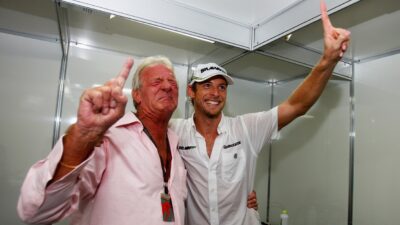
It is hard to believe that this coming Friday will be the 10-year anniversary of the death of John Button. Best known as the chummy, kind, funny, humble yet larger-than-life father who attended all but one (Brazil 2001) of his famous son’s grands prix between his Formula 1 debut (Australia 2000) and the last (Brazil 2013) that occurred before his untimely demise on the front steps of his home in the south of France, near Monaco, on January 12, 2014, he had enjoyed a successful racing career in his own right in the 1970s and 1980s.
Well, not racing per se, but rallycross, not that he was wont to blow his own trumpet about it in F1 paddocks, even in the company of vainer men who were only too eager to boast about motorsport exploits less notable than those of Papa Smurf, Jenson’s nickname that his old man never seemed to mind all and sundry calling him. In the 1970s he rallycrossed a souped-up Volkswagen, painted black and orange and therefore known as the Colorado Beetle, and in the early 1980s a Mk1 Golf, again suitably souped-up. He was good too — in the 1976 British Rallycross Championship finishing second to Trevor Hopkins, a rallycross legend who did a lot of winning back then, mostly in fast Fords.
Those who knew John as Jenson’s nice old dad tended to underestimate his sheer hard graft
The souping-up was largely engine-focused, for tuning was John’s forte. When eight-year-old Jenson began to shine in junior karting, his dad gave up rallycross and devoted his souping-up skills to making sure that his boy’s karts were as quick as they possibly could be. That, combined with Jenson’s already uncommonly smooth and deceptively rapid driving style, led to extraordinary early success. In 1991 the British Cadet Kart Championship comprised 34 races. How many did 11-year-old Jenson win? The answer, dear reader, is 34.
Such exceptional domination could not continue, and it did not. Nonetheless, as a karter, Jenson was always one of the main contenders, and John was invariably at his side, tuning his engines for all he was worth. Jenson progressed to Formula 3, where he also did well. In late 1999, still not yet 20, he tested an F1 McLaren at Silverstone and an F1 Prost at Barcelona. He had a chance of a drive with each team, and with Stewart Grand Prix too, but in the end it was the offer of a drive for Frank Williams’ recently indomitable F1 team that John and Jenson went for.
The rest is history – and you know most of it. Jenson won 15 grands prix, stood on 50 F1 podiums, and won the F1 world championship in 2009. Those who knew John only as Jenson’s nice old dad, which constituency comprised the overwhelming majority of 21st-century F1 folk, tended to underestimate the profound influence that he had had on the propulsion of his nipper from karts to F1, and indeed how much sheer hard graft from him it had required. However, now that Jenson had made it, and he really had, John was content to sit back and relax. Yes, he watched like a hawk every session of every grand prix weekend; yes, he listened carefully on a team headset to every debrief; yes, he understood much more about F1 than he let on; but, unlike many F1 dads, he almost never interfered.
I first knew John when I became a full-time motor sport journalist, the best part of 30 years ago now, and I liked him from the get-go. When Jenson arrived in F1, we British racing hacks spent enjoyable time with John every race weekend. After the 2000 Brazilian Grand Prix, in which Jenson had driven well to sixth place in only his second F1 race, becoming the then-youngest point-scorer in F1 history at a time when points were awarded only to the first six finishers and were therefore extremely hard to come by, and thereby breaking the record set by Ricardo Rodriguez at Spa in 1962, John was as pleased as Punch. In the same place nine years later Jenson went one better, finishing fifth rather than sixth, but it was a far more significant result, because it earned him points enough to clinch that year’s world championship. I think John hugged everyone in the Interlagos paddock that afternoon.