Max Verstappen was lauded for his consistent Mexican GP lap times, but they are nothing exceptional for an F1 driver — you need to look at another of this year's races to appreciate his talent, writes Mark Hughes
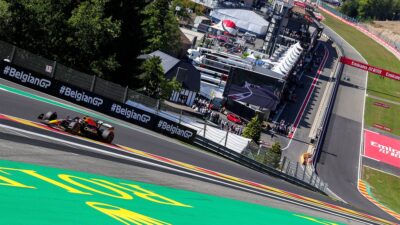
On top of the world: Verstappen made a stunning Spa comeback in 'undriveable' car
Max Verstappen has enjoyed one of the most dominant seasons in the sport’s history, despite a car that was often not the fastest in the season’s first half. This weekend in Brazil Verstappen could extend his existing all-time record of the most victories in a season to 15.
There is no question that he has delivered a stunning level of personal performance, regardless of how quick his car has been, and how good his team has been on race day. His onslaught has been pummelling, relentless and worthy of comparison with any of the greats in the sport’s history. His performance at Spa was perhaps the finest of his career to date. From 14th on the grid into the lead and pulling away with two-thirds of the race still to go in a car with a neutral balance through the fast corners that was buying him chunks of lap time but which for most others – his team mate Sergio Perez included – would have been undriveable.
So don’t take the following as criticism of him. But whenever anyone points to the ‘amazing consistency’ of his lap times, that doesn’t actually mean as much as it used to in the sprint era. When you are driving to your brake or tyre temperatures, lifting and coasting to get either those targets or your fuel usage on schedule, by their standards it is painting by numbers. They are nowhere near their own personal limits when doing this, so it’s relatively easy to achieve ‘consistency’.
Michael Schumacher and Renault-title-era Fernando Alonso each carved their reputations from how they could drive on the limit for lap after lap and just grind the opposition into the ground, inflicting damage on them every single lap.
That isn’t actually what’s going on in this era when we see this ‘amazing consistency’. Let’s take Mexico stint 1 as a case study.
Verstappen, in the lead on soft tyres and being followed by Lewis Hamilton on mediums, doesn’t have the pace advantage to be able to pull away without, in this case, overheating his brakes. The task then is to edge out enough of a gap that he is a) out of DRS range and b) out of undercut range as the pitstop window opens a few laps later. He knows Hamilton is facing the exact same challenge with the brakes, so knows the Mercedes cannot be driven flat-out either. In fact, in Verstappen’s dirty air, Hamilton will likely have to be conserving his brakes even more.
The battle for the Mexican GP lead was an exercise in brake conservation
Grand Prix Photo
We know the potential ultimate pace of the cars from qualifying. In the race, we have to factor in the effect of the fuel weight, the tyre degradation and a power unit which – unlike during a lap of qualifying – cannot have full electrical deploy on demand, as there must be a balance between harvest and deploy to keep the battery charged.
If we factor all those in, we can see what lap time the car on ‘x’ fuel load and with ‘y’ tyre age should be capable of. Comparing that to the actual lap will be a measure of how much the driver is ‘managing’, ie how much he is having to back off to conserve – in the case of Mexico – his brakes. But if it’s not brakes it’s fuel and if it’s not fuel it’s tyres. The theoretical fastest way to run the race is always some combination of managing so as to get the most efficient stint lengths. It never involves running flat-out.
Max Verstappen wasn’t happy about starting towards the back of the 2022 Belgian GP grid, but made victory look easy in the race. Mark Hughes explains why he had such an advantage
By
Mark Hughes
Here are the numbers from Mexico stint 1.
• Verstappen qualified on pole with a 1min 17.775sec, new tyres, near-empty tanks, power unit in full deploy.
• By lap two of the race he has, let’s say, 98.6kg of fuel on board. Around here that will cost a calculated 2.76sec of lap time.
• He is on tyres which have done three attack laps, with a calculated degradation rate of 0.0667sec per lap. So costing him a further 0.2sec of lap time.
• His power unit now needs to be in an equilibrium state between harvest and deployment to keep the battery charged. That comes at a cost of around 0.3sec.
So that 1m 17.775sec of qualifying (if he was pushing to the same extent in the race and assuming similar track conditions) would now be 1min 21.036sec. But if he did that he’d quickly have no brakes. Or no tyres. Or both. So, driving to the temperature of his brakes in this case, he actually laps at 1min 23.247sec. So he is driving 2.211sec slower than he is personally capable of doing. Hamilton behind him is doing much the same. We can look at his whole stint like this.
Verstappen Race stint 1 Mexico qualifying 1m 17.775sec
Lap
Fuel pen.
Tyre pen.
PU pen.
Theoretical
Actual
Managing
L2
Q time + 2.7610s
+
0.200sec
+
0.3sec
=
1min 21.036sec
1min 23.247sec
2.211sec
L3
2.7216sec
+
0.267sec
+
0.3sec
=
1min 21.063sec
1min 23.079sec
2.016sec
L4
2.6824sec
+
0.335sec
+
0.3sec
=
1min 21.092sec
1min 23.566sec
2.474sec
L5
2.6432sec
+
0.402sec
+
0.3sec
=
1min 21.120sec
1min 23.226sec
2.106sec
L6
2.6040sec
+
0.469sec
+
0.3sec
=
1min 21.148sec
1min 23.294sec
2.146sec
L7
2.5648sec
+
0.536sec
+
0.3sec
=
1min 21.176sec
1min 23.115sec
1.939sec
L8
2.5256sec
+
0.603sec
+
0.3sec
=
1min 21.204sec
1min 23.292sec
2.088sec
L9
2.4864sec
+
0.670sec
+
0.3sec
=
1min 21.231sec
1min 23.246sec
2.015sec
L10
2.4472sec
+
0.737sec
+
0.3sec
=
1min 21.259sec
1min 23.257sec
1.998sec
L11
2.4080sec
+
0.804sec
+
0.3sec
=
1min 21.287sec
1min 23.164sec
1.877sec
L12
2.3688sec
+
0.871sec
+
0.3sec
=
1min 21.315sec
1min 23.076sec
1.761sec
L13
2.3296sec
+
0.938sec
+
0.3sec
=
1min 21.343sec
1min 23.109sec
1.766sec
L14
2.2904sec
+
1.005sec
+
0.3sec
=
1min 21.370sec
1min 23.056sec
1.686sec
L15
2.5120sec
+
1.072sec
+
0.3sec
=
1min 21.398sec
1min 22.971sec
1.573sec
L16
2.2120sec
+
1.139sec
+
0.3sec
=
1min 21.426sec
1min 23.076sec
1.650sec
L17
2.1728sec
+
1.206sec
+
0.3sec
=
1min 21.454sec
1min 23.161sec
1.707sec
L18
2.1336sec
+
1.273sec
+
0.3sec
=
1min 21.482sec
1min 23.288sec
1.806sec
L19
2.0944sec
+
1.340sec
+
0.3sec
=
1min 21.509sec
1min 23.432sec
1.923sec
L20
2.0552sec
+
1.407sec
+
0.3sec
=
1min 21.537sec
1min 23.674sec
2.137sec
L21
2.0160sec
+
1.474sec
+
0.3sec
=
1min 21.655sec
1min 23.295sec
1.640sec
L22
1.9768sec
+
1.541sec
+
0.3sec
=
1min 21.592sec
1min 23.597sec
2.004sec
L23
1.9376sec
+
1.608sec
+
0.3sec
=
1min 21.621sec
1min 23.655sec
2.034sec
L24
1.8984sec
+
1.675sec
+
0.3sec
=
1min 21.648sec
1min 23.861sec
2.213sec
We can see that the closest Verstappen ever gets to his theoretical potential pace is on lap 15 at just under 1.6sec off what he could do if he wasn’t having to manage brakes/tyres etc. He is lapping throughout the stint at between 1.6sec and 2.2sec of what he could physically do – from the perspective of driving ability. The consistency is indeed impressive, but it is ‘just’ a consistency in matching his brake temperatures, tyre temperatures and power unit usage while trying to eke out the necessary gap over Hamilton so as not to be under threat around the pit stops. It’s a great skill, but it’s not the differentiator between a great driver and a good one in the way that nailing the same lap time when absolutely on the physical limit in the sprint era of F1 was, when you had just enough fuel in the tank for that stint and tyre war rubber which didn’t wildly overheat when you pushed on. Then, the fastest way to complete a race was by driving flat-out and hence the consistency of super-fast times was an awesome achievement. Nowadays, it does not signify what it used to.
Could Verstappen achieve that level of consistency in the ‘sprint’ era of F1? Of course he could – because he is a truly incredible driver. But forget ‘consistency’ being the proof of this. They can all ‘manage’ a race stint.
In previous lives Mark raced cars, worked at Jim Russell racing school, got a university degree which he never used, tried working in industry, didn’t like it, left and joined Motoring News in 1988 as a junior club race reporter. Went freelance in ’96, concentrated on F1 from 2000. Grand Prix editor of Autosport for 10 years.