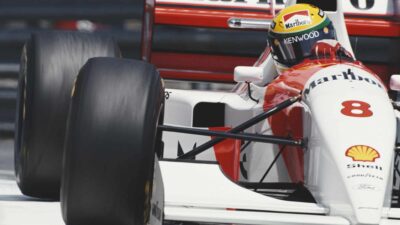
Though the Brazilian qualified fourth and briefly fell to fifth at the race start, a scintillating opening sequence saw him in the lead before the first lap was over, passing Karl Wendlinger, Michael Schumacher, Damon Hill and Prost in just a handful of corners.
After all the hard hours put in at the factory, Jeffreys was at home with family witnessing the incredible race unfold on television.
“Ayrton had this innate ability to know where the grip was. He had that exceptional seat-of-pants knowledge of where the limit was at all times. He used that on the first lap.”
Further adding to the advantage was the fact that this was a rare occasion that McLaren and its driver had the technology sussed better than Williams – as its then technical director Patrick Head explains to Motor Sport.
“Taking nothing from Ayrton, but his win owed much to our incompetence,” he says.
“The rain was very heavy, resulting in water building up on the track, generally a few millimetres deep, but in places much deeper.
“Our active car maintained very low ride heights, just a few millimetres above the ground, and gained aerodynamic performance by this, but when the water was deeper than the ride height of the car, our drivers were ‘surfing’.
“Although we had the possibility of making ride height adjustments from the cockpit controls, I don’t think we fully understood what was causing the problem for the drivers.
“I think Alain made eight visits to the pits and Damon seven, coming in as they had ‘no grip’ expecting that this was due to a problem with the tyres, but it was not.”
“It was amazing what he achieved. But we were still underdogs” Matthew Jeffreys
Despite Williams’ technological advantage, Senna brilliantly won three of the first six races, putting him five points ahead of Prost in the championship after Monaco.
“I, and probably a lot of people, thought it was amazing what he achieved. But we were still underdogs, because we had high-power circuits coming up in Silverstone and Hockenheim.”
And so it was – an ultimate lack of pace and mid-season reliability issues saw Senna’s challenge falter, before a late flurry when Prost’s title was won saw the Brazilian’s win tally finish at five – including his last ever F1 victory at Adelaide.
Senna would leave to replace Prost at Williams, unable to be persuaded to stay at Woking. Despite this, the ’93 car still stands as another fine example of McLaren engineering in its vastly successful history of competition machinery – and also one of F1’s great ‘what ifs’.
“It’s a close second to the MP4/4 for me,” says Jeffreys of ranking the MP4/8 amongst his favourite McLarens. “It’s a nice, nimble, fast car.
“I think we would have been in good shape to win the championship in ’93 [had the team had a better engine.]
“History would have had been different in a number of ways.”






 Great Read


