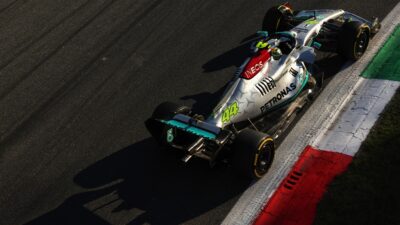
Lewis Hamilton was glad to see the back of the Mercedes W13, but could the team's desperate search to understand its troublesome 2022 car reap dividends in the future? asks Mark Hughes
Zero-sidepod concept was ambitious but didn't work
The upturn in Mercedes’ form since the Austin update lasted only three races and by the Abu Dhabi finale last week it was back to being only the third-fastest car a chunky 0.6sec off Red Bull in qualifying.
That’s all readily explainable by the circuit layouts and how the Yas Marina track is way more punishing of drag than COTA, Mexico City or Interlagos and that the Mercedes W13 is a draggier car for a given level of downforce than its rivals. Furthermore the circuit features, in sector 1, a few of the sort of fast, long corners which roll the car enough to have the outer edge of floor touch the track, triggering the dreaded aero porpoising phenomenon, to which the Merc remained more susceptible than the Red Bull.
But what does this tell us about 2023 and the prospect of Mercedes competing with Red Bull on equal terms? James Vowles, the team’s chief strategist, said earlier this week, “I don’t think you can truly now, or even across the winter, state that we know everything about the W13.”
Early struggles with porpoising left Mercedes cut adrift of the top teams
Grand Prix Photo
No-one ever knows everything about their cars – even when they are dominating. All that’s required is that they know enough. But there is enough knowledge now to broadly understand the root of the car’s limitations. The crucial decider for ’23 will be whether knowing how not to do something means they will know exactly how do it right instead. That’s simplifying in the extreme, obviously, but broadly true nonetheless.
The crucial limitations of the W13 were multi-dimensional in that the floor was prone to induce porpoising, so obliging it to be run higher than it was designed for, the resultant downforce loss from the floor then needing to be compensated for by bigger wings, increasing the drag. Furthermore, the rear suspension had a restricted range of travel appropriate to the originally envisaged ride height, so had to be run extremely stiffly. This stiffness initiated a mechanical bouncing problem separate from the aerodynamic porpoising but accentuated by it. The whole structure ended up being stiffer than the tyres, so further amplifying the problem. After much experimenting during the first half of the season the team had a good handle on the narrow window in which the car demanded to be run and its form improved, though the underlying limitations remained.
George Russell vs Lewis Hamilton was the most interesting rivalry in F1 this season. Despite facing the most successful GP driver in history, Russell showed he is the real deal, writes Andrew Frankel
By
Andrew Frankel
So, with a good working knowledge of the design hazards of this generation of ground effect car now in place, the Mercedes technical team can get on with making a state-of-the-art version without the built-in restrictions. That’s the theory.
But while Mercedes has spent a season working around the limitations it baked into the car, Red Bull (and to a lesser extent Ferrari) have been developing something which was fundamentally sound in the first place. By definition it might be assumed it will be further on in its learning and ready to develop something even more effective.
But Mercedes feels that in addressing the very fundamentals in trying to understand just what was wrong with the car in the first place, it may have reached a higher degree of understanding than those whose car worked well immediately. It may have been forced to dig deeper and to have found things in that process which give a fuller understanding of ‘why’ rather than just ‘what’.
Which brings us back to no team ever understanding exactly why it’s car is slow or quick relative to the opposition, but has just a working knowledge and best-fit analysis. Are we poised at the beginning of a Red Bull/Verstappen multiple year domination? Or set for a rematch of the 2021 dog-fight, perhaps with Ferrari in the mix too? The work which will determine those answers is fully ongoing right now.
In previous lives Mark raced cars, worked at Jim Russell racing school, got a university degree which he never used, tried working in industry, didn’t like it, left and joined Motoring News in 1988 as a junior club race reporter. Went freelance in ’96, concentrated on F1 from 2000. Grand Prix editor of Autosport for 10 years.