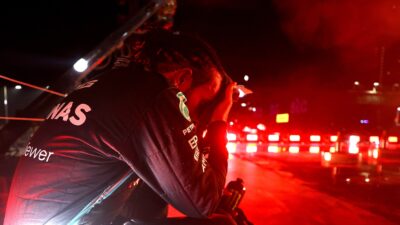
It's been three seasons of struggle for Mercedes and Lewis Hamilton, writes Mark Hughes. But at the 2021 Saudi Arabian GP, Mercedes was on the rise. Pitted against a determined Max Verstappen, the scene was set for one of the great grands prix
Lewis Hamilton sits with his head in his hands after draining win in 2021 Saudi Arabian GP
Jeddah last weekend was troubling for Lewis Hamilton and Mercedes. Going into the third year of these regulations, the car’s bouncing problems through the high-speed sweeps of Sector 1 ensured it was uncompetitive with Ferrari and McLaren, let alone Red Bull. The team still seems to be wrestling with how to find competitive usable downforce under these regulations. For Hamilton it was even more worrying in that he was not even on the pace of team-mate George Russell. This is not a new thing for Hamilton at Jeddah. He has struggled there for the last three years, even relative to his team-mates. There’s something about the combination of fast, wall-lined sweeps and the high-speed oversteer of a venturi-floored Mercedes that just loses him the confidence needed to push the envelope.
But actually the inaugural Jeddah race was where he scored his most recent grand prix victory – the penultimate race of the ’21 season, in the midst of his epic seasonal fight with Max Verstappen. In that late phase of the season the Mercedes was a quicker car than the Red Bull. Verstappen had understood this two races earlier, in Brazil. A fundamental rethink on set-up between Mexico and Brazil had allowed Mercedes to fully unleash the potential of its Silverstone upgrade which in enhancing the diffuser stall at speed allowed bigger wing levels to be used. That and a new power unit introduced in Brazil, which could be run much more aggressively as it would be used for only three races rather than the routine seven, made it unstoppable. With that combination, even starting a penalised last from the sprint race and 10th from the main event had not been enough to prevent Hamilton being victorious despite Verstappen’s best efforts at encouraging contact between them as he ran the Mercedes off the road at Interlagos’s Turn 4.
Any time he was close to Hamilton he was prepared to adopt the ‘yield or we crash’ approach
That was tactical on Verstappen’s part. He had a 19-point lead with four races to go, but the late-season Mercedes performance boost had shocked Red Bull. Verstappen realised his points cushion probably wasn’t going to be enough to see him still ahead at the end. With 25 points for a win and just 18 for second, Hamilton was potentially going to take 28 points from him in the four races from Brazil. So any time he was in close proximity to Hamilton he was prepared to adopt the ‘yield or we crash’ approach in the full knowledge that if they did take each other out, that was to Verstappen’s advantage as the points leader.
Max Verstappen steps away: one corner from a legendary qualifying lap in Jeddah
Andrej Isakovic/AFP via Getty Images
In Qatar he never got close enough to dice with the Mercedes, Hamilton winning by 25sec after qualifying 0.6sec clear of the Red Bull. Then came Jeddah. The Red Bull was much more competitive around the fast sweeps of this place and Verstappen sensed that all might not be lost. It was particularly quick through the fast sweeps of Sector 1, Verstappen lifting only once between Turns 6-10, a section where the Mercedes drivers were having to lift four times. The Mercs would make it back up on the straights. The high-rake Red Bull always had the edge in high-speed downforce, the low-rake Merc was always more aero-efficient. Here it was quite evenly matched over the lap, the Mercedes probably edging it but the Red Bull within reach. Thus encouraged, Verstappen set out on his final Q3 run determined to do the lap of a lifetime. If he could snatch pole it could be the foundation of an against-the-odds victory. The siege mentality he’d evidently been in since Brazil was now going to be unleashed on making the difference. The car was close enough here for him to feel that he could out-drive his way to pole and he was taking no prisoners. Out of Turn 2 his left-rear was within millimetres of the wall and that set the tone for the lap; it was an incredibly audacious performance even by his standards as he left absolutely nothing on the table and literally skimmed the walls. As the lap unfolded on the big screen, Q2 casualties Fernando Alonso and Daniel Ricciardo were being interviewed. Alonso nudged Ricciardo and pointed him at the screen. They stood open-mouthed and wide-eyed at what Verstappen was doing.
The extraordinary finale to the Abu Dhabi Grand Prix concluded what has been – by absolutely any standards – an extraordinary season of Formula 1 world championship racing. To the…
By
Doug Nye
As he approached the tight final turn he was 0.3sec faster than Hamilton over the lap. But arriving there just a little faster than ever before, braking at his usual point locked up the inside front and took him wide of the apex. Such was his state of mind, his reaction to this wasn’t to back off to avoid contact with the wall but to belligerently stand hard on the gas in a desperate attempt at power-sliding the required direction change. Which put him hard into the wall. It remains arguably the greatest qualifying lap that never was, up there with Gilles Villeneuve’s Piquet-thwarted effort at Monaco ’79 (when until encountering the dawdling Brabham at the chicane he’d been set for pole by 0.5sec). From dancing on the edge of possible, the hard impact with the wall brought Verstappen down to earth and looking at starting the race from third, behind an all-Mercedes front row.
He took the attitude into the race with him though, and you just knew if he got anywhere close to Hamilton, things were likely to get messy. Eight points down and just two races left, Hamilton had to avoid at all costs any incident. But he also had to avoid being passed by Verstappen. Potentially it was a mentally exhausting task. Verstappen by contrast had to throw everything at Hamilton, totally uncompromising, knowing that if they collided, all the better. In the first stage of the race it looked like Verstappen wasn’t going to get that opportunity as Hamilton led with team-mate Valtteri Bottas watching his back and allowing him to pull away. It was a Mick Schumacher crash which prised the race open for Verstappen. Trying to judge whether this would trigger a safety car or a red flag was impossible. Mercedes brought its drivers in, in the knowledge that Red Bull would do the opposite of whatever they did. Verstappen stayed out. An initial safety car was replaced by a red flag. Meaning Verstappen got his tyre change for free and would take the restart from pole. Game on.
Verstappen swept past Hamilton. The chase was on
Hamilton out-dragged the Red Bull off the line, Verstappen, with his take-no-prisoners approach, simply took to the run-off with all four wheels to take the place back. Hamilton had to lift and steer hard left to avoid contact as Max rejoined, allowing Esteban Ocon’s Alpine to pass the Merc too. There wasn’t time for Verstappen to be ordered to give the place back – as there was immediately another red flag for an accident in the midfield. For the second restart the race director told Red Bull that Verstappen could either be reported to the stewards for gaining advantage by leaving the track – or take the equivalent of giving the place back by starting from third (behind Ocon and Hamilton). They took the latter choice. But fitted him this time with medium tyres rather than the hards everyone else was on, with the aim of out-accelerating the front-row starters. It worked, and Verstappen swept straight past Hamilton into the first turn and edged out Ocon too. Once Hamilton got by the Alpine, the chase was on.
Medium-tyred Verstappen got the jump on Ocon and Hamilton at the second restart
Dan Mullan/Getty Images via Red Bull
Hamilton knew Verstappen’s tyres would surrender before his and that he’d soon be upon him. But then what? How to pass without a collision. This was not going to be straightforward. Here’s how we called it that night.
With the aid of DRS he got ahead on the pit straight – only for Verstappen to again refuse to surrender around the outside run-off, with a big oversteer moment that forced Hamilton off track too, thereby getting the Red Bull back ahead. Again it was judged not a legitimate move and he was ordered to give the place back.
This is where it got really strange. Verstappen decided he’d slow just before the DRS detection point before the final turn, get Hamilton to pass him there so that he’d get DRS on him and slipstream back ahead. Hamilton didn’t want to do that and so delayed passing him. Verstappen tried to further ensure he got his way by braking – at 2.4g. Hamilton clipped the back of the Red Bull but remarkably the front wing was still working.
Verstappen sprinted away, the Red Bull plan now being to anticipate a 5sec penalty by getting more than 5sec lead. But he couldn’t – as Hamilton tracked him. So a second attempt at letting him by was made – at Turn 23. Hamilton came by, Verstappen immediately counter-attacked into 24 to take it back again.
That wasn’t deemed satisfactory and just as the stewards then imposed the 5sec penalty, Hamilton was diving down Verstappen’s inside at the final corner, the decisive move for victory.
Unpredictability, unclear rules of engagement and a title in the balance produced a chaotic race in Jeddah says Mark Hughes
By
Mark Hughes
Afterwards Hamilton found a corner for himself and sat with his head in his hands, clearly mentally drained by the task of trying to deal with this force of nature prepared to do whatever it took. Even Adrian Newey later said that Verstappen’s brake test of Hamilton was ‘a bit silly’. He was lucky not to be excluded from the results for it. Little did we know what was in store a week later.
But that was the last time Mercedes was able to provide Hamilton with a competitive car. Last weekend, the W15 Merc was slower through the fast Turn 6-10 section than the 2021 car. Through Turn 7, the part of the sequence requiring a lift of the throttle even for Verstappen’s Red Bull, the Mercedes this year was travelling at 225km/h (140mph), 3km/h (2mph) slower than the ’21 car. Verstappen at the same place this year was reaching 245km/h (152mph), around 10km/h (6mph) quicker than he’d managed in ’21 on that take-no-prisoners Q3 lap.
Hamilton escaped with front wing still attached after Verstappen braked heavily
Lars Baron/Getty Images via Red Bull
Such isolated numbers don’t tell us everything but they do paint a picture of a Mercedes team still struggling to get to grips with this type of car going into the third year of the formula.
In a weekend when Verstappen suggested that if Helmut Marko has to leave Red Bull, so might he, and then Christian Horner effectively calling his driver’s bluff, Verstappen might ask himself if he really would be prepared to depart the team which has shown complete mastery of these regulations to sit in Hamilton’s place instead.
In previous lives Mark raced cars, worked at Jim Russell racing school, got a university degree which he never used, tried working in industry, didn’t like it, left and joined Motoring News in 1988 as a junior club race reporter. Went freelance in ’96, concentrated on F1 from 2000. Grand Prix editor of Autosport for 10 years.