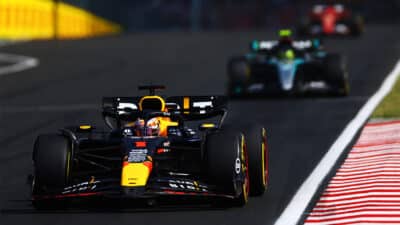
Reports of an asymmetric braking system — which has now been made illegal — fuelled rumours about Red Bull's sudden decrease in form. But, as Mark Hughes writes, the claims made are unsubstantiated
Are Red Bull falling back? Or are others catching up?
Interesting reactions to last week’s asymmetric braking story here in which we assessed the possible evidence for the existence of such systems on the cars of each of the leading three teams. While pointing out that it was entirely possible that no-one had used such technology.
The original, somewhat wild, Italian-sourced story stating definitively that it had been in use by Red Bull was not substantiated and the dates for its supposed use and the additional regulation wording banning it did not align. It was a story to be treated with intrigue but suspicion. There were reasons why the underlying story, beneath the fuzzy details, was very feasible. It was a technology which would be fantastically useful in addressing one of the biggest limitations of the current generation of F1 car – that of achieving good balance at both low speed and high. But there was nothing concrete standing it up.
We are slightly better informed one week on, though still finding out more. But, talking to the relevant people in the paddock, it looks very much like no-one was using it, although at least one team (and probably three) had versions of it ready to go.
Little evidence suggests that any current front-runner had used the now-illegal braking system
Grand Prix Photo
The impetus for those teams preparing such systems (a version of which is widely used, and fully legal, in WRC rallying) was the sudden appearance in the relevant 2026 regulation of the additional wording: “Any system or mechanism that can systematically or intentionally produce asymmetric braking torques for a given axle is prohibited.” Because this additional wording was not in the 2025 regulations, it triggered the natural team response of: ‘So does that mean we can use such systems until then? Because if we don’t, others will.’ To which the FIA has responded with, ‘No’ and inserted the additional wording into the ’25 regs.
At least one F1 team is suspected of using an asymmetric braking system that has been specifically outlawed over the summer break. Mark Hughes looks at where the evidence points
By
Mark Hughes
But the flakiness of the original story has not stopped whole swathes of the F1 fanbase from believing it to be gospel and now historical fact. Many have further made the assertion that it was obviously true because of how Red Bull lost its dominance post-China (when it was supposedly told to remove the system) and wasn’t it strange how McLaren and subsequently Mercedes become competitive?
It is so easy to demolish this reasoning with the raw numbers of qualifying performance that it’s almost comical. But here are a few key measures to test that supposed supporting evidence — for the benefit of any remaining doubters.
Claims that ‘Red Bull suddenly lost 0.5sec per lap or more’ post-China are total fantasy. Red Bull’s competitive advantage over McLaren and Mercedes has obviously reduced since the beginning of the season to now. But how do we determine how much (if any) of that is Red Bull losing outright performance and how much to McLaren and Mercedes finding performance? It’s actually not so difficult.
Taking Miami out of the equation (the track was so hot and gripless that everyone was slower than in ’23) we can compare this year’s Red Bull qualifying times pre and post-China to the same tracks in 2023. When we do that we get the following:
Red Bull qualifying lap time improvement ’23 to ’24 up to China: 0.825%
Red Bull qualifying lap time improvement ’23 to ’24 post China: 0.933%
I.e., nothing significant, even slightly better post-China (but well within the ‘noise’ of variation from track to track).
Red Bull’s grip on both world titles has slipped
Red Bull
Next, we can look at how much McLaren and Mercedes have improved their performance pre and post-China, taking Red Bull out of the equation. If we express their qualifying relative to the other (non-Red Bull) teams, we get the following:
McLaren
McLaren advantage over non-Red Bull field before Miami: 0.899%
McLaren advantage over non-Red Bull field after Miami: 1.247%
I.e. McLaren pulled away from the non-Red Bull teams by 0.348% pre and post Miami.
Mercedes
Mercedes advantage over non-Red Bull teams before Miami: 0.614%
Mercedes advantage over non-Red Bull teams after Miami: 0.952%
I.e. Mercedes pulled away 0.337% from non-Red Bull teams pre and post Miami.
Red Bull
If we do the same calculation for Red Bull (taking out Mercedes and McLaren), we get the following:
2024 Red Bull advantage before Miami: 1.22%
2024 Red Bull advantage after Miami: 1.29%
I.e. almost unchanged gap between Red Bull and the non-Mercedes/McLaren teams pre and post China.
So in summary, since the supposed change was imposed upon Red Bull, there has been no significant change in its pace. But McLaren and Mercedes have improved by over 0.3% relative to the non-Red Bulls. Which utterly demolishes the idea that the numbers support the contention that Red Bull had some advantage which was subsequently taken off it. They absolutely do not.
In previous lives Mark raced cars, worked at Jim Russell racing school, got a university degree which he never used, tried working in industry, didn’t like it, left and joined Motoring News in 1988 as a junior club race reporter. Went freelance in ’96, concentrated on F1 from 2000. Grand Prix editor of Autosport for 10 years.