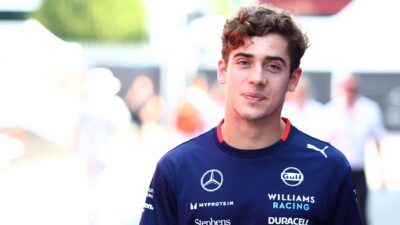
Franco Colapinto found out on Tuesday that he’d be an F1 driver for the rest of the season and that he could forget about the Monza F2 race he was preparing for. As Logan Sargeant’s replacement at Williams, he gets a nine grands prix opportunity to establish his F1 credentials alongside Alex Albon before being obliged to stand aside in ’25 for the already-signed Carlos Sainz.
A member of the Williams junior driver academy since last year, the Argentinian is 21 years old. His FP1 performance at the British Grand Prix in Sargeant’s car was genuinely impressive: within a few tenths of Alex Albon, consistent, clearly unafraid of the car through the fast turns and giving good feedback. It was this session which in reality put him on the radar for the team as it continued to steadily lose faith in Sargeant’s ability to turn his season around. Being stood down by the team in Melbourne (to hand his car over to Albon who had destroyed his own) so early in the season can’t have done Sargeant’s confidence any good. But had his performances been stronger up to that point, he may not have had that imposed upon him.
Sargeant wasn’t a no-hoper. He had displayed real flashes of ability in the junior categories. He was a close match for team mate Oscar Piastri in F3 and took the championship contest with him to the final round. But it just never quite clicked for him in F1 at Williams.
Young Argentinian has to get to grips with F1 fast
Getty Images
Quite why one driver continues to develop while another flat-lines is not readily apparent. But Sargeant was definitely one of the latter, once he got to F1. In a sense, that makes Colapinto’s task easier: if he can show the sort of progression which Sargeant could not, it will have been a qualified success. If he can throw in the occasional bit of sparkle, all the better.
Colapinto has a decent but not stellar record in the junior categories, but his peaks have been impressive. It’s also refreshing to see a team looking to its own academy for F1 drivers (Sargeant was also from the academy) rather than dusting off someone with experience from the sidelines.
Williams is one of F1’s most successful teams, but hasn’t won in a long time – its principal James Vowles explains why the approach of Frank and Patrick won’t work in the modern age, and how he’s doing things differently
By
James Elson
He is, according to those who’ve worked with him in F2, a man in a hurry, impatient for success. His confidence has sometimes been higher than his actual level and he’s needed careful guidance to get him to back away from the ragged edge and to build from there. The natural impulse is all-or-nothing, unafraid and undeterred. He arrived in F2 with P1 as his only target, one which was soon revealed as unrealistic. But in his rookie season in the category he’s become steadily more competitive – to an extent which has surprised his MP Motorsport team.
And he’s not afraid to get stuck in wheel-to-wheel: “He’s not in the least overawed by anyone – ‘you have two arms, two legs same as me. Let’s go at it,’ has been his attitude,” says Jeremy Cotterill, team boss at MP. The F2 team has endeavoured to co-operate with Williams in helping him develop and has given him the appropriate guidance in meeting those targets.
Colapinto’s spirit and inner confidence – which sometimes means it takes a lot to convince him to change his view on something – can be valuable traits. They can be the basis of the sort of mental strength needed to flourish in F1 – but only if they are combined with the intelligence to adapt and learn. The signs are promising that he will not be one of those guys who flat-lines, even if he is less fully developed than, say, Kimi Antonelli or Ollie Bearman, both of whom will be on the F1 grid next year.
Colapinto has one sprint race win so far this year
Getty Images
He’s probably going to have the odd wild moment and maybe the Williams mechanics have not yet finished rebuilding damaged cars this season. But if that is accompanied by pace and progress, it’s easier for the team to accept.
Assuming he shows the sparkle in his nine-race F1 opportunity, what happens next? There’s no 2025 vacancy in the team. Well, he’ll be further on than he was, regardless. When the next F1 vacancy arises, he may have done enough to make him an obvious choice. Or perhaps he could return to F2, much more fully developed with those grands prix under his belt – and deliver in a big way. Whatever, the man in a hurry has received the call. It’s all in his hands now.
In previous lives Mark raced cars, worked at Jim Russell racing school, got a university degree which he never used, tried working in industry, didn’t like it, left and joined Motoring News in 1988 as a junior club race reporter. Went freelance in ’96, concentrated on F1 from 2000. Grand Prix editor of Autosport for 10 years.