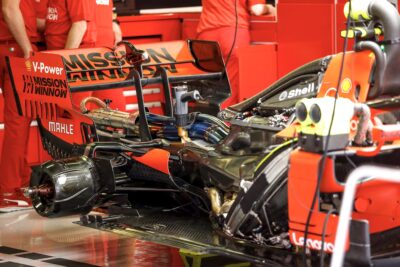
Racing beckons and after the pandemic months of compromise, co-operation and big picture thinking between the teams, the competitive niggle has begun already. The complex fuel flow-limited, hybrid power units are rich in potential for creating suspicion. The two key power-defining hard points – fuel flow and electrical power – are artificially limited by regulation. The temptation is therefore always to find ways around that and the assumption is always there that the others are doing just that.
During this recent period of inactivity on track, the FIA has tightened up further on regulations around fuel flow, ERS deployment and oil burning. This follows on from the introduction of a second fuel flow sensor for 2020, introduced as a result of suspicions last year from other teams about what Ferrari may have been doing to get around it. But which the FIA could not prove in a post-season investigation.
To recap, Ferrari was believed to have found a way of ‘aliasing’ the fuel flow meter in a way that made it possible to momentarily exceed the flow limit in between the pulses of it being measured. The flow meter between the tank and the injectors uses ultrasound pulses to measure how quickly the fuel is flowing. These measurements are sent via electronic signal to the FIA sensor. But if a way could be found to ‘alias’ the signal – ie to interfere with the signal and reconstruct it – then you could make enough extra power to find another 0.5sec of single lap performance and, even though this would use too much fuel to be used continuously over a full race distance, it could be worth an estimated 15sec of race time.
What effect will these changes have? That’s a question the teams will be very interested in.
A second sensor, with random irregular sampling frequency, should make it impossible to alias. The first and second sensors should always match, but the frequency with which the second one is operating is random. So a team would have no way of matching the two. It’s essentially a series of random spot checks at millisecond time scales.
That was all introduced for what was going to be the beginning of this season. But additionally, one of the four new technical directives issued a couple of weeks ago has tightened up further on fuel flow. Now, there are further restrictions on how much fuel can flow on part-throttle. Previously, the permitted flow rose at a specified rate with the revs until reaching its maximum of 100kg/hour at 10,500rpm. Now there is an additional requirement on part-throttle matching the flow to the engine’s power: below 50kW the fuel flow must not exceed 10kg/hour. As power increases, so the flow can increase at the rate determined by a set formula. This should prevent an excess of fuel being delivered at low throttle which could be somehow stored between tank and injectors and used to increase flow at full throttle.
Next, there is a new IVT sensor for the ERS system. The IVT sensor (measuring voltage and current) is used to ensure the electrical energy between the different parts of the power unit is not distributed in a way that would subvert the regulations which limit the electrical energy boost to 120kW maximum. A new, more electronically sophisticated version has been introduced and will be on the cars of Mercedes, Ferrari and Red Bull from Austria – and on the rest subsequently.