Christian Horner's future as Red Bull F1 boss hangs in the balance. If he does leave, how could the team replace the man who has built and led it from the very start? asks Mark Hughes
Everything is in place for the team to continue to be highly successful for a season or two just on pure momentum. The technical core of the team is there, the sharp strategy team, the deep understanding which underscores performance in this formula: they will be enough to allow Max Verstappen to continue much as he would with Horner still there. For a time, at least.
When Niki Lauda and Luca di Montezemolo departed Ferrari within a year of each other in the mid-70s, the team which had dominated F1, setting new standards, moving the game on, continued to be a powerhouse for a few years afterwards. Similarly the departure there in quick succession of Michael Schumacher, Jean Todt and Ross Brawn didn’t prevent Ferrari winning titles in 2007 and the constructors’ championship in ’08. In the 1980s and ’90s Ron Dennis presided over McLaren’s greatest era of success, redefining the scale of what an F1 team was. With Dennis forced out by political pressures applied by his nemesis Max Mosley, McLaren continued to be a major force: Lewis Hamilton won the 2008 drivers’ title and was a contender right through to 2012.
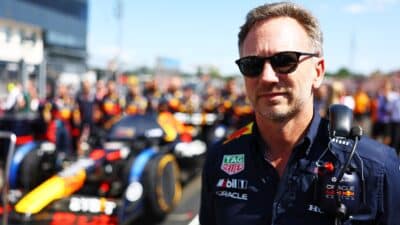
Red Bull’s success has been built around Horner’s leadership
Getty via Red Bull
But in all those cases that momentum slowly lost energy without the driving forces of those people whose vision had formed the nucleus of the success. Because throughout any structural changes of the sport itself, regulation changes, redrawn commercial landscapes, that vision remained intact so long as those exceptional leaders were there. Without them, the energy was less focused and became diffused over time and changes within the F1 environment.
He was the calm conductor of Red Bull’s precise F1 teamwork. Now Jonathan Wheatley has been announced as the new team principal of Audi’s grand prix team. Here’s everything you need to know about the former mechanic turned boss
By
Cambridge Kisby
So if the parent Red Bull company deems it necessary to release Horner (depending upon the investigation’s outcome into the allegations that Horner denies), it’s not obvious how he can be replaced. Especially as the running of it has now become necessarily more complex through the establishment of Red Bull Powertrains. Even as the team has grown, it has retained a simplicity of purpose: a lean, adaptive, ingenious racing operation, intensely competitive and that environment has attracted like-minded high-calibre people. When that was coupled with the massive budget of the owner but left to be run by the racing people without any of the corporate entanglements which tend over time to slow F1 teams, it became the colossus that it is. But it’s been Horner who has done the running of it and he’s done it in accordance with the singularity of purpose and simplicity arising from his own vision. With the late Dietrich Mateschitz replaced by more conventional management at the parent company, there has inevitably been a power vacuum. If that management views any Horner misbehaviour as an opportunity rather than a very serious blow, it should not.
There are very experienced racing people there fully capable of keeping it all functioning. There are doubtless good corporate managers at the parent company capable of looking after the business side of it. But without the man at the core of it all from the start, the tentacles of resistance will already be growing, unseen, the barnacles will be growing on the hull. Key personnel will leave over time, certain decisions will be made without an appreciation of the impact, the environment in which the team competes will itself change, as it always does. All these developments will require a confidence-inspiring leader with binding ethos shared by everyone else there. Not so easy to magic up one of those.
In previous lives Mark raced cars, worked at Jim Russell racing school, got a university degree which he never used, tried working in industry, didn’t like it, left and joined Motoring News in 1988 as a junior club race reporter. Went freelance in ’96, concentrated on F1 from 2000. Grand Prix editor of Autosport for 10 years.