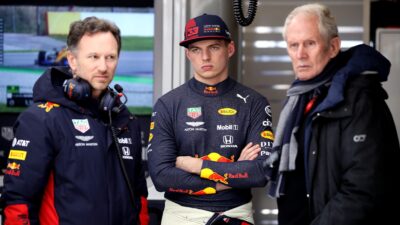
A power struggle for the future of Red Bull Racing is almost certainly behind Jos Verstappen's call for Christian Horner to step down, writes Mark Hughes. The F1 team principal faces a political tightrope - beyond any challenges on track
Horner, Verstappen and Marko: the current centres of influence at Red Bull
Jos Verstappen’s post-Bahrain comments suggesting Red Bull team principal Christian Horner was damaging the team by not resigning in the aftermath of the allegations made against him by a member of his staff triggered the rumour that Jos might take son Max out of there if Horner stayed. Fuel was added to the fire as Jos was seen having breakfast with Mercedes’ Toto Wolff in their Bahrain hotel.
Carlos Sainz is in search of a new F1 seat in 2025, while Red Bull may well have a vacancy, writes Mark Hughes. And reuniting with a top team built around Max Verstappen may look more attractive than rebuilding with Audi
By
Mark Hughes
The chances of Max Verstappen switching from Red Bull to Mercedes next year I’d estimate as somewhere between slim and zero. Jos would no more want that than would Max. Why quit one of the most potent teams the sport has ever seen operating at its absolute zenith? This feels more like Jos applying pressure to the management of the Austrian parent company, trying to give them the impression it could lose Max if it doesn’t dismiss Horner.
Which leads to the question of why Jos would want Horner gone. It’s almost certainly tied up in the politics behind the ownership of the team in the wake of the death of Dietrich Mateschitz in late ’22. The longer Horner is there, the more chance he succeeds in convincing the Austrians to sell their 49% stake in the team to the Thai 51% owners. In that scenario Horner would run the team, quite possibly still with Red Bull sponsorship, maybe even with an equity interest himself (like Wolff at Mercedes). That way he’d be without interference from the Austrian management or from Helmut Marko, Mateschitz’s old friend and the man who brought the Verstappens to Red Bull. Both Jos and, especially, Max are loyal to Marko. Helmut answers to no-one and is officially merely an advisor to the Austrian management to which Horner reports. One advises, the other reports. You can see how that’s an awkward dynamic without the annealing presence of Mateschitz.
Mateschitz sits at the centre of 2010 Red Bull team photo, flanked by Horner and Marko
Getty Images
The Verstappen-Marko axis holds enormous sway in the power dynamic at this team, despite Horner being team principal. That influence would be drastically reduced – and Horner’s enhanced – if Marko were no longer there. It would cut a whole problematical chunk from Horner’s world as he tries to lay the team’s – and his – foundation for the future, in partnership with Ford and striving to be less reliant on the generational talents of Verstappen and Adrian Newey. Of course he’d want to keep them, but also to future-proof the team which will one day be without them. That’s a tricky tightrope to walk – and perhaps Jos would like him to fall from it.
From that perspective Horner’s predicament regarding the staff complaint has made him very vulnerable. How this plays out will probably have more to do with boardroom politics than racing imperatives. Meantime, Sainz would still be a sound choice for the seat alongside Max.
In previous lives Mark raced cars, worked at Jim Russell racing school, got a university degree which he never used, tried working in industry, didn’t like it, left and joined Motoring News in 1988 as a junior club race reporter. Went freelance in ’96, concentrated on F1 from 2000. Grand Prix editor of Autosport for 10 years.