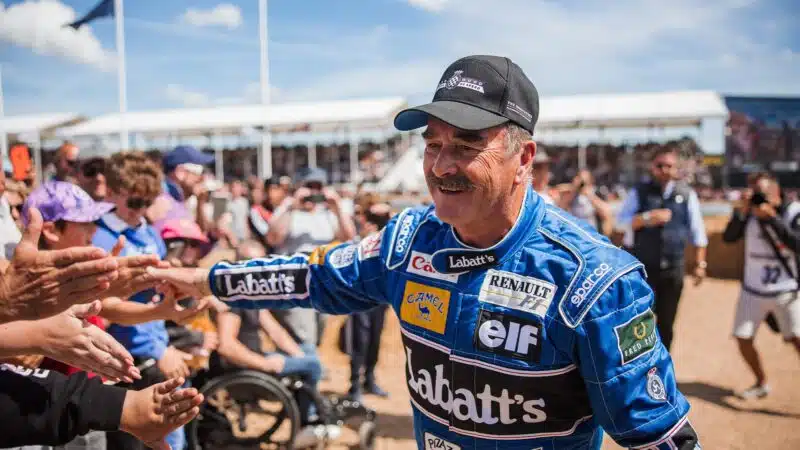
When Williams and Nigel Mansell combined in Formula 1, the results were spectacular. Damien Smith gives his verdict on a new documentary that unashamedly celebrates the championship-winning partnership with rediscovered footage
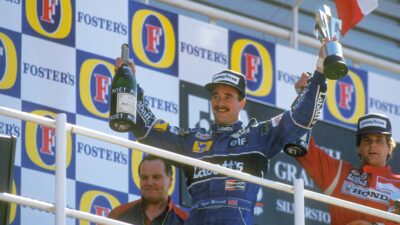
Mansell on the Silverstone podium after winning the 1991 British GP. Patrick Head (left) says he was one of F1's fastest
Maybe that’s part of it. But Mansell was always a figure of derision and division, a blue-collar hero loved unconditionally by the public and treated with something little short of scorn by some in the establishment. Then again, he didn’t always help himself. No one knows better than Head how difficult the 1992 world champion could be out of the car, but as he reminds us, Mansell did win 29 races in Williams cars – contributing more than any other driver to the team’s tally of 114 grand prix wins, and never gave anything less than 100% every time he slid into the cockpit, including at test sessions. Head says Mansell made everyone he worked with “sharp”, Patrick expressing in his retirement a high degree of respect and even some fondness for a driver who hasn’t always been taken entirely seriously, in part because of the melodrama and suspicions of exaggeration Il Leone tended to leave in his wake.
But the key point Head supports – and it’s a pretty important one – is that when he was in the cockpit, Mansell was simply one of the fastest of his (and any) age. And more often than not, he did deliver, especially when he was in a Williams.
In that context, it’s heartening to watch a new documentary about the man that celebrates a figure who inspired such fierce public devotion, like no other racing driver before or since. As the title suggests, Williams and Mansell: Red 5 focuses specifically on the defining team relationship of his career. It will be broadcast and made available over the weekend of the British Grand Prix (July 8-9) on Sky, and will surely prove a popular addition to the remarkable string of racing films and biographies that have been released in recent times.
Cruising to another win: Mansell in Portugal, ’92, having already clinched the title
Grand Prix Photo
The feature-length documentary is purposely one-sided, as these films tend to be. How else would they have convinced Mansell to come on board? But while a critical eye is sorely lacking, especially with such a divisive character, it doesn’t mean the film isn’t without huge value. This is unashamedly Mansell’s own view of his F1 career, featuring an in-depth, colourful and often fascinating new interview with the man himself, with added contributions from others who, more often than not, were ‘on his side’: friend, journalist and ex-Williams staffer Peter Windsor, who did so much to promote Mansell’s talent and who does much of the story-telling in this film; broadcaster and Mansell biographer James Allen; plus PR Ann Bradshaw, TV anchor Steve Rider, and fellow British world champions Damon Hill and Jenson Button. All offer valid perspectives and personal insight.
Written and directed by James Wiseman, this is a very well-crafted tribute to Mansell packed with wonderful archive curated by Wiseman’s prolific brother, Richard. The combination of Mansell’s perspective at the age of 69 and the gems unearthed here – many shown for the first time since they were first broadcast back in the day – makes this a film anyone a must for anyone who reads Motor Sport. Even if it’s too one-sided to be considered definitive history.
Wiseman has chosen Monaco 1992 as the kicking-off point, as Mansell darts left and right in his frantic chase of Senna following the pitstop for a suspected puncture that cost him a sixth successive victory. Immediately, there’s hyperbole: “Today Ayrton would have got a stop-go penalty for blocking,” Mansell tells us earnestly. Really? You sure about that? As Nigel admits, there was no contact between the Williams and McLaren. Didn’t Senna just park the bus fairly and squarely, as was his right? Straight away, then, we’re off.
We’re taken back to the beginning, Mansell recalling his humble Midlands roots and his lack of a “silver spoon” – and expressing himself nearly always in his characteristic ‘royal we’ perspective. The most revealing insight here is when Mansell describes how his father Eric broke a promise to support him into racing, causing a painful estrangement. Loyalty, trust and a sense of injustice were always key elements in the Mansell psyche.
Peter Warr (left) didn’t rate Mansell, here with team-mate Elio de Angelis in Brazil, 1984
Grand Prix Photo
Although the focus is on his Williams years, the big break with Lotus and first F1 seasons are inevitably essential to the tale. A brilliant interview at home with Mansell during the Essex era, not long after his grand prix debut at the 1980 Austrian GP, is enjoyable and captures a young driver still trying to find his way. It’s entirely fitting that his first race should have pitched him straight into adversity, sitting in spilt fuel that caused second-degree burns – including to his “goolies”. Which other F1 drivers would use such a word? Priceless.
The mentor role of Colin Chapman is played up. Some within Lotus have suggested the relationship has been inflated beyond reality, but Mansell’s emotion seems genuine as he describes the devastation and consequences of Chapman’s death in December 1982. “I lost my father,” claims Nigel, starkly.
He also speaks openly about the hostility he faced from the late Peter Warr, whose antipathy towards Mansell isn’t really investigated. Why did Chapman’s lieutenant have so little time for him? Here, a voice to explore that perspective would have been welcome. Instead, we’re reminded of the nasty old “won’t win a grand prix while I’ve got a hole in my arse” comment, Mansell offering that Warr must be “constipated” given what followed at Williams – in the present tense, as if the bespectacled chief is still alive. It’s an odd moment.
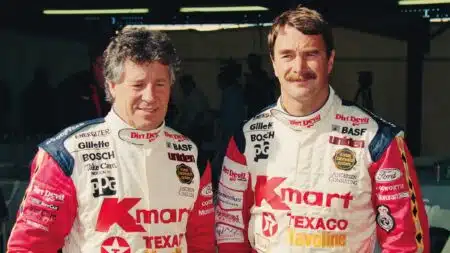
Nigel Mansell and Damon Hill were Britain’s best drivers of the early 1990s, and proved over two testing seasons: when Mansell won the IndyCar title in his debut year, and when Hill took the lead at Williams after the death of Ayrton Senna
By
Matt Bishop
There’s some great action footage of a spectacular era as the story plunges us back to the turbulent Williams years. Look out for the clip of Mansell flat through the fearsome Bosch Curve at the Österreichringin 1987 – it will take your breath away. Look out too for moments of pure Partridge with a young Richard Keys reporting on Mansell’s exploits from the TV-AM sofa. Proper time-warp stuff.
Again, a Nelson Piquet or Keke Rosberg interview would have been ideal for the other side of the story, but after all these years it’s still interesting to hear Mansell speak about aspects of his career that are woven so deeply into F1 lore. “I couldn’t breathe,” he says of his distraught state in the wake of the tyre blow-out in Adelaide 1986. Indeed, the pain of that championship loss still appears to skewer him even now – although as he admits, “it kept me going”. In a strange way, it was the making of him and only added to the adversity/hard luck narrative he’d always pedal, even in 1992 when he enjoyed a massive car advantage.
Weaving his reunion with the Williams FW14B at the Goodwood Festival of Speed last year into the story of his early 1990s is nicely done, and it’s heartening to see the warmth between the old warrior and his mechanics. They clearly love getting him back in the car, and he revels in moments that are akin to putting on an old suit and finding it still fits – just.
Mansellmania returned last year, with ’92 champion back in the Williams FW14B
XPB via Williams
Mansell: fan favourite, with no ounce given on track
Again, there’s a sense that this film is not attempting to offer a definitive biography. It’s a warm-hearted tribute, one that’s probably overdue and that his still-loyal fans will surely appreciate. Actually ironically the biggest missing voice, the pillar around which his whole life has been built, is his wife Roseanne. She has always shunned the limelight. But as Mansell talks so passionately about the most important person in his life, to whom he owes so much, you can’t help thinking: why can’t we hear directly from her?
Damon Hill, eloquent as always, sums up the man and the complexity of how he is perceived: “A prophet is never recognised in his own country.” That’s a suitably overblown epitaph, but one with a grain of truth too. ‘Our Nige’ was always a figure of contradiction.
Damien spent two spells as editor of Motor Sport – at nine issues, his first was short. The second was longer, rejoining in 2007 until 2016. Between he spent two years as editor-in-chief of Autosport, a magazine he first joined in 1996. During his time on the weekly, Damien covered everything from club racing to Formula 1, via Formula 3000 and sports car racing.





 Great Read