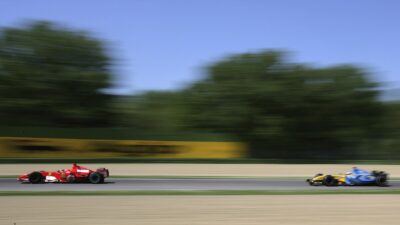
Lando Norris and Max Verstappen's fight for victory at Imola had the ingredients for a vintage F1 race, says Mark Hughes. Just as the Alonso vs Schumacher battles of 2005 and 2006 did...
The duel for victory this time between Max Verstappen and Lando Norris did however bear a remarkable resemblance to those Alonso-Schumacher fights. In all three cases, the race was so thrilling because the faster car was behind on a circuit where overtaking is difficult.
The similarity of the 2005/06 races with that of last weekend is in some ways remarkable given how totally different the demands of racing are between the two eras. Back then it was a series of short sprints between fuel stops on tyre war tyres and now of course we have cars starting the race with over twice as much fuel, no stops and standard tyres. Back then DRS wasn’t yet a twinkle in the FIA’s eye, now it’s fundamental to the racing. In the 2005 race Alonso and Schumacher were driving 3-litre V10s and a year later 2.4-litre V8s but neither featured any form of electrical power, all their braking and exhaust energy dissipating into the air rather than captured, stored and deployed. Their cars weighed around 200kg less than those of Verstappen and Norris and looked like three-quarter size versions of current cars. But they had nothing like the underbody downforce at high speed, nowhere near the monstrous torque to fire them out of the corners.
Alonso defends against Schumacher in ’05
Getty Images
Roles reversed in 2006 Imola race
Getty Images
And yet the races were broadly similar. Only those looking in detail would note how much tactical battery deployment was shaping the Verstappen/Norris dice. Only the hardcore fan would know how absolutely crucial it was for Norris to try to get to the DRS detection point after the Variante chicane less than 1sec behind Verstappen. You’d need to go back and watch those early century races to realise that it was trickier then to stay close to the car ahead exiting Tosa and Acqua Minerale because the relatively weedy torque gave the advantage to the car ahead. Passing attempts then were under braking at the end of the straights from very similar terminal speeds. Now the crucial attempts are put in place at the beginning of the straight, judging how much to deploy – and of course whether you have DRS or are defending from it.
The 2005 San Marino Grand Prix has stood the test of time as being one of the all-time great battles between two championship-calibre drivers. 16 years on from Fernando Alonso…
By
Jake Williams-Smith
Alonso recently talked about his 2005 victory, saying that he felt relatively calm despite the intensity of the dice because he knew he only really had to cover the Tosa braking area. That’s no longer the real battle zone. It’s now about getting close enough in that DRS detection point just after a fast chicane, which if you manage it will likely allow you to breeze effortlessly past before Tamburello. Except Norris couldn’t quite get there, just as Schumacher couldn’t quite get down Alonso’s inside into Tosa.
One thing all three races have in common is that the leader – Alonso in 2005, Schumacher in 2006 and Verstappen last weekend – were suffering tyre dramas late in the race. Front graining was the problem Alonso (in ’05) and Schumacher (in ’06) were contending with as their rival hunted them down on much healthier rubber. Last weekend Verstappen simply wore out his fronts, partly as a consequence of Red Bull’s set up dramas earlier in the weekend. With the tread wearing away, the temperatures dropped and there was no bringing them back.
Norris in pursuit of Verstappen at Imola
Joe Portlock/F1 via Getty Images
So, what do we take from all this? The combination of the slower car being ahead and a track on which overtaking is difficult can be the recipe for a vintage race. On a circuit where passing is more feasible, once the leader had hit tyre trouble, the chaser would simply have caught and overtaken in very quick order. There may have been a few seconds of wheel-to-wheel action as the leader fought the inevitable. Instead we got lap after lap of not knowing how the battle would be settled. The other thing we learned is that the circuit is way more dominant than the cars, as even cars with radically different traits produced the essentially the same race in the same situation.
There are always those insisting things were way better in the old days and sometimes they were. But Imola? It’s pretty much like it ever was.
In previous lives Mark raced cars, worked at Jim Russell racing school, got a university degree which he never used, tried working in industry, didn’t like it, left and joined Motoring News in 1988 as a junior club race reporter. Went freelance in ’96, concentrated on F1 from 2000. Grand Prix editor of Autosport for 10 years.